All Articles

Kubla Khan

Kubla Khan Facts For Kids

Kubla Khan is a famous poem by Samuel Taylor Coleridge that depicts the grandeur of a palatial pleasure dome built by the Mongol emperor Kublai Khan, blending themes of nature and creativity.

🎨 Reading age for 6-8
Background blob
Kubla Khan
Kubla Khan
Facts for Kids!

Do more with AI

Introduction

Kublai Khan is a famous poem written by the British poet Samuel Taylor Coleridge in 1797. 🏰It tells the story of Kublai Khan, who was a powerful ruler of China in the 12th century. The poem begins with a beautiful description of a magical palace, where rivers flow and gardens bloom. 🌸Coleridge's poem is known for its dreamy and mysterious atmosphere. It's an example of Romantic poetry, which often focuses on nature and imagination. The opening lines are famous and invite readers into a fantastical world filled with wonder! 🌈

Images of Kubla Khan

Coleridge, 1814

Coleridge, 1814

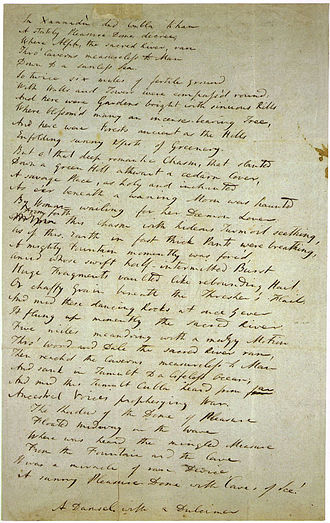
The Crewe manuscript, handwritten by Coleridge himself some time before the poem was published in 1816

The Crewe manuscript, handwritten by Coleridge himself some time before the poem was published in 1816

Title page of Christabel, Kubla Khan, and the Pains of Sleep (1816)

Title page of Christabel, Kubla Khan, and the Pains of Sleep (1816)

Xanadu (here called Ciandu, as Marco Polo called it) on the French map of Asia made by Sanson d'Abbeville, geographer of King Louis XIV, dated 1650. It was northeast of Cambalu, or modern-day Beijing.

Xanadu (here called Ciandu, as Marco Polo called it) on the French map of Asia made by Sanson d'Abbeville, geographer of King Louis XIV, dated 1650. It was northeast of Cambalu, or modern-day Beijing.

Debre Damo, an amba (flat-topped mountain) in Ethiopia similar to Amba Geshen (Mount Amara)Image by A.Savin, licensed under Free Art License

Debre Damo, an amba (flat-topped mountain) in Ethiopia similar to Amba Geshen (Mount Amara)

Lord Byron, second-generation Romantic poet who encouraged Coleridge's publication of "Kubla Khan", by Richard Westall

Lord Byron, second-generation Romantic poet who encouraged Coleridge's publication of "Kubla Khan", by Richard Westall

Self-portrait of William Hazlitt, Romantic critic who wrote the first negative review of "Kubla Khan"

Self-portrait of William Hazlitt, Romantic critic who wrote the first negative review of "Kubla Khan"

Leigh Hunt, second-generation Romantic poet who praised "Kubla Khan"

Leigh Hunt, second-generation Romantic poet who praised "Kubla Khan"

T. S. Eliot, poet and literary critic

T. S. Eliot, poet and literary critic

Coleridge, 1814

Coleridge, 1814

The Crewe manuscript, handwritten by Coleridge himself some time before the poem was published in 1816

The Crewe manuscript, handwritten by Coleridge himself some time before the poem was published in 1816

Title page of Christabel, Kubla Khan, and the Pains of Sleep (1816)

Title page of Christabel, Kubla Khan, and the Pains of Sleep (1816)

Xanadu (here called Ciandu, as Marco Polo called it) on the French map of Asia made by Sanson d'Abbeville, geographer of King Louis XIV, dated 1650. It was northeast of Cambalu, or modern-day Beijing.

Xanadu (here called Ciandu, as Marco Polo called it) on the French map of Asia made by Sanson d'Abbeville, geographer of King Louis XIV, dated 1650. It was northeast of Cambalu, or modern-day Beijing.

Debre Damo, an amba (flat-topped mountain) in Ethiopia similar to Amba Geshen (Mount Amara)Image by A.Savin, licensed under Free Art License

Debre Damo, an amba (flat-topped mountain) in Ethiopia similar to Amba Geshen (Mount Amara)

Lord Byron, second-generation Romantic poet who encouraged Coleridge's publication of "Kubla Khan", by Richard Westall

Lord Byron, second-generation Romantic poet who encouraged Coleridge's publication of "Kubla Khan", by Richard Westall

Self-portrait of William Hazlitt, Romantic critic who wrote the first negative review of "Kubla Khan"

Self-portrait of William Hazlitt, Romantic critic who wrote the first negative review of "Kubla Khan"

Leigh Hunt, second-generation Romantic poet who praised "Kubla Khan"

Leigh Hunt, second-generation Romantic poet who praised "Kubla Khan"

T. S. Eliot, poet and literary critic

T. S. Eliot, poet and literary critic

Legacy And Impact

Kublai Khan's legacy still influences the world today! 🌏His rule helped connect East and West, leading to better trade and cultural exchange. The use of paper money he introduced is used in modern economies worldwide! 💵The stories of Marco Polo about Kublai continue to inspire people to explore and travel. His acceptance of different cultures and religions helps promote understanding and tolerance even now. Kublai Khan's reign as a fair and enlightened ruler makes him a powerful figure in world history! 🏆

Historical Context

Kublai Khan, born in 1215, was a grandson of Genghis Khan, the founder of the Mongol Empire! 🐉He became the Emperor of China in 1271. Kublai ruled during a time when the Mongols were expanding their territory, creating a vast empire stretching across Asia and parts of Europe. 🗺️ The Mongol Empire was known for its speed and skilled horsemen. Kublai Khan's dynasty is also referred to as the Yuan Dynasty in China. This period saw a mix of cultures, as Kublai encouraged trade and welcomed foreigners to his court. 🏯

Religious Policies

Kublai Khan was a ruler who respected many religions! 💒He believed in welcoming people from different faiths, such as Buddhism, Taoism, and Islam. Kublai himself practiced Buddhism and built many temples during his reign. ⛩️ He wanted his empire to be a place where everyone felt safe to practice their beliefs. By treating different religions kindly, Kublai brought harmony among his people. This open-mindedness helped foster a peaceful environment where culture and ideas could flourish. 🌈

Economic Innovations

During Kublai Khan's rule, the economy grew stronger! 💰He worked on improving trade by building roads and canals. The Grand Canal connected rivers, making it easier for merchants to transport goods across the empire. 📦Kublai also introduced paper money, which made buying and selling simpler! This was a big change because people often used coins before. He encouraged trade with different countries, which brought in new products like spices and silk. 🚢This period saw an increase in business, travel, and the sharing of ideas!

Cultural Contributions

Kublai Khan's reign was a time for wonderful cultural growth! 🎨He encouraged art, literature, and music from both Chinese and Mongolian traditions. Kublai invited talented people, including painters and musicians, to his court. 🖌️ One exciting thing he did was support travelers and explorers. His rule helped spread knowledge and ideas between Asia and Europe. The famous traveler Marco Polo even visited Kublai and wrote stories about his amazing court, which inspired many! 📖This mixing of cultures made the period rich in creativity and learning!

Life And Rule Of Kublai Khan

Kublai Khan ruled for 34 years and focused on uniting his empire. 👑He moved the capital from Mongolia to Beijing in China. Kublai was known for his fairness and ability to mix different cultures. He built roads, improved farming, and started the Grand Canal, which helped trade. ⚓He also promoted science and arts, asking many artists and scholars from different places to come to his court. Kublai loved to explore, and he even tried to invade Japan! 🌏His adventurous life made him a legendary figure in history!

Relationship With Marco Polo

Marco Polo was a famous Italian traveler who visited Kublai Khan in the late 1200s! 🧳He traveled from Venice, Italy, all the way to China. When Marco met Kublai, he was amazed by the grand court and the lavish lifestyles. Kublai liked Marco and hired him as an advisor. 🌍Marco stayed in China for almost 17 years, learning about the culture and trading. After returning to Europe, he shared stories of Kublai's incredible empire, making people curious about Asia! 📜His tales inspired many explorers to discover new lands!

Kublai Khan In Literature And Art

Kublai Khan has inspired many writers and artists throughout history! 📚In literature, Samuel Taylor Coleridge's poem is one of the most famous works about him. The poem paints Kublai as a powerful and mystical figure controlling a magical realm. 🎭Artists have also created paintings and illustrations of Kublai’s magnificent palace and his adventures. This has helped people understand the beauty of his time! Kublai Khan continues to be a symbol of strength and rich culture, captivating imaginations everywhere. 🌟

Kubla Khan Quiz

Q1
Question 1 of 10

Learn more about Kubla Khan

Ready to create?

Drop Files here
Make

To create a safe space for kid creators worldwide!

Create

Vibe Coding

Kids GPT

All Tools

Kibu

Resources

Worksheets

SafeTube

Blog

FAQ

Account

Pricing

Log-in

Sign-up

Data Deletion

Company

About

Community Guidelines

Privacy Policy

Terms of Service

2025, URSOR LIMITED. All rights reserved. DIY is in no way affiliated with Minecraft™, Mojang, Microsoft, Roblox™ or YouTube. LEGO® is a trademark of the LEGO® Group which does not sponsor, endorse or authorize this website or event. Made with love in San Francisco.