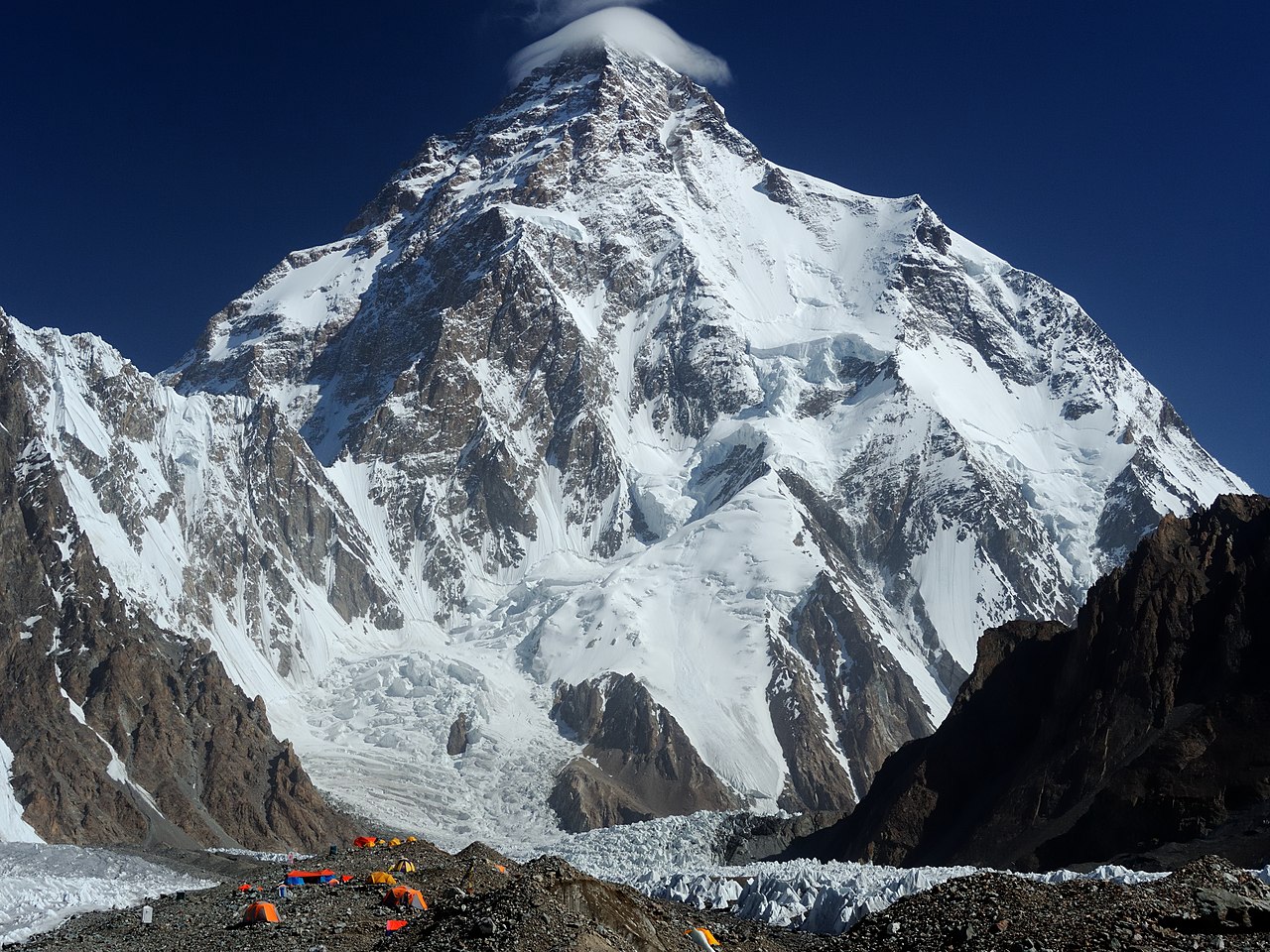
K2 is the second highest mountain in the world, standing at 8,611 meters (28,251 feet) above sea level! ποΈ It is located in the Karakoram Range, which is part of the Himalayas. K2 is often called "The Savage Mountain" because climbing it is extremely hard, and many adventurers have faced dangerous challenges. The name "K2" comes from its location, as it was the second peak to be measured in this range. Most climbers try to reach K2 during the summer months when the weather is milder. Itβs a place of stunning beauty that draws explorers from all over! π
The routes climbed on the Northwest of the mountain. A: West Ridge; B: West Face; C: Northwest Ridge; D: North Ridge; E: Northeast Ridge.
πΌ Flora And Fauna
K2 is located in a unique ecosystem where various plants and animals thrive. πΌThe lower slopes of the mountain host beautiful flowers like edelweiss and gentians, which bloom in summer. Many animals also inhabit this area, including the elusive snow leopard, a stunning feline that prowls the rocky slopes. πYou may also encounter Himalayan ibex, a type of wild goat, and various birds like the golden eagle soaring high in the sky! Each of these creatures plays a crucial role in maintaining the balance of nature around K2. π±π¦
The first successful ascent of K2 occurred on July 31, 1954, by an Italian expedition led by Ardito Desio. πΆββοΈ The climbers were Lino Lacedelli and Achille Compagnoni, marking a significant achievement in mountain climbing history. However, climbing K2 is known to be more difficult than Mount Everest, mainly because of unpredictable weather and steep paths. Over the years, many climbers have attempted to reach the summit, but the journey has challenges, such as avalanches and altitude sickness. Climbing K2 takes great courage and skill! π₯Ύπͺ
K2 continues to be a point of interest for future explorers and climbers. π§As technology advances, climbers are finding better ways to tackle its challenges, like improved climbing gear and weather tracking devices. Scientists are also studying the mountain to learn more about climate change and its impact on glaciers. πThis exploration helps us understand our planet better and encourages responsible climbing practices. Who knows? Maybe one day, technology will offer new paths to the summit of K2! The mountain holds many secrets yet to be discovered! ππ
K2 and its surroundings are sensitive to environmental changes. Climate change has affected the glaciers in this region, causing them to melt faster. π‘οΈ This melting can lead to rising sea levels and changes in the local ecosystem. Overcrowding from climbers can also harm the fragile environment, as trash and waste may accumulate. Conservation efforts are underway to protect the area and ensure that K2 remains a pristine natural wonder. It is vital to care for our planet, so future generations can also marvel at this breathtaking mountain! πβ¨
K2 holds great importance for local communities and climbers worldwide. For the local people, the mountain is more than just a peak; it has deep cultural and spiritual meanings. πThey often share stories and legends about K2, linking it to their history. For climbers, K2 represents an ultimate challenge, a feat that not many have achieved. Many adventurers dream of standing atop its summit, feeling a sense of accomplishment and connection to the mountains. β¨K2 symbolizes strength, resilience, and the indomitable human spirit in the face of challenges. π
K2 lies on the border between Pakistan and China, specifically in the Gilgit-Baltistan region, with the eastern side facing China. πΊοΈ The mountain is surrounded by glaciers, which are huge rivers of ice. One of the most famous glaciers nearby is the Baltoro Glacier, which stretches over 63 kilometers (39 miles). K2 is part of a group of tall peaks called the βGasherbrumβ and βKarakoram,β where multiple mountains soar over 8,000 meters (26,247 feet) tall. The area is very remote, and it takes many days of travel just to reach the base camp! π²ποΈ
Many brave adventurers have made attempts to climb K2. Notable expeditions include the American attempt in 1938, which faced many obstacles and ended without success. πIn 1986, a team of Soviet climbers successfully reached the peak in winter, which is considered one of the most impressive feats in climbing history! In 2008, a tragic event occurred when 11 climbers died on the mountain during a single season. K2 has a rich history filled with awe-inspiring tales of adventure, teamwork, and sometimes heartbreak! ποΈβ€οΈ