Julian The Apostate Facts For Kids
Julian the Apostate was a Roman Emperor known for his efforts to revive paganism and oppose the rise of Christianity during his reign from 361 to 363 AD.
About this topic
Key Points
Photos of Julian The Apostate
![Rome solidus minted c. 356. The obverse shows a beardless Julian inscribed dn·cl·iulianus nc.[10] The reverse depicts Roma and Constantinopolis alongside the inscription fel·temp·reparatio ("happy renewal of times"), probably referencing Rome's 1100th anniversary in 348.[11]](https://upload.wikimedia.org/wikipedia/commons/thumb/7/73/Coin_of_Julian_as_Caesar.jpg/960px-Coin_of_Julian_as_Caesar.jpg)
Rome solidus minted c. 356. The obverse shows a beardless Julian inscribed dn·cl·iulianus nc.[10] The reverse depicts Roma and Constantinopolis alongside the inscription fel·temp·reparatio ("happy renewal of times"), probably referencing Rome's 1100th anniversary in 348.[11]
![Statue at the Musée de Cluny formerly identified as Julian.[ii]](https://upload.wikimedia.org/wikipedia/commons/thumb/1/13/Visit_of_the_H%C3%B4tel_de_Cluny_20150707_-_26.JPG/960px-Visit_of_the_H%C3%B4tel_de_Cluny_20150707_-_26.JPG)
Statue at the Musée de Cluny formerly identified as Julian.[ii]
![Male portrait head, possibly depicting Julian, exhibited at the National Archaeological Museum, Athens.[18]](https://upload.wikimedia.org/wikipedia/commons/thumb/d/dc/Male_portrait_head%2C_Julian_the_Apostate_%28A.D._361-363%29%2C_according_to_one_view.jpg/960px-Male_portrait_head%2C_Julian_the_Apostate_%28A.D._361-363%29%2C_according_to_one_view.jpg)
Male portrait head, possibly depicting Julian, exhibited at the National Archaeological Museum, Athens.[18]

19th century depiction of Julian being proclaimed emperor in Paris (fancifully located in the Thermes de Cluny, then thought to have been the Imperial Palace), standing on a shield in the Frankish manner, in February 360.

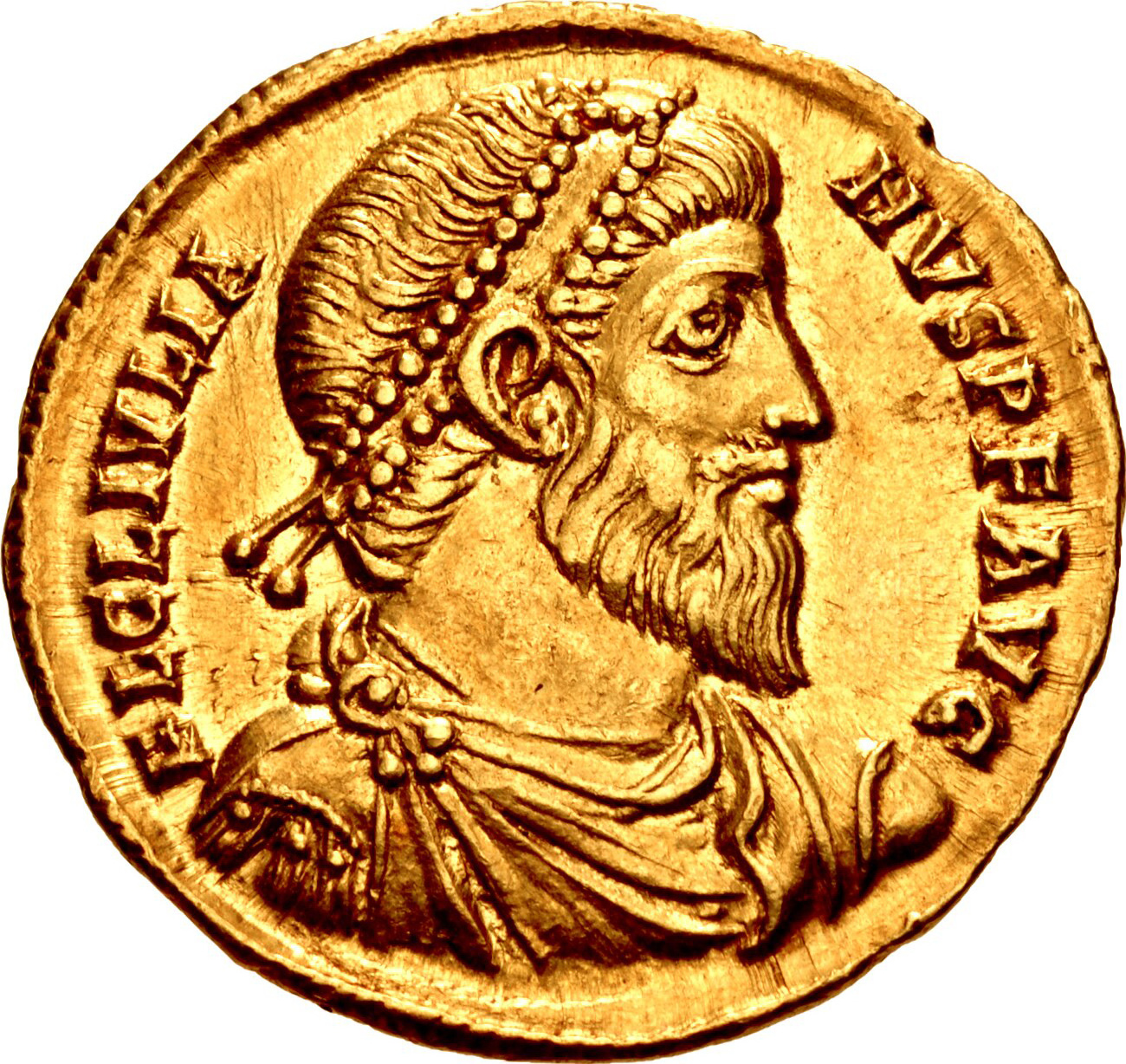
Solidus of Julian issued at Ravenna in 361, during his war with Constantius. The reverse reads VIRTUS EXERC(ITUS) GALL(ICARUM), 'virtue of the Gallic army', celebrating Julian's legions from Gaul which acclaimed him as emperor.

The Church of the Holy Apostles, where Julian brought Constantius II to be buried.
![A small chalcedony bust of an emperor, most likely Julian.[47]](https://upload.wikimedia.org/wikipedia/commons/thumb/5/54/Chalcedony_bust_of_Julian_%281%29.png/330px-Chalcedony_bust_of_Julian_%281%29.png)
A small chalcedony bust of an emperor, most likely Julian.[47]

Illustration from The Fall of Princes by John Lydgate (which is a translation of De Casibus Virorum Illustribus by Giovanni Boccaccio) depicting "the skyn of Julyan". There is no evidence that Julian's corpse was skinned and displayed, and it is likely that the illustrator simply confused the fate of Julian's body with that of Emperor Valerian.

Julian before Ctesiphon in modern-day Iraq, from the 9th century Paris Gregory.