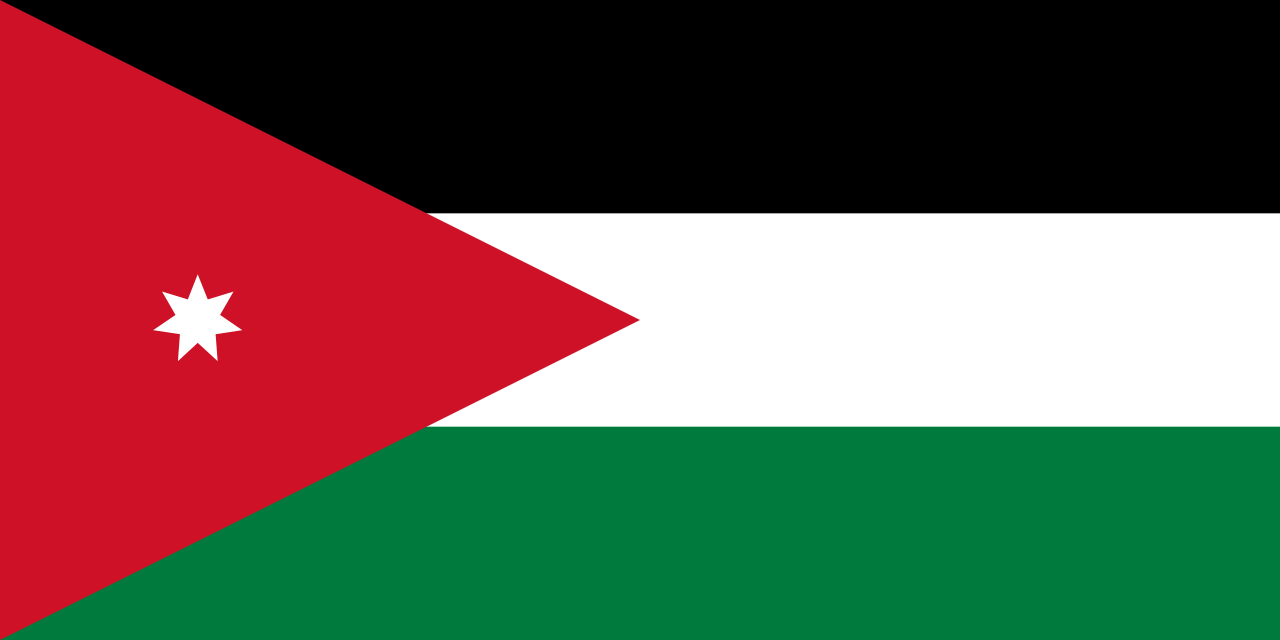
Jordan is a country in the Middle East πΊοΈ, located in Western Asia. It shares its borders with several countries: to the north lies Syria, to the east is Iraq, and to the west is Israel and Palestine. The capital city of Jordan is Amman, which is also the largest city. People in Jordan speak Arabic and the country has a rich history that dates back thousands of years! The population is about 10 million people. Jordan is known for its amazing sites, such as Petra, a famous ancient city carved into rock! π°
The Oval Forum of Jerash (c. 1st century AD), then member of the ten-city Greco-Roman league, the Decapolis, seven of which are present in modern-day Jordan.
Ottoman Ten Arches Bridge built south of Amman in 1904, as part of the Hejaz railway, which stretched across the length of Transjordan and linked Damascus with Medina.
Soldiers of the Hashemite-led Arab Army holding the flag of the Great Arab Revolt against the Ottoman Empire in the Hejaz, 1916
As-Salt residents gather on 20 August 1920 during the British High Commissioner's visit to Transjordan
π Economy
Jordan's economy is diverse, but it faces some challenges due to limited natural resources. The country doesn't have much oil, but it has a strong tourism industry π. People from all over the world visit Jordan to see its historical sites like Petra and the Dead Sea. Agriculture is also important, producing olives, fruits, and vegetables. Additionally, Jordan is working on growing its technology and service industries. Despite facing difficulties, the people of Jordan are very hardworking and continue to find new ways to improve their economy! πͺ
Jordan has a fascinating history π! Thousands of years ago, it was home to many different civilizations, including the Nabataeans who built Petra around the 5th century BC. The area also saw great empires like the Romans and Byzantines! In 1946, Jordan became an independent country after being part of the British Empire. King Abdullah I was the first king of Jordan. The country has faced many challenges, but it continually works towards peace and stability. Today, Jordan is known for being a safe haven for many people from neighboring countries.
Tourism is very important in Jordan! πPeople visit from all over the world to see amazing places. Petra, a UNESCO World Heritage Site, is famous for its incredible archaeological sites. The Dead Sea attracts many tourists who want to float in its waters πββοΈ. Wadi Rum is known for its stunning desert views and rock climbing. Tourists also explore the ancient Roman city of Jerash. Jordan is famous for its warm hospitality, and many visitors leave with wonderful memories and new friends. So, if you love adventure or history, Jordan is the place to be! π°
Education is a priority in Jordan π! The country has made great efforts to provide free schooling for children. Children typically start school at around six years old and go to primary school for six years, followed by secondary school. Jordan also has many universities and colleges where students can continue their education. The government is focused on improving education and has programs to teach science, technology, and math! Education is important because it helps young people build a better future for themselves and their communities! π
Jordan has diverse geography! πThe country features the beautiful Jordan Valley and the impressive mountains of the Amman Highlands. One of its most famous landmarks is the Dead Sea, the lowest point on Earth's surface. Did you know that you can float in the Dead Sea? Because of its high salt content, it's much easier to float there than in regular water! Jordan also has deserts, like Wadi Rum, known for its stunning rock formations and red sands. The weather in Jordan can be very hot, especially in summer! βοΈ
Jordan has a rich culture mixed from many peoples. The traditional Jordanian dish is called Mansaf π½οΈ, made with lamb and yogurt served over rice or bulgur. Jordanian people celebrate special occasions with family gatherings and delicious food! Festivals like Jerash Festival of Culture and Arts are popular, featuring music and dance. Folk dances like the "Dabke" are a big part of celebrations! Also, Jordan has many historical sites where traditional customs are kept alive. Jordanβs culture is a blend of ancient and modern influences that make it very special! π
Jordan is a constitutional monarchy, which means it has a king as the head of state π. King Abdullah II is the current king, and he has ruled since 1999. The country has a parliament that helps make laws. Jordan encourages democracy and seeks to provide citizens with a voice. The government also focuses on peace and cooperation with other countries in the Middle East. Despite challenges, Jordan continues to work towards creating a better future for its people. It is dedicated to education, health, and security.
Jordan is home to many unique plants and animals! πΏThe country has different environments, from deserts to mountains, which support a variety of wildlife. You can find species like the Arabian Oryx, a rare antelope, in protected areas. Jordanβs ecosystems have over 400 species of birds, making it a birdwatcher's paradise! The government and organizations work to protect the environment and conserve natural resources. People are also encouraged to recycle and go green! By taking care of nature, Jordan hopes to maintain its beautiful landscapes for future generations! π¦