All Articles

Johann Pachelbel

Johann Pachelbel Facts For Kids

Johann Pachelbel was a German composer, organist, and teacher known for his influential role in the Baroque music era and his famous piece, 'Canon in D.'

🎨 Reading age for 6-8
Background blob
Johann Pachelbel
Facts for Kids!

Do more with AI

Introduction

Johann Pachelbel was a famous German composer 🎹 born on September 1, 1653, in Nuremberg, Germany. He is best known for his beautiful music, especially his famous piece "Canon in D." Pachelbel’s music is still loved today! His work helped shape the Baroque music style. He was not just a composer but also a talented organist and teacher who made a big impact on music. He passed away on March 3, 1706, in Nuremberg. Pachelbel wrote many pieces for choir and organ, inspiring many musicians around the world! 🌍🎶

Images of Johann Pachelbel

Fugue subjects from Magnificat fugues: secundi toni 7, octavi toni 10, primi toni 16, sexti toni 10, quarti toni 8 and octavi toni 13

Fugue subjects from Magnificat fugues: secundi toni 7, octavi toni 10, primi toni 16, sexti toni 10, quarti toni 8 and octavi toni 13

St. Sebaldus Church, Nuremberg, which played an important role in Pachelbel's lifeImage by Rafael Rodrigues Camargo, licensed under Creative Commons Attribution-Share Alike 4.0

St. Sebaldus Church, Nuremberg, which played an important role in Pachelbel's life

Predigerkirche, the Erfurt church, where Pachelbel worked for 12 years, starting in 1678Image by Tilman2007, licensed under Creative Commons Attribution-Share Alike 3.0

Predigerkirche, the Erfurt church, where Pachelbel worked for 12 years, starting in 1678
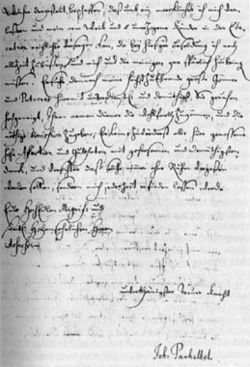
Pachelbel's letter

Pachelbel's letter

Pachelbel's tomb at the St. Rochus Cemetery in Nuremberg[n 5]

Pachelbel's tomb at the St. Rochus Cemetery in Nuremberg[n 5]

Example from "Wenn mein Stündlein vorhanden ist" of Pachelbel's chorales, bars 35–54. The chorale in the soprano is highlighted.

Example from "Wenn mein Stündlein vorhanden ist" of Pachelbel's chorales, bars 35–54. The chorale in the soprano is highlighted.

Gnome-mime-audio-openclipart

Gnome-mime-audio-openclipart

Excerpt from Magnificat Fugue octavi toni No. 12 (bars 15–18). Fugue subject that appears once in this excerpt is highlighted.

Excerpt from Magnificat Fugue octavi toni No. 12 (bars 15–18). Fugue subject that appears once in this excerpt is highlighted.

A page from the original printed edition of Hexachordum Apollinis, showing the fourth variation of the first aria

A page from the original printed edition of Hexachordum Apollinis, showing the fourth variation of the first aria

St. Sebaldus Church, Nuremberg, which played an important role in Pachelbel's lifeImage by Rafael Rodrigues Camargo, licensed under Creative Commons Attribution-Share Alike 4.0

St. Sebaldus Church, Nuremberg, which played an important role in Pachelbel's life

Predigerkirche, the Erfurt church, where Pachelbel worked for 12 years, starting in 1678Image by Tilman2007, licensed under Creative Commons Attribution-Share Alike 3.0

Predigerkirche, the Erfurt church, where Pachelbel worked for 12 years, starting in 1678

Pachelbel's letter

Pachelbel's letter

Pachelbel's tomb at the St. Rochus Cemetery in Nuremberg[n 5]

Pachelbel's tomb at the St. Rochus Cemetery in Nuremberg[n 5]

Example from "Wenn mein Stündlein vorhanden ist" of Pachelbel's chorales, bars 35–54. The chorale in the soprano is highlighted.

Example from "Wenn mein Stündlein vorhanden ist" of Pachelbel's chorales, bars 35–54. The chorale in the soprano is highlighted.

Gnome-mime-audio-openclipart

Gnome-mime-audio-openclipart

Fugue subjects from Magnificat fugues: secundi toni 7, octavi toni 10, primi toni 16, sexti toni 10, quarti toni 8 and octavi toni 13

Fugue subjects from Magnificat fugues: secundi toni 7, octavi toni 10, primi toni 16, sexti toni 10, quarti toni 8 and octavi toni 13

A typical Pachelbel repercussion subject. Listenⓘ

A typical Pachelbel repercussion subject. Listenⓘ

Excerpt from Magnificat Fugue octavi toni No. 12 (bars 15–18). Fugue subject that appears once in this excerpt is highlighted.

Excerpt from Magnificat Fugue octavi toni No. 12 (bars 15–18). Fugue subject that appears once in this excerpt is highlighted.

A page from the original printed edition of Hexachordum Apollinis, showing the fourth variation of the first aria

A page from the original printed edition of Hexachordum Apollinis, showing the fourth variation of the first aria

Musical Career

Pachelbel had a wonderful musical career! 🎉He worked in many places, including the courts of Germany, which were like royal families. He became known as one of the best organists of his time. By the 1680s, he took a job in Göttingen where he played for special events. Pachelbel wrote music for instruments like violins, organs, and even voices! 🎻He loved composing for churches and created many religious pieces. His work was exciting and helped inspire other musicians to create beautiful sounds that we still enjoy today! 🎶

In Popular Culture

Pachelbel's music appears in many movies, TV shows, and even commercials! 🎬You might hear "Canon in D" in romantic scenes, weddings, or fun celebrations. Many pop musicians have reimagined this beautiful piece, making it more popular than ever! Pachelbel's music is even used in video games and cartoons, bringing joy to both children and adults alike! 🎮His melodic tunes have entered the hearts of many, proving that great music can be timeless and enjoyed by everyone. 🎉

Later Years And Legacy

In his later years, Pachelbel continued to compose and teach. Although he faced challenges, including the loss of his first wife and children, he kept creating music. 🎹Pachelbel moved back to Nuremberg, where he produced some of his most famous works. His music has survived through time, and he remains a celebrated composer. 🌈His compositions are often played in concerts and orchestras worldwide! Pachelbel's legacy is that of a talented musician who inspired countless people, leaving behind beautiful music for all to enjoy! 🎼

Pachelbel's Canon In D

Pachelbel's "Canon in D" is one of the most famous pieces of classical music! 🎶It was written in the late 17th century and is loved by many people around the world. The piece has a simple, beautiful melody that repeats over and over, but each time it adds more layers. 🎻You might hear it at weddings, in movies, and on TV shows! It’s thought that "Canon in D" was originally played at celebrations and special events. When you listen, you feel the beauty and harmony, making it a favorite for many! 🎉

Teaching And Mentorship

Pachelbel was not just a composer; he was also an excellent teacher! 👩‍🏫 He taught many young musicians, sharing his knowledge and skills with them. He held a teaching position at the St. Sebaldus Church in Nuremberg, where he guided new organists. Pachelbel encouraged his students to be creative and follow their passions! ⭐Many of his students went on to become successful musicians themselves. His approach to music made learning fun and exciting, ensuring his legacy would live on through generations of musicians! 🎵

Early Life And Education

Pachelbel grew up in Nuremberg, a city known for its beautiful old buildings. His father was a wine dealer, but Pachelbel showed a talent for music very early on! 🎵He learned to play the organ and studied music at the University of Altdorf. By the time he was 18, he had already traveled to other German cities like Regensburg and Stuttgart to learn even more. He learned from great musicians and developed his own style along the way. Pachelbel was filled with creativity and passion for music even as a young boy! 🎓

Pachelbel's Compositions

Pachelbel wrote a lot of music throughout his life! 🎼Some of his well-known pieces include "Canon in D," "Chaconne in F," and "Magnificat." These pieces were often played at weddings and special celebrations. Pachelbel was also famous for writing music for the organ, a large instrument with many keys. One of his special talents was creating music that made people feel peaceful and happy. 🌅His compositions have a unique and flowing style, making them perfect for listening when you want to relax or celebrate with friends!

Influence On Baroque Music

Pachelbel played a big role in the Baroque music period, which lasted from around 1600 to 1750. 🎶This was a time of great creativity when many musicians were experimenting with new ideas. Pachelbel’s music influenced composers like Johann Sebastian Bach, who admired his work! 🎻The Baroque style is known for its catchy melodies and harmonies. Pachelbel's use of chords and patterns inspired other musicians to create similar music. His contributions helped shape what we think of as classical music today! 🎼

Notable Performances And Recordings

Many talented musicians have performed Pachelbel's works over the years! 🎻Some famous orchestras, like the London Philharmonic or the Berlin Philharmonic, have included his music in their concerts. You can also find many recordings of "Canon in D" by different artists! 🎼These performances showcase various instruments like violins, cellos, and organs, allowing you to hear his music in many styles. Pachelbel's music has become a favorite among audiences, with thousands of recordings available online and in music stores! 🎵

Johann Pachelbel Quiz

Q1
Question 1 of 10

Learn more about Johann Pachelbel

Ready to create?

Drop Files here
Make

To create a safe space for kid creators worldwide!

Create

Vibe Coding

Kids GPT

All Tools

Kibu

Resources

Worksheets

SafeTube

Blog

FAQ

Account

Pricing

Log-in

Sign-up

Data Deletion

Company

About

Community Guidelines

Privacy Policy

Terms of Service

2025, URSOR LIMITED. All rights reserved. DIY is in no way affiliated with Minecraft™, Mojang, Microsoft, Roblox™ or YouTube. LEGO® is a trademark of the LEGO® Group which does not sponsor, endorse or authorize this website or event. Made with love in San Francisco.