Hyperboloid Facts For Kids
A hyperboloid is a smooth surface defined by a hyperbola in three-dimensional space, characterized by its unique curving shapes which can be one or two sheets.
Select reading age
Hyperboloid Facts For Kids
Videos & Quizzesincluded
About this topic
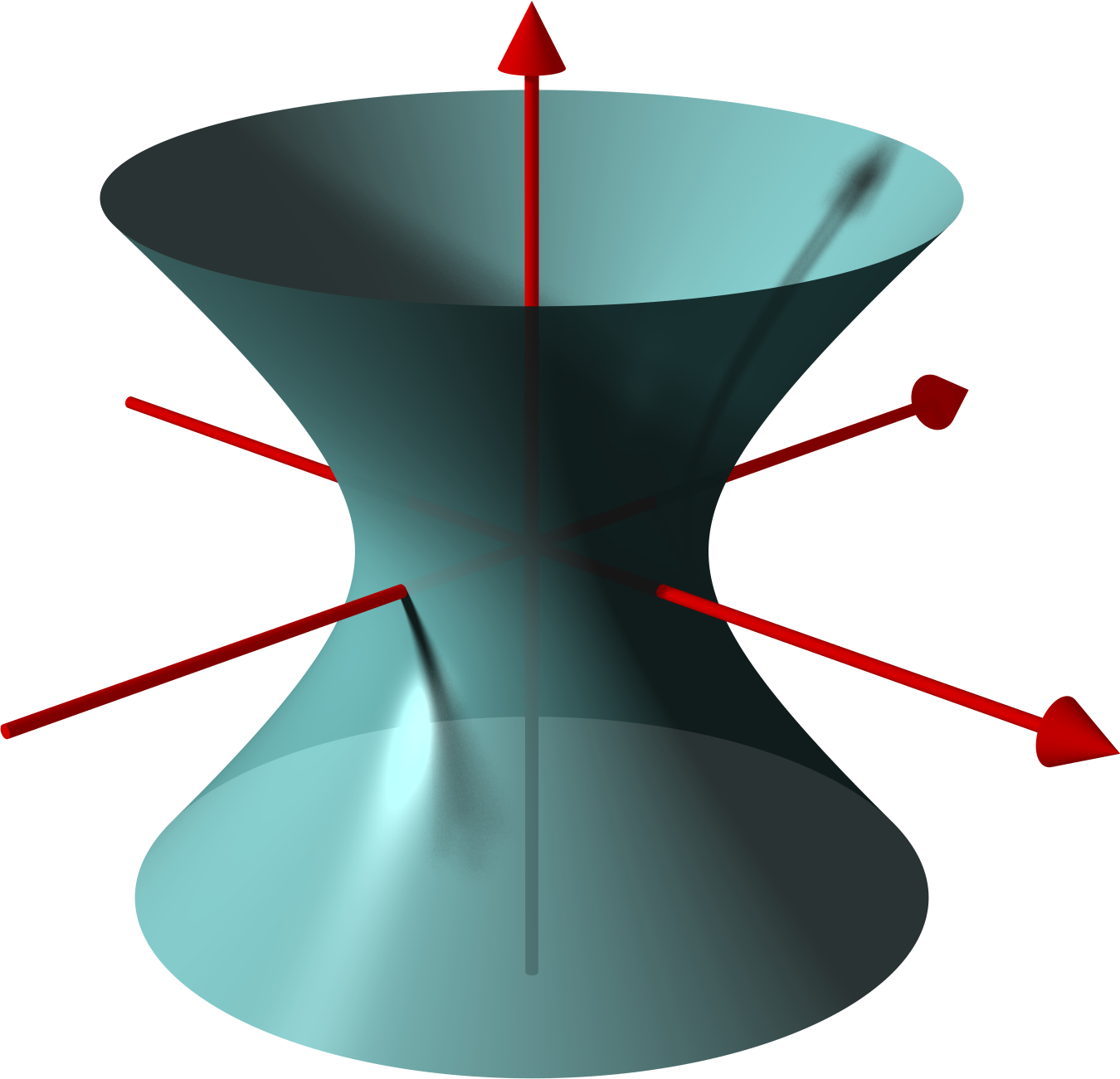
A hyperboloid is a special shape that looks a bit like an hourglass! ⏳It can have one or two curves, and it's made up of straight lines that create a wavy surface. Hyperboloids can be found in many places, like the towers of power plants and even in some sculptures! 🎨The shape is formed by spinning a hyperbola (a type of curve) around a center line. Hyperboloids are not just cool to look at; they also have interesting properties that help engineers and architects build strong structures. Let's learn more about this fun shape!
Explore with ChatDinoKey Points
The hyperboloid shape has a rich history!
In math, a hyperboloid is defined by a special equation: \[(x^2/a^2) + (y^2/b^2) - (z^2/c^2) = 1\] In this equation, \(a\), \(b\), and \(c\) are numbers that help describe the shape's size!
There are two types of hyperboloids: one sheet and two sheets!
In physics, hyperboloids can help explain various concepts.
Hyperboloids are part of a fascinating family of shapes!
Hyperboloids are great for building strong structures!
Engineers love hyperboloids because they create very strong shapes!
Visualizing hyperboloids can be really fun!
Photos of Hyperboloid

double cone

Hyperboloid of two sheet

Animation of a hyperboloid of revolution

hyperboloid of one sheet: generation by a rotating hyperbola (top) and line (bottom: red or blue)

hyperboloid of one sheet: plane sections

hyperboloid of two sheets: generation by rotating a hyperbola

hyperboloid of two sheets: plane sections

Hyperboloid — photo 8

Hyperboloid — photo 9
📚 Historical Development
The hyperboloid shape has a rich history! 📚In the 19th century, mathematicians like Augustin-Louis Cauchy studied it. They discovered its properties and equations, contributing to what we know today! 🧑🏫 Engineers used these concepts to build impressive towers and structures. By the 20th century, hyperboloids appeared in buildings like the famous TWA Flight Center in New York City, designed by Eero Saarinen. ✈️ Hyperboloids have come a long way and are an essential part of modern architecture and design!
Go deeper📏 Mathematical Definition
In math, a hyperboloid is defined by a special equation:
\[(x^2/a^2) + (y^2/b^2) - (z^2/c^2) = 1\]
In this equation, \(a\), \(b\), and \(c\) are numbers that help describe the shape's size! 📏If \(c\) is larger than \(a\) and \(b\), we get a hyperboloid of one sheet, which looks like a saddle. 🐴If they are smaller, it creates two separate parts, known as a hyperboloid of two sheets. Understanding hyperboloids helps us see how shapes can change based on simple numbers.
Go deeper\[(x^2/a^2) + (y^2/b^2) - (z^2/c^2) = 1\]
In this equation, \(a\), \(b\), and \(c\) are numbers that help describe the shape's size! 📏If \(c\) is larger than \(a\) and \(b\), we get a hyperboloid of one sheet, which looks like a saddle. 🐴If they are smaller, it creates two separate parts, known as a hyperboloid of two sheets. Understanding hyperboloids helps us see how shapes can change based on simple numbers.
📐 Geometry Of Hyperboloids
There are two types of hyperboloids: one sheet and two sheets! 📐A hyperboloid of one sheet connects all parts smoothly together. Imagine a delicious ice cream cone that twists! 🍦In contrast, a hyperboloid of two sheets looks like two separate bowls, floating in the air! 🥣Both shapes can be curved wide or narrow, depending on their measurements. When you look at them from different angles, they can appear very unique. This wavy geometry makes hyperboloids both fun and complex at the same time!
Go deeper🌌 Physics And Hyperboloids
In physics, hyperboloids can help explain various concepts. 🌌For example, when studying how waves travel, we might use hyperboloids to see how they spread out. 📡Hyperboloids also relate to things like light and gravity, making them important in understanding the universe! 🌠Scientists use hyperboloid shapes in experiments to study gases and fluids, helping us learn more about the world around us. So, while it might look like a simple shape, it helps us explore complex scientific ideas!
Go deeper🧊 Related Geometric Shapes
Hyperboloids are part of a fascinating family of shapes! 🧊Related shapes include hyperbolas, ellipsoids, and paraboloids. A hyperbola is a curve that looks like two open arms reaching away from each other. 🤲Ellipsoids are like stretched-out spheres, while paraboloids curve smoothly, like a satellite dish. 📡Studying these shapes helps us understand how different curves and surfaces interact in the world. So, when you think of hyperboloids, remember the exciting family of shapes it belongs to!
Go deeper🏗️ Applications In Architecture
Hyperboloids are great for building strong structures! 🏗️ Architects like to use them because they spread forces evenly, making buildings stable. The famous “Habitat 67” near Montreal, Canada, is a beautiful example of a hyperboloid structure. 🌍Also, in many bridges, hyperboloids help to support weight and add to the beauty of the design! 🛤️ When you see a building shaped like a hyperboloid, you can remember that its unique shape not only looks cool but also keeps it strong.
Go deeper💪 Hyperboloid Structures In Engineering
Engineers love hyperboloids because they create very strong shapes! 💪They can be found in towers, water tanks, and cooling towers of power plants. ⚡When a hyperboloid is built tall and narrow, it can better hold heavy loads. The Space Needle in Seattle is another great example of applying hyperboloid design! 🌌By using this shape, engineers ensure structures can withstand strong winds and earthquakes. Next time you see a hyperboloid structure, think of the smart people behind its design!
Go deeper🖼️ Visualization And Graphing Techniques
Visualizing hyperboloids can be really fun! 🖼️ You can use graphing software or mathematical tools to see how they look in 3D. When plotted, hyperboloids can twist and turn in exciting ways. 🎢You can even draw them with graph paper! If you sketch their curves carefully, you can create hyperboloids to understand their beauty. Using colors like blue and red makes your drawings pop! Create diagrams using online tools or apps to explore different shapes and dimensions of hyperboloids.
Go deeper