The Hungarian Revolution of 1848 was a pivotal uprising for independence from the Austrian Empire, fueled by ideas of nationalism and democracy.

Set reading age
View for Kids
Easy to read and understand
View for Students
Clear, detailed explanations
View for Scholars
Deep dives and big ideas
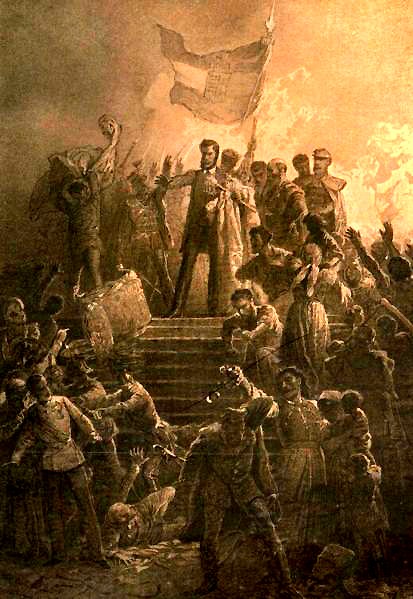
The Hungarian Revolution of 1848 was an exciting time in Hungary! 🎉It was a fight for freedom from the Habsburg Empire, which was in charge of Hungary. People wanted to have their own rules and make their own decisions. This revolution started on March 15, 1848, when many Hungarians gathered in Budapest, waving flags and chanting for liberty! 🕊️ It was part of a larger wave of revolutions across Europe that year. By the end, Hungary faced tough battles and important changes, shaping its future for many years to come.
The revolution deeply influenced Hungarian culture! 🎨Writers and poets found new inspiration, reflecting on the fight for freedom in their work. For example, Sándor Petőfi became a national symbol of bravery through his poetry. The revolution also helped shape Hungarian music, art, and traditions, making them more vibrant and diverse. Today, Hungarians remember 1848 with national holidays, celebrations, and parades that honor the bravery of those who fought for their freedom. 🥳It's an important chapter in Hungary's story that continues to inspire its people!
Several key figures made a big difference during the Hungarian Revolution! Lajos Kossuth was one of the most important leaders. He was a lawyer and a politician who pushed for independence. 👨⚖️ Other notable leaders were Sándor Petőfi, a famous poet who wrote the National Song, and Mór Jókai, a writer who inspired many with his words. These people rallied others to join the fight, and they encouraged the Hungarian people to believe in their power to change their lives! ✊
The revolution had many important events! One of the first was the gathering in Budapest on March 15, 1848, when thousands of people demanded change. ⚔️ Another significant battle was the Siege of Buda in 1849, where Hungarian troops fought bravely against the Austrian army. The revolution lasted for over a year and included fierce fighting. However, the revolutionists faced challenges from the Habsburgs and their allies, and many battles like the Battle of Kápolna became important moments in the struggle for independence.
The Hungarian Revolution left a lasting mark on society! Even though it did not achieve independence right away, it sparked a new sense of identity among Hungarians. 🎭People began to gather more, share their culture, and speak out for their rights. This movement inspired a new generation of writers, artists, and politicians to continue pushing for change. Many social reforms were later adopted, making education and language more accessible to all. So even though there were challenges, the revolution helped shape a new, proud Hungarian society!
Nationalism and patriotism played a huge role in the Hungarian Revolution! 🇭🇺 People felt a strong love for their country and wanted to show pride in being Hungarian. This national pride united many different groups who spoke different languages and came from various regions. They all believed they should have a say in their own government and future. By celebrating their culture, history, and language during the revolution, Hungarians inspired each other to take a stand for their rights and independence! 🎈
After the revolution, things were tough for Hungary. The Habsburg Empire regained control, but tensions remained. ⚠️ Many leaders were captured or fled, like Lajos Kossuth, who went to the United States! However, the fight for freedom didn't stop. The ideas and passion from 1848 planted seeds of rebellion that would bloom again later. In 1867, Hungary finally gained more autonomy, becoming part of the Austro-Hungarian Empire. So, while it was a challenging time, 1848 changed the country's path forever!
In the early 1800s, Hungary was part of the Habsburg Empire, ruled by Austria. 🇦🇹 Many Hungarians felt that they were not being treated fairly. They wanted more rights and to use their own language. People were inspired by the ideas of freedom and equality from writers and leaders like Lajos Kossuth. Кossuth became a famous figure for advocating for Hungarian independence and democracy. 📜The revolution was driven by citizens who were tired of being controlled and wanted to create a better life for their families!
The Hungarian Revolution was part of the larger wave of revolutions across Europe in 1848. 📅In places like France, Italy, and Germany, people were fighting for similar rights! The ideas of liberty and democracy traveled from one country to another, inspiring many. Hungarian leaders were influenced by the successful revolutions in France when they realized that change was possible! 🌍This shared spirit of rebellion brought people together and made them feel they could accomplish great things for their countries!
The Hungarian Revolution of 1848 shares similarities with other revolutions of the same year, like those in France and Italy. 🇫🇷 In France, people also fought for democracy and better rights. Like Hungary, these movements were driven by a strong sense of nationalism. However, each revolution faced different challenges and had unique outcomes. Some countries succeeded in gaining freedom, while others struggled longer. The Hungarian Revolution was special because it showed that many people across Europe wanted to express their identities and fight for a brighter future together! ✨