Hooded Merganser Facts For Kids
Hooded mergansers are small, unique ducks known for their striking crests and distinctive plumage, primarily found in freshwater habitats across North America.
Select reading age

Hooded Merganser Facts For Kids
Videos & Quizzesincluded
About this topic
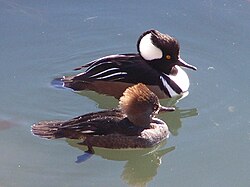
The hooded merganser is a small, beautiful duck found in North America! 🦆These birds are famous for their unique, fan-shaped crests, especially the males who have striking white, black, and chestnut colors. Their scientific name is Lophodytes cucullatus and they can be spotted in rivers, lakes, and ponds. Hooded mergansers are around 14 to 19 inches long, with males generally larger than females. They are great swimmers and divers, using their webbed feet to paddle through the water. If you hear a soft "kak-kak-kak" call, it might just be a hooded merganser saying hello! 🐦
Explore with ChatDinoKey Points
These ducks are skilled hunters!
Hooded mergansers are found all over North America!
Did you know that hooded mergansers are excellent divers?
Hooded mergansers are currently classified as a species of "Least Concern."
Hooded mergansers are cavity nesters, which makes them unique among ducks!
Scientists study hooded mergansers to learn about their habits, reproduction, and the health of wetlands!
Hooded mergansers are appreciated by many nature lovers and birdwatchers across North America!
Male hooded mergansers wear a striking black-and-white plumage!
Photos of Hooded Merganser

Hooded Merganser — photo 1

Hooded Merganser — photo 2

Hooded Merganser — photo 3

Hooded Merganser — photo 4
Hooded Merganser — photo 5

Female at Walsrode Bird Park, Germany

Lophodytes cucullatus - MHNT

Hybrid with common goldeneye, in Ontario
🦆 Behavior And Diet
These ducks are skilled hunters! 🦆Hooded mergansers dive underwater to catch their favorite meals, which include fish, insects, and small crustaceans. They have excellent eyesight that helps them see in the water. They also forage along the surface of the water, tipping down to reach food. Mergansers are social birds, often found in small groups. During mating season, males showcase their colorful plumage and perform courtship displays to attract females. They can be seen bobbing up and down or shaking their heads in fascinating displays. 🎉
Go deeper🌎 Habitat And Range
Hooded mergansers are found all over North America! 🌎During the breeding season, they prefer freshwater lakes and rivers with lots of trees nearby for nesting. In winter, they migrate towards coastal waters and warmer lakes, moving south to Florida and Mexico. They can be seen in the northern United States and Canada during the summer. 🍂Some travel to the eastern parts of the U.S. and parts of the Pacific coast during migration. Their favorite habitats are rich in aquatic plants and clear water, where they can hunt for food. 🏞️
Go deeper🌊 Interesting Facts
Did you know that hooded mergansers are excellent divers? 🌊They can dive as deep as 15 feet to catch food! Their unique crests can change shape depending on their mood – they raise it to show off during courtship. And they can be found in mixed groups with other ducks. Young hooded mergansers are able to start diving for food just a few weeks after they hatch! 🐣Have you ever tried diving under the water? These clever ducks do it every day to find their meals!
Go deeper📊 Conservation Status
Hooded mergansers are currently classified as a species of "Least Concern." 📊 This means they are not in immediate danger. However, they rely on healthy wetland habitats to thrive. Pollution, habitat loss, and development can impact their homes. Birds like these ducks are monitored by wildlife organizations to ensure their populations remain stable. Conservation efforts focus on protecting wetland environments and creating safe nesting sites. By preserving their natural habitats, we can help ensure that hooded mergansers continue to swim in our lakes and rivers for years to come! 🌍
Go deeper🌳 Breeding And Nesting
Hooded mergansers are cavity nesters, which makes them unique among ducks! 🌳They look for tree holes or boxes that provide safety from predators. The female lays around 8 to 12 eggs, which are a pale tan color. After laying eggs, the female incubates them for about 30 days. 🥚Once the chicks hatch, they are ready to jump out of the nest and into the water just a few hours later! Chicks are good swimmers and start foraging for food almost immediately. Parents help guide them to find safety and food until they can fly at about 70 days old. 🕊️
Go deeper📚 Research And Studies
Scientists study hooded mergansers to learn about their habits, reproduction, and the health of wetlands! 📚Research has shown that they play an important role in their ecosystems by helping to control fish populations. Tracking their migration patterns helps conservationists understand the impact of climate change on their habitats. Some studies involve fitting birds with tiny GPS devices to track their movements. By studying these fascinating ducks, researchers gather important information that aids in protecting their habitats and ensuring the future of hooded mergansers in North America! 🧑🔬
Go deeper🦅 Cultural Significance
Hooded mergansers are appreciated by many nature lovers and birdwatchers across North America! 🦅Some Native American tribes view them as symbols of beauty and grace. Artists and photographers love capturing their colorful plumage and unique behavior. Additionally, they are part of many educational programs to teach kids about wetlands and conservation. By learning about hooded mergansers, people grow to appreciate and protect our natural environments! Schools even engage in fun activities like building duck boxes to help them nest safely. 🎨
Go deeper🌈 Physical Characteristics
Male hooded mergansers wear a striking black-and-white plumage! Their distinctive crest can be raised to show off bright white feathers. 🌈This crest can be flattened down when they need to hide. Females are mostly brown with a smaller, simplified crest. Both genders have long, slender necks and pointed bills, which help them catch fish, frogs, and invertebrates. They have webbed feet, perfect for swimming! Their body shape is streamlined, which helps them dive and move quickly underwater. Adult males weigh about 1.5 to 2.7 pounds, while females are slightly lighter. 🚣♂️
Go deeper