Heptagon Facts For Kids

A heptagon is a polygon with seven edges and vertices, classified into regular and irregular types based on the length of its sides and angles.

Select reading age
Go deeper More articles
Heptagon
Heptagon Facts For Kids
Videos & Quizzesincluded

About this topic

A heptagon is a special shape in geometry! 🖼️ It has seven sides and seven corners. Heptagons can be found in many places, but they are not as common as shapes like squares or triangles. All heptagons have angles, which are the corners where the sides meet! The word "heptagon" comes from Greek. "Hepta" means seven, and "gonia" means angle. That means a heptagon has seven angles too! If you add up all the inside angles, they equal 900 degrees! That’s quite a number, isn’t it? 🤔
Explore with ChatDino

Key Points

There are mainly two types of heptagons: regular and irregular.
Heptagons can be seen in nature if you look closely!
In geometry, shapes help us learn about space and figures!
Heptagons have unique properties!
A heptagon is a polygon with seven sides and seven vertices (corners).
Heptagons are popular in many art pieces and buildings!
The heptagon appears in various cultures and mythologies too!
To find the area of a heptagon, we use a special formula!
Mathematically, heptagons are interesting to study!

Photos of Heptagon

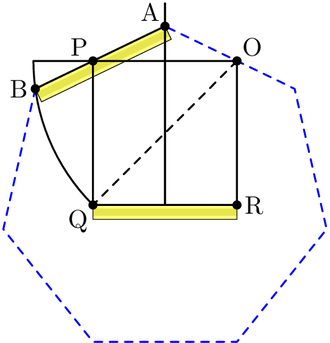
Heptagon with given side length: An animation from a neusis construction with marked ruler, according to David Johnson Leisk (Crockett Johnson).Image by Petrus3743, licensed under Creative Commons Attribution-Share Alike 4.0

Heptagon with given side length: An animation from a neusis construction with marked ruler, according to David Johnson Leisk (Crockett Johnson).

Heptagon — photo 2Image by User:Raoul NK, licensed under Creative Commons Attribution-Share Alike 3.0

Heptagon — photo 2

Neusis construction of a regular heptagonImage by User:AndrewKepert, licensed under Creative Commons Attribution-Share Alike 3.0

Neusis construction of a regular heptagon

Regular heptagon, animation, exact design, trisection of an angle by Tomahawk (blue)Image by Petrus3743, licensed under Creative Commons Attribution-Share Alike 4.0

Regular heptagon, animation, exact design, trisection of an angle by Tomahawk (blue)

Symmetries of a regular heptagon. Vertices are colored by their symmetry positions. Blue mirror lines are drawn through vertices and edges. Gyration orders are given in the center.[5]Image by Tomruen, licensed under Creative Commons Attribution-Share Alike 4.0

Symmetries of a regular heptagon. Vertices are colored by their symmetry positions. Blue mirror lines are drawn through vertices and edges. Gyration orders are given in the center.[5]

a=red, b=blue, c=green lines

a=red, b=blue, c=green lines

Heptagon — photo 7

Heptagon — photo 7

The densest double lattice packing of the Euclidean plane by regular heptagons, conjectured to have the lowest maximum packing density of any convex setImage by Toby Hudson, licensed under Creative Commons Attribution-Share Alike 3.0

The densest double lattice packing of the Euclidean plane by regular heptagons, conjectured to have the lowest maximum packing density of any convex set

Heptagon — photo 9Image by Rama, licensed under Creative Commons Attribution-Share Alike 2.0 fr

Heptagon — photo 9

Heptagon — photo 10Image by Rabanus Flavus, licensed under Creative Commons Attribution 3.0

Heptagon — photo 10

🌟 Types Of Heptagons

There are mainly two types of heptagons: regular and irregular. A regular heptagon has all sides the same length and all angles equal, making it look really nice! 🌟An irregular heptagon doesn’t follow these rules—it may have sides of different lengths and varying angles. 🌈You can think of an irregular heptagon like a house with all different shaped walls! Another interesting variation is the concave heptagon. It looks “caved in,” meaning one or more corners point inward. Finally, there’s the convex heptagon, where all corners point outward! 🏠
Go deeper

🌿 Heptagons In Nature

Heptagons can be seen in nature if you look closely! 🌿For instance, some flowers, like the Bitterweed, have petals arranged in a heptagon shape. Additionally, honeycombs built by bees often use hexagons, but when bees make other shapes, they can be heptagonal! 🐝Other natural wonders like snowflakes might also show beautiful patterns that could resemble heptagons! Even in fruits, the arrangement of seeds in some berries can look heptagonal! Nature has its magical way of creating shapes, and the heptagon is part of that mystery! 🌺
Go deeper

📐 Heptagon In Geometry

In geometry, shapes help us learn about space and figures! 📐The heptagon is one of the many polygons studied. It is a fascinating shape because it has seven sides! 💫Heptagons are used in various geometric proofs to help us learn about angles and sides. You might even see them when learning about symmetry! In geometry, we love understanding shapes, and heptagons fit right into the family of polygons, which includes squares, triangles, and more! So when you're thinking about geometry, think of heptagons too!
Go deeper

✅ Properties Of Heptagons

Heptagons have unique properties! ✅A regular heptagon has equal sides and equal angles—each angle measures about 128.57 degrees. In an irregular heptagon, the sides and angles can be different. 🛠️ Heptagons also have a fascinating symmetry! You could draw lines through the center to show how they mirror each other. Additionally, a heptagon has seven edges, meaning if you walk around the shape, you would take seven steps! Last fun fact: Heptagons can tile a plane, which means you can fill a flat area with them without gaps.
Go deeper

📏 Definition Of A Heptagon

A heptagon is a polygon with seven sides and seven vertices (corners). 📏A polygon is any flat shape made up of straight lines. To be a heptagon, each side must connect at the corners to make a closed shape. You can draw a heptagon by having seven equal-length sides, called a regular heptagon. 🌟These angles can be different lengths in an irregular heptagon. Even though they look different, they still have seven sides! Just like how a rainbow can have 7 colors, a heptagon can have different designs too! 🌈
Go deeper

🎨 Heptagon In Art And Architecture

Heptagons are popular in many art pieces and buildings! 🎨For example, the United Nations Headquarters in New York has heptagonal elements in its design, giving it a unique look. Artists often use heptagons in their artwork to create interesting patterns or frames, and it catches the eye! 👀In modern art, heptagons can represent creativity, diversity, and balance. You might even find heptagonal designs on playgrounds and structures, which make them fun and different! So next time you’re enjoying art or a building, see if you can spot any heptagons! 🏛️
Go deeper

🌍 Heptagon In Culture And Mythology

The heptagon appears in various cultures and mythologies too! 🌍In some ancient stories, seven is a magical number! This number is seen as lucky in many cultures, like in the Seven Wonders of the Ancient World and even in fairy tales. ✨Some legends also mention seven heroes or seven gods, which connects to the heptagon. In Buddhism, the Heptagram symbol represents spiritual growth—perfect for heptagons! 🌌It’s amazing how a simple shape can connect to many stories and beliefs throughout human history!
Go deeper

🧮 Calculating The Area Of A Heptagon

To find the area of a heptagon, we use a special formula! 🧮For a regular heptagon, the area can be calculated using A = (7/4) * s² * (1/tan(π/7)), where "s" is the length of one side. It might look complicated, but don't worry! You can also divide the heptagon into triangles for easier calculations. 🍰If you cut it like a pizza into triangles, it might make finding the area a bit easier! Remember that finding the area means figuring out how much space is inside the shape. It’s like measuring how much frosting you could spread on a cake shaped like a heptagon!
Go deeper

📊 Mathematical Significance Of Heptagons

Mathematically, heptagons are interesting to study! 📊They share important relationships with other shapes. The sum of all angles in a heptagon is 900 degrees, and this helps mathematicians understand the properties of polygons. This significance can also lead to fun math puzzles and geometric challenges! 🔍Heptagons help us learn symmetry, tessellations, and even calculus! The study of heptagons and their characteristics aids in designing everything from video games to computer graphics! Mathematics loves heptagons, and so should you! 📚✨
Go deeper

🧠 Take the Quiz about Heptagon

Question 1 of 10

How many sides does a heptagon have?

Question 2 of 10

What is the total measure of the internal angles of a heptagon?

Question 3 of 10

What is the measure of each internal angle in a regular heptagon?

Question 4 of 10

Can a heptagon be concave?

Question 5 of 10

What is the sum of the exterior angles of a heptagon?

Question 6 of 10

What does the prefix 'hepta-' mean?

Question 7 of 10

Is a heptagon commonly used in everyday designs?

Question 8 of 10

How many types of heptagons are there?

Question 9 of 10

What shape is formed by connecting the corners of a heptagon?

Question 10 of 10

Which of the following is a property of a regular heptagon?

🔒

Your results

Answer all 10 questions to see how you did.

Kid-safe AI powered by AstroSafe

DIY.org

Kid-safe AI for discovery and learning. Ask anything, explore everything, learn with confidence.

Product

  • Pricing
  • App
  • All Apps

Resources

  • Blog
  • Kids Wikipedia
  • Worksheets
  • Activities for Kids
  • Build a Hacker Simulator
  • SafeTube

Company

  • About
  • Terms & Conditions
  • Privacy Policy
  • AstroSafe
TwitterInstagramYouTube

© 2026 DIY.org. All rights reserved. · Powered by AstroSafe