All Articles

Harold Godwinson

Harold Godwinson Facts For Kids

Harold Godwinson, also called Harold II, was the last crowned Anglo-Saxon king of England whose reign in 1066 ended after he was defeated in the Battle of Hastings.
🎨 Reading age for 6-8
Background blob
Harold Godwinson
Facts for Kids!

Do more with AI

Introduction

Harold Godwinson, also known as King Harold II, was the last Anglo-Saxon king of England. 👑He ruled in 1066, a very important year! Harold was born around 1022 in England and came from a powerful family. His life was filled with battles and adventures. Sadly, Harold's reign was short, lasting only about 9 months! He is best known for fighting against invaders who wanted to claim the English throne. In a famous battle, he faced off against William the Conqueror. Harold's story is an exciting part of England's history! ⚔️

Images of Harold Godwinson

HAROLD SACRAMENTUM FECIT VVILLELMO DUCI ("Harold made an oath to Duke William"): the Bayeux Tapestry shows Harold touching two altars at Bayeux as the duke watches.

HAROLD SACRAMENTUM FECIT VVILLELMO DUCI ("Harold made an oath to Duke William"): the Bayeux Tapestry shows Harold touching two altars at Bayeux as the duke watches.

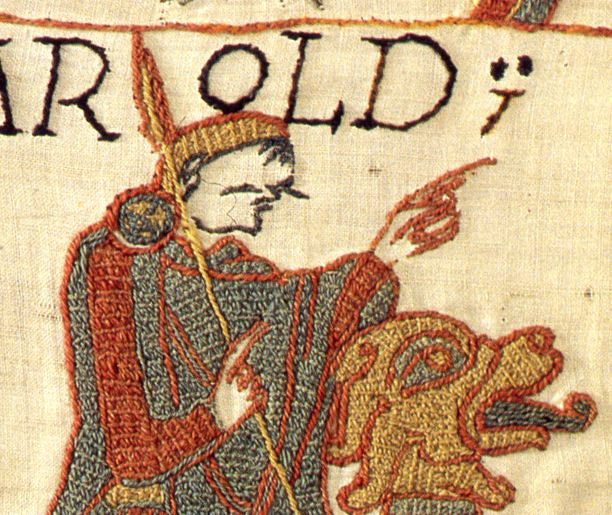
HIC RESIDET HAROLD REX ANGLORUM. STIGANT ARCHIEP[ISCOPU]S. "Here sits Harold King of the English. Archbishop Stigand". Scene immediately after crowning of Harold by (according to the Norman tradition) Archbishop of Canterbury Stigand (d. 1072). Detail from the Bayeux Tapestry.

HIC RESIDET HAROLD REX ANGLORUM. STIGANT ARCHIEP[ISCOPU]S. "Here sits Harold King of the English. Archbishop Stigand". Scene immediately after crowning of Harold by (according to the Norman tradition) Archbishop of Canterbury Stigand (d. 1072). Detail from the Bayeux Tapestry.

Coin of King Harold Godwinson

Coin of King Harold Godwinson

Gyrth and his brother's death at the Battle of Hastings, scene 52 of the Bayeux Tapestry.HIC CECIDERUNT LEVVINE ET GYRÐ FRATRES HAROLDI REGIS(Here have fallen dead Leofwine and Gyrth, brothers of King Harold)

Gyrth and his brother's death at the Battle of Hastings, scene 52 of the Bayeux Tapestry.HIC CECIDERUNT LEVVINE ET GYRÐ FRATRES HAROLDI REGIS(Here have fallen dead Leofwine and Gyrth, brothers of King Harold)

Harold's death depicted in the Bayeux Tapestry, reflecting the tradition that Harold was killed by an arrow in the eye. The annotation above states [Hic] Harold Rex interfectus est, "[Here] King Harold has been killed".

Harold's death depicted in the Bayeux Tapestry, reflecting the tradition that Harold was killed by an arrow in the eye. The annotation above states [Hic] Harold Rex interfectus est, "[Here] King Harold has been killed".

The spot where Harold reportedly died, which became the site of Battle Abbey in East Sussex.

The spot where Harold reportedly died, which became the site of Battle Abbey in East Sussex.

Bosham Church in West Sussex: the lower three storeys of the tower are pre-conquest, the top storey Norman

Bosham Church in West Sussex: the lower three storeys of the tower are pre-conquest, the top storey Norman

13th century version of Harold's crowning, from an anonymous Life of King Edward the Confessor in Cambridge University Library.

13th century version of Harold's crowning, from an anonymous Life of King Edward the Confessor in Cambridge University Library.

HAROLD SACRAMENTUM FECIT VVILLELMO DUCI ("Harold made an oath to Duke William"): the Bayeux Tapestry shows Harold touching two altars at Bayeux as the duke watches.

HAROLD SACRAMENTUM FECIT VVILLELMO DUCI ("Harold made an oath to Duke William"): the Bayeux Tapestry shows Harold touching two altars at Bayeux as the duke watches.

HIC RESIDET HAROLD REX ANGLORUM. STIGANT ARCHIEP[ISCOPU]S. "Here sits Harold King of the English. Archbishop Stigand". Scene immediately after crowning of Harold by (according to the Norman tradition) Archbishop of Canterbury Stigand (d. 1072). Detail from the Bayeux Tapestry.

HIC RESIDET HAROLD REX ANGLORUM. STIGANT ARCHIEP[ISCOPU]S. "Here sits Harold King of the English. Archbishop Stigand". Scene immediately after crowning of Harold by (according to the Norman tradition) Archbishop of Canterbury Stigand (d. 1072). Detail from the Bayeux Tapestry.

Coin of King Harold Godwinson

Coin of King Harold Godwinson

Gyrth and his brother's death at the Battle of Hastings, scene 52 of the Bayeux Tapestry.HIC CECIDERUNT LEVVINE ET GYRÐ FRATRES HAROLDI REGIS(Here have fallen dead Leofwine and Gyrth, brothers of King Harold)

Gyrth and his brother's death at the Battle of Hastings, scene 52 of the Bayeux Tapestry.HIC CECIDERUNT LEVVINE ET GYRÐ FRATRES HAROLDI REGIS(Here have fallen dead Leofwine and Gyrth, brothers of King Harold)

Harold's death depicted in the Bayeux Tapestry, reflecting the tradition that Harold was killed by an arrow in the eye. The annotation above states [Hic] Harold Rex interfectus est, "[Here] King Harold has been killed".

Harold's death depicted in the Bayeux Tapestry, reflecting the tradition that Harold was killed by an arrow in the eye. The annotation above states [Hic] Harold Rex interfectus est, "[Here] King Harold has been killed".

The spot where Harold reportedly died, which became the site of Battle Abbey in East Sussex.

The spot where Harold reportedly died, which became the site of Battle Abbey in East Sussex.

Bosham Church in West Sussex: the lower three storeys of the tower are pre-conquest, the top storey Norman

Bosham Church in West Sussex: the lower three storeys of the tower are pre-conquest, the top storey Norman

13th century version of Harold's crowning, from an anonymous Life of King Edward the Confessor in Cambridge University Library.

13th century version of Harold's crowning, from an anonymous Life of King Edward the Confessor in Cambridge University Library.

Key Battles

Harold Godwinson was known for his bravery and desire to protect England. He fought in many battles during his life. 🌟The most famous battles include the Battle of Stamford Bridge against Harald Hardrada and the Battle of Hastings against William the Conqueror. During the Battle of Stamford Bridge, Harold’s forces were outnumbered, but they won, showing Harold's strength! ⚔️ However, right after this victory, he had to rush back south to face William. The two battles were crucial moments for Harold and determined the fate of England!

Reign As King

Harold's time as king was filled with challenges. He had to protect England from invaders, especially the surprising Viking attack from Norway led by Harald Hardrada in September 1066. 😮With only a small army, Harold quickly marched north to face them. After a tough battle called the Battle of Stamford Bridge, Harold won! 🎉However, he soon faced another threat from William of Normandy, who was planning to invade too. Sadly, Harold only ruled for a short time before his fate changed dramatically in a famous battle!

Rise To Power

In 1066, King Edward the Confessor died without a clear heir, which led to a struggle for the throne. Harold Godwinson was chosen to be king because he was a powerful noble and had the support of many people! 🎉He was crowned king on January 6, 1066, in Westminster Abbey, London. But his path to the throne was not easy! Some believed that another man, Harold Hardrada from Norway, had a claim to the crown. Additionally, William, Duke of Normandy, also wanted to be king. This made Harold’s rise to power exciting yet dangerous! ⚔️

Death And Legacy

Harold Godwinson died at the Battle of Hastings in 1066, marking a significant change for England! 😢After his death, William the Conqueror became king and began to change many things in the country. Harold’s legacy lives on, as he is remembered as a brave warrior and a significant figure in English history. 🌟Many believe he fought bravely to protect England, even though he lost. His story shows that even in defeat, someone can still be admired. Harold's impact on England is still taught in schools today!

Historical Impact

Harold Godwinson’s reign changed the course of English history forever! 🌍After his death, William the Conqueror brought new customs and language to England. This led to the beginning of the Norman rule, which influenced the country's development for many years! ⚔️ People often remember Harold for his bravery and the challenges he faced. His story helps us learn about kings, battles, and what it means to lead a country. Harold's legacy is a reminder of how history is shaped by both triumphs and defeats!

Cultural Depictions

Harold Godwinson has been depicted in many stories, movies, and games! 🎮One of the most famous depictions is in the Bayeux Tapestry, a colorful tapestry that tells the story of the Battle of Hastings! ✨It shows Harold’s life, the battles he fought, and even his famous defeat. His character has also appeared in films depicting this historical period, making his story exciting for kids. 📚Through books and art, people continue to share what makes Harold's story interesting and important today!

The Battle Of Hastings

The Battle of Hastings took place on October 14, 1066, and changed English history forever! 😲Harold's army faced William's troops near Hastings, East Sussex. The battle began early in the morning and lasted for hours. Harold’s men fought bravely, but William's army used clever tactics, like pretending to retreat! 🏇Harold was finally struck by an arrow in the eye and fell, leading to his defeat. The victory allowed William to become king of England, marking the end of the Anglo-Saxon rule! The battle is remembered as a turning point in history! ⚔️

Early Life And Background

Harold was born into the Godwin family, one of the most important noble families in England. 🇬🇧 His father, Godwin, was the Earl of Wessex, making Harold important from a young age! He grew up learning how to fight and lead soldiers. Harold had several siblings, including a brother named Tostig. 🌟Harold was known for being brave and smart. He even traveled to the continent (Europe) and met with many rulers! This early life helped him prepare to become king. His experiences shaped him into a strong leader for England!

Political Alliances And Challenges

Harold Godwinson faced many political challenges during his rule. He had to secure alliances with important nobles to help defend England! 🌍However, some nobles were unhappy and wanted their own power. After becoming king, Harold quickly needed to handle the Viking invasion led by Harald Hardrada and the threats from William of Normandy. These challenges made Harold's rule very difficult! 🛡️ Despite these issues, Harold's leadership shone as he gathered support and planned strategies to fight against his enemies. His political skills were put to the test!

Relationship With Other Noble Families

Harold Godwinson had connections with many powerful noble families in England. 🤝His family, the Godwins, was influential, and they formed alliances through marriage. For example, Harold’s mother, Gytha, was part of a noble family, which strengthened their ties. However, there was rivalry, especially with King Edward’s family and other nobles who also wanted power. 🌟Harold’s relationship with nobles was both helpful and challenging, as they sometimes supported him, but sometimes they wanted to take his power.

Harold Godwinson Quiz

Q1
Question 1 of 10

Learn more about Harold Godwinson

Ready to create?

Make

To create a safe space for kid creators worldwide!

Create

Vibe Coding

Kids GPT

All Tools

Kibu

Resources

Worksheets

SafeTube

Blog

FAQ

Account

Pricing

Log-in

Sign-up

Data Deletion

Company

About

Community Guidelines

Privacy Policy

Terms of Service

2025, URSOR LIMITED. All rights reserved. DIY is in no way affiliated with Minecraft™, Mojang, Microsoft, Roblox™ or YouTube. LEGO® is a trademark of the LEGO® Group which does not sponsor, endorse or authorize this website or event. Made with love in San Francisco.