All Articles

Grand Principality Of Moscow

Grand Principality Of Moscow Facts For Kids

The Grand Principality of Moscow was a powerful medieval Russian state that played a crucial role in uniting Russia and establishing Moscow as its central hub of power, culture, and trade.
🎨 Reading age for 6-8
Background blob
Grand Principality Of Moscow
Facts for Kids!

Do more with AI

Introduction

The Grand Principality of Moscow was a powerful region in medieval Russia. 🏰It became important from the 13th to the 16th centuries. The capital city, Moscow, grew from a small town to a big and busy place. The Grand Principality included parts of today’s Russia, like Tver, Vladimir, and Novgorod! 🗺️ It was ruled by princes and played a key role in uniting different Russian lands. The people were mostly farmers, and they lived in small villages, working hard to grow food and raise animals. 🐄This principality laid the foundation for the modern country of Russia.

Images of Grand Principality Of Moscow

Photos of Grand Principality Of Moscow
The Moscow Kremlin under Ivan Kalita, painting by Apollinary Vasnetsov, 1921

The Moscow Kremlin under Ivan Kalita, painting by Apollinary Vasnetsov, 1921

Ivan I and Simeon, frescoes of the Archangel Cathedral, 1652–1666

Ivan I and Simeon, frescoes of the Archangel Cathedral, 1652–1666

Dmitry Donskoy in the Battle of Kulikovo, painting by Adolphe Yvon, 1849

Dmitry Donskoy in the Battle of Kulikovo, painting by Adolphe Yvon, 1849

Sergius of Radonezh blessing Alexander Peresvet before the Battle of Kulikovo, miniature from the Illustrated Chronicle of Ivan the Terrible

Sergius of Radonezh blessing Alexander Peresvet before the Battle of Kulikovo, miniature from the Illustrated Chronicle of Ivan the Terrible

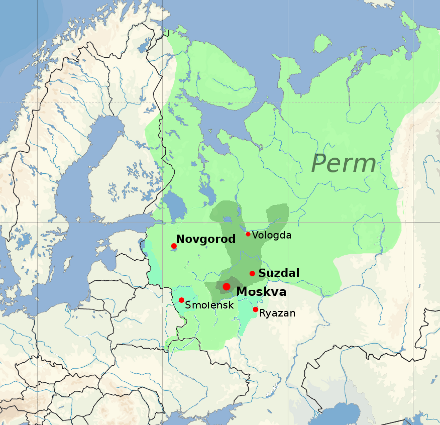
Growth of the Moscow principality from 1300 to 1462Image by Koryakov Yuri, licensed under Creative Commons Attribution-Share Alike 3.0

Growth of the Moscow principality from 1300 to 1462

Eastern Europe at the time of Ivan III's death in 1505Image by Николаев В.В, licensed under Creative Commons Attribution-Share Alike 4.0

Eastern Europe at the time of Ivan III's death in 1505

The Dormition Cathedral in the Moscow KremlinImage by Skif-Kerch, licensed under Creative Commons Attribution-Share Alike 4.0

The Dormition Cathedral in the Moscow Kremlin

The 1488 Hungarian legation in the court of Ivan III, early 16th century

The 1488 Hungarian legation in the court of Ivan III, early 16th century

Photos of Grand Principality Of Moscow
The Moscow Kremlin under Ivan Kalita, painting by Apollinary Vasnetsov, 1921

The Moscow Kremlin under Ivan Kalita, painting by Apollinary Vasnetsov, 1921

Ivan I and Simeon, frescoes of the Archangel Cathedral, 1652–1666

Ivan I and Simeon, frescoes of the Archangel Cathedral, 1652–1666

Dmitry Donskoy in the Battle of Kulikovo, painting by Adolphe Yvon, 1849

Dmitry Donskoy in the Battle of Kulikovo, painting by Adolphe Yvon, 1849

Sergius of Radonezh blessing Alexander Peresvet before the Battle of Kulikovo, miniature from the Illustrated Chronicle of Ivan the Terrible

Sergius of Radonezh blessing Alexander Peresvet before the Battle of Kulikovo, miniature from the Illustrated Chronicle of Ivan the Terrible

Growth of the Moscow principality from 1300 to 1462Image by Koryakov Yuri, licensed under Creative Commons Attribution-Share Alike 3.0

Growth of the Moscow principality from 1300 to 1462

Eastern Europe at the time of Ivan III's death in 1505Image by Николаев В.В, licensed under Creative Commons Attribution-Share Alike 4.0

Eastern Europe at the time of Ivan III's death in 1505

The Dormition Cathedral in the Moscow KremlinImage by Skif-Kerch, licensed under Creative Commons Attribution-Share Alike 4.0

The Dormition Cathedral in the Moscow Kremlin

The 1488 Hungarian legation in the court of Ivan III, early 16th century

The 1488 Hungarian legation in the court of Ivan III, early 16th century

Economic Development

The Grand Principality of Moscow had a flourishing economy! 🏦The main sources of income were agriculture, trade, and taxes. People grew crops like wheat, rye, and barley, and raised animals like cows and sheep. 🐑Moscow was also a center for trade, where merchants exchanged goods for cloth, spices, and tools from other lands. The princes would collect taxes from the towns to support their armies and build roads. 🛣️ This helped everyone travel and trade more easily. With a growing economy, Moscow became richer and more powerful, attracting people from different regions to come and live there!

Legacy And Influence

The Grand Principality of Moscow has left a huge mark on Russian history! 🎉It played a key role in turning Russia into a powerful country. The ideas of strong leadership developed in this period set the tone for future Tsars. The culture, art, and traditions established during this time still influence Russia today! 🎨The magnificent buildings and unique architecture from this era attract visitors and inspire artists. The concept of unity under Moscow laid the groundwork for modern Russia. Today, the history of the Grand Principality is a fascinating story of resilience, strength, and creativity! 🏰

The Rise Of Ivan Iii

Ivan III, also known as Ivan the Great, became the Grand Prince of Moscow in 1462. 👑He played a crucial role in expanding the Grand Principality. Ivan III successfully fought against the Golden Horde and ended their control over Moscow! ⚔️ He was clever and used marriage alliances to gain power over other territories. He also built strong defenses around Moscow with tall walls and towers, making it safer. 🏯Ivan III even claimed the title of Tsar, meaning "Emperor," and sought to unite all Russian lands under Moscow's rule, paving the way for a mighty Russia!

Historical Background

In the 12th century, several small principalities existed in what we now call Russia. The Grand Principality of Moscow began in 1283 when Prince Daniel, the son of Alexander Nevsky, became the ruler. 🏇Over time, princes like Ivan I and Ivan III expanded its territory and power. In 1380, a famous battle called the Battle of Kulikovo united Russians against the Golden Horde, a group of Mongol invaders. ⚔️ This battle marked the beginning of the decline of Mongol control over Russia. By the late 15th century, the Grand Principality was a major power, with its rulers claiming to be the leaders of all Russia.

Geography And Political Structure

The Grand Principality of Moscow was located in the northwest part of Russia. 🌳It was surrounded by forests, rivers, and lakes, making it an ideal place for farming and hunting. The people lived in towns, and the biggest one, of course, was Moscow! The political structure was based on a hierarchy, where the Grand Prince was the highest leader. Under the Grand Prince, there were many princes who controlled smaller territories. 🏞️ These princes collected taxes and maintained order. Towns were important as they held markets, schools, and churches, and helped the principality grow and thrive!

Relations With Neighboring States

The Grand Principality of Moscow had many neighbors, and they didn’t always get along! 🌍One important neighbor was the Grand Duchy of Lithuania, which tried to expand its territory too. The two often fought over land, with several battles taking place in the 15th century. 📅Moscow also faced threats from the Polish-Lithuanian Commonwealth. However, by uniting with other Russian regions, the Grand Principality strengthened its position. 😃Over time, Moscow began to dominate its neighbors, leading to a powerful empire known as Russia!

Cultural And Artistic Contributions

The Grand Principality of Moscow is known for its rich culture and art! 🎨During this time, the Russian Orthodox Church played a big role in people's lives. Many beautiful churches were built, like the famous St. Basil's Cathedral in Moscow, which has colorful onion domes! ⛪Artists created stunning icons that are still admired today. Music and dance were also important: people celebrated holidays with traditional songs and folk dances. 🎶Literature began to flourish, with famous works like "The Tale of the Princess Frog" being shared. These cultural contributions helped shape Russian identity and traditions.

Military Developments And Conflicts

The Grand Principality of Moscow faced many challenges from other nations and groups. ⚔️ Notably, the Mongol Empire, known as the Golden Horde, controlled much of Russia for centuries! The princes knew they needed a strong military to protect their lands. They used swords, bows, and tactics to fight battles like the famous Battle of Kulikovo in 1380. 🏇Over time, the military became better organized, and the Grand Principality managed to break free from Mongol rule! By the late 15th century, the military strength of Moscow was growing, allowing it to expand its territories and influence.

Transition To The Tsardom Of Russia

The Grand Principality of Moscow transformed into the Tsardom of Russia in the early 16th century. 🗓️ After Ivan III, his grandson Ivan IV, was crowned as the first Tsar in 1547. 👑The title "Tsar" showed that Russia was a powerful empire! This change signified a shift in leadership, with Tsars ruling not only Moscow but all of Russia. Ivan IV, also known as Ivan the Terrible, expanded the territories further and made major reforms. He established a centralized government, creating a lasting foundation that would shape Russia's future as a great nation! 🌟

Grand Principality Of Moscow Quiz

Q1
Question 1 of 10

Learn more about Grand Principality Of Moscow

Ready to create?

Make

To create a safe space for kid creators worldwide!

Create

Vibe Coding

Kids GPT

All Tools

Kibu

Resources

Worksheets

SafeTube

Blog

FAQ

Account

Pricing

Log-in

Sign-up

Data Deletion

Company

About

Community Guidelines

Privacy Policy

Terms of Service

2025, URSOR LIMITED. All rights reserved. DIY is in no way affiliated with Minecraft™, Mojang, Microsoft, Roblox™ or YouTube. LEGO® is a trademark of the LEGO® Group which does not sponsor, endorse or authorize this website or event. Made with love in San Francisco.