All Articles

Grand Piano

Grand Piano Facts For Kids

A grand piano is a large, elegant musical instrument known for its superior sound quality and is favored by professional musicians for performances.

🎨 Reading age for 6-8
Background blob
Grand Piano
Grand Piano
Facts for Kids!
Image by Gryffindor, licensed under Creative Commons Attribution-Share Alike 3.0

Do more with AI

Introduction

The grand piano is a large musical instrument that has 88 keys! 🎹It produces beautiful sounds when you press the keys. The grand piano is known for its rich tones and is often used in concerts and classical music. It comes in different sizes and is usually made of wood, giving it a shiny appearance. 🌟This instrument can be found in homes, schools, and concert halls all around the world, especially in places like Europe and North America. Did you know that the largest grand piano ever made is over 11 feet long? That’s really big! 😲

Images of Grand Piano

Photos of Grand PianoImage by Anfrx, licensed under Creative Commons Attribution-Share Alike 4.0
Range of Piano with modern extensionsImage by BFolkman, licensed under Creative Commons Attribution-Share Alike 4.0

Range of Piano with modern extensions

Gnome-mime-audio-openclipart

Gnome-mime-audio-openclipart

The 1726 Cristofori piano in the Musikinstrumenten-Museum in LeipzigImage by Opus33, licensed under Creative Commons Attribution-Share Alike 4.0

The 1726 Cristofori piano in the Musikinstrumenten-Museum in Leipzig

A grand piano by Louis Bas of Villeneuve-lès-Avignon, 1781. Earliest French grand piano known to survive; includes an inverted wrestplank and action derived from the work of Bartolomeo Cristofori (ca. 1700) with ornately decorated soundboard.

A grand piano by Louis Bas of Villeneuve-lès-Avignon, 1781. Earliest French grand piano known to survive; includes an inverted wrestplank and action derived from the work of Bartolomeo Cristofori (ca. 1700) with ornately decorated soundboard.

Duplex scaling of an 1883 Steinway Model 'A'. From lower left to upper right: main sounding length of strings, treble bridge, duplex string length, duplex bar (nickel-plated bar parallel to bridge), hitchpins, plate strut with bearing bolt, plate hole

Duplex scaling of an 1883 Steinway Model 'A'. From lower left to upper right: main sounding length of strings, treble bridge, duplex string length, duplex bar (nickel-plated bar parallel to bridge), hitchpins, plate strut with bearing bolt, plate hole

The mechanism and strings in upright pianos are perpendicular to the keys. The cover for the strings is removed for this photo.
The mechanism and strings in upright pianos are perpendicular to the keys. The cover for the strings is removed for this photo.

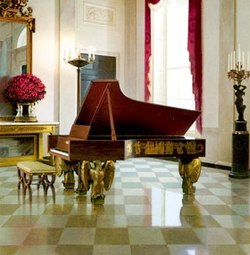
A Steinway & Sons grand piano in the White House

A Steinway & Sons grand piano in the White House

An August Förster upright pianoImage by Manuel Strehl, licensed under Creative Commons Attribution-Share Alike 2.5

An August Förster upright piano

Photos of Grand PianoImage by Anfrx, licensed under Creative Commons Attribution-Share Alike 4.0
Range of Piano with modern extensionsImage by BFolkman, licensed under Creative Commons Attribution-Share Alike 4.0

Range of Piano with modern extensions

Gnome-mime-audio-openclipart

Gnome-mime-audio-openclipart

The 1726 Cristofori piano in the Musikinstrumenten-Museum in LeipzigImage by Opus33, licensed under Creative Commons Attribution-Share Alike 4.0

The 1726 Cristofori piano in the Musikinstrumenten-Museum in Leipzig

A grand piano by Louis Bas of Villeneuve-lès-Avignon, 1781. Earliest French grand piano known to survive; includes an inverted wrestplank and action derived from the work of Bartolomeo Cristofori (ca. 1700) with ornately decorated soundboard.

A grand piano by Louis Bas of Villeneuve-lès-Avignon, 1781. Earliest French grand piano known to survive; includes an inverted wrestplank and action derived from the work of Bartolomeo Cristofori (ca. 1700) with ornately decorated soundboard.

Duplex scaling of an 1883 Steinway Model 'A'. From lower left to upper right: main sounding length of strings, treble bridge, duplex string length, duplex bar (nickel-plated bar parallel to bridge), hitchpins, plate strut with bearing bolt, plate hole

Duplex scaling of an 1883 Steinway Model 'A'. From lower left to upper right: main sounding length of strings, treble bridge, duplex string length, duplex bar (nickel-plated bar parallel to bridge), hitchpins, plate strut with bearing bolt, plate hole

The mechanism and strings in upright pianos are perpendicular to the keys. The cover for the strings is removed for this photo.

The mechanism and strings in upright pianos are perpendicular to the keys. The cover for the strings is removed for this photo.

A Steinway & Sons grand piano in the White House

A Steinway & Sons grand piano in the White House

An August Förster upright pianoImage by Manuel Strehl, licensed under Creative Commons Attribution-Share Alike 2.5

An August Förster upright piano

Photos of Grand PianoImage by Anfrx, licensed under Creative Commons Attribution-Share Alike 4.0
Range of Piano with modern extensionsImage by BFolkman, licensed under Creative Commons Attribution-Share Alike 4.0

Range of Piano with modern extensions

Gnome-mime-audio-openclipart

Gnome-mime-audio-openclipart

The 1726 Cristofori piano in the Musikinstrumenten-Museum in LeipzigImage by Opus33, licensed under Creative Commons Attribution-Share Alike 4.0

The 1726 Cristofori piano in the Musikinstrumenten-Museum in Leipzig

A grand piano by Louis Bas of Villeneuve-lès-Avignon, 1781. Earliest French grand piano known to survive; includes an inverted wrestplank and action derived from the work of Bartolomeo Cristofori (ca. 1700) with ornately decorated soundboard.

A grand piano by Louis Bas of Villeneuve-lès-Avignon, 1781. Earliest French grand piano known to survive; includes an inverted wrestplank and action derived from the work of Bartolomeo Cristofori (ca. 1700) with ornately decorated soundboard.

Duplex scaling of an 1883 Steinway Model 'A'. From lower left to upper right: main sounding length of strings, treble bridge, duplex string length, duplex bar (nickel-plated bar parallel to bridge), hitchpins, plate strut with bearing bolt, plate hole

Duplex scaling of an 1883 Steinway Model 'A'. From lower left to upper right: main sounding length of strings, treble bridge, duplex string length, duplex bar (nickel-plated bar parallel to bridge), hitchpins, plate strut with bearing bolt, plate hole

The mechanism and strings in upright pianos are perpendicular to the keys. The cover for the strings is removed for this photo.

The mechanism and strings in upright pianos are perpendicular to the keys. The cover for the strings is removed for this photo.

A Steinway & Sons grand piano in the White House

A Steinway & Sons grand piano in the White House

An August Förster upright pianoImage by Manuel Strehl, licensed under Creative Commons Attribution-Share Alike 2.5

An August Förster upright piano

Photos of Grand PianoImage by Anfrx, licensed under Creative Commons Attribution-Share Alike 4.0
Range of Piano with modern extensionsImage by BFolkman, licensed under Creative Commons Attribution-Share Alike 4.0

Range of Piano with modern extensions

Gnome-mime-audio-openclipart

Gnome-mime-audio-openclipart

The 1726 Cristofori piano in the Musikinstrumenten-Museum in LeipzigImage by Opus33, licensed under Creative Commons Attribution-Share Alike 4.0

The 1726 Cristofori piano in the Musikinstrumenten-Museum in Leipzig

A grand piano by Louis Bas of Villeneuve-lès-Avignon, 1781. Earliest French grand piano known to survive; includes an inverted wrestplank and action derived from the work of Bartolomeo Cristofori (ca. 1700) with ornately decorated soundboard.

A grand piano by Louis Bas of Villeneuve-lès-Avignon, 1781. Earliest French grand piano known to survive; includes an inverted wrestplank and action derived from the work of Bartolomeo Cristofori (ca. 1700) with ornately decorated soundboard.

Duplex scaling of an 1883 Steinway Model 'A'. From lower left to upper right: main sounding length of strings, treble bridge, duplex string length, duplex bar (nickel-plated bar parallel to bridge), hitchpins, plate strut with bearing bolt, plate hole

Duplex scaling of an 1883 Steinway Model 'A'. From lower left to upper right: main sounding length of strings, treble bridge, duplex string length, duplex bar (nickel-plated bar parallel to bridge), hitchpins, plate strut with bearing bolt, plate hole

The mechanism and strings in upright pianos are perpendicular to the keys. The cover for the strings is removed for this photo.

The mechanism and strings in upright pianos are perpendicular to the keys. The cover for the strings is removed for this photo.

A Steinway & Sons grand piano in the White House

A Steinway & Sons grand piano in the White House

An August Förster upright pianoImage by Manuel Strehl, licensed under Creative Commons Attribution-Share Alike 2.5

An August Förster upright piano

Types Of Grand Pianos

There are different types of grand pianos! The most common types include the concert grand, which is the largest and often used in orchestras, measuring over 9 feet long! 🎼Next is the semi-concert grand, which is slightly smaller but still produces great sound. The third type is the baby grand, about 5 to 6 feet long, perfect for homes. 🎉Lastly, there’s the travel grand, which is lighter and can be easily moved. Each type has its own unique sound, so musicians can choose the one that fits their music style best! 🎤

How A Grand Piano Works

When you press a key on a grand piano, a hammer inside strikes a string. 🎶The string vibrates, producing sound. This sound travels through the piano and is amplified by the soundboard. 🪕The grand piano can play different volumes depending on how hard you press the keys: soft for gentle songs and loud for energetic ones! The pedals at the base of the piano also help change the sound. The right pedal sustains the sound, making it last longer, while the left pedal softens the sound. Together, they allow musicians to express emotions through music! 😍

Famous Grand Piano Makers

Some famous grand piano makers include Steinway & Sons, Yamaha, and Bösendorfer. 🎹Steinway was founded in New York City in 1853 and is known for its high-quality pianos played by many famous musicians! 🎶Yamaha is a Japanese company that makes pianos for everyone, from beginners to professionals. Bösendorfer, from Austria, is known for its luxurious pianos that have an extra octave! Many famous composers and performers, like Elton John and Lang Lang, play on these grand pianos. When you hear their music, you can bet there’s a beautiful grand piano involved! 🎉

Anatomy Of The Grand Piano

A grand piano has many important parts! 🛠️ The main parts include the keyboard, hammers, strings, and soundboard. The keyboard is what you press to make music! The hammers strike the strings inside the piano to create sound. 🎵The strings are made of steel and need to be very tight to work properly. The soundboard helps amplify the sound, making it louder! Most grand pianos are built in a shape that resembles a triangle, which helps with sound projection. Finally, a lid can open and close, letting out even more sound! Isn’t that cool? 😃

History Of The Grand Piano

The grand piano was invented in Italy by Bartolomeo Cristofori in the year 1700. 🎶At the time, it was called the “gravicembalo col piano e forte,” which means "harpsichord with soft and loud." The piano became popular in Europe, especially in countries like Germany and France. 🎻By the late 18th century, famous composers like Mozart and Beethoven began to write music specifically for the piano! Over the years, different styles of grand pianos were developed, making them better and better for music. The first grand pianos were different from what we play today, but every grand piano has its roots in Cristofori’s invention!

Grand Piano In Music Genres

The grand piano is used in many music genres! 🎶In classical music, composers like Chopin and Bach wrote beautiful pieces for the piano. It can also be found in jazz music, where musicians like Duke Ellington played improvisational solos. 🎷In pop music, many singers have grand pianos on stage while performing, like Alicia Keys and Elton John. 🎤The grand piano is versatile, making it perfect for all styles of music! Even in movie soundtracks, you will often hear the grand piano adding magic to the scenes! This instrument really is a star! ✨

Learning To Play The Grand Piano

Learning to play the grand piano is fun and exciting! 🎵You can start by taking lessons with a teacher or learning from online videos. It’s important to practice regularly to improve your skills! 🎹You can play your favorite songs, and with time, you can even compose your own music! Many children start learning the piano as young as 5 years old. Practicing with your hands correctly will help you play faster and better. 🎶With patience and love for music, anyone can learn to make beautiful sounds on the grand piano!

Cultural Impact Of The Grand Piano

The grand piano has had a huge impact on culture and music! 🎼It has been featured in movies, TV shows, and works of art. Famous musicians and composers throughout history have played and created masterpieces using the grand piano. 🎹In classical concerts, this instrument often shines on stage, captivating audiences! The grand piano has also influenced many musical genres, making it a favorite among performers. 🎤It helps people connect emotionally through music, bringing joy and inspiration to listeners all around the world. The grand piano truly makes life more musical! 🎉

Maintenance And Care For Grand Pianos

Taking care of a grand piano is important to keep it sounding great! 🎹First, you should keep it in a temperature-controlled room, avoiding places that are too hot or too cold. Clean the keys using a soft cloth to keep them shiny! Regularly schedule a tuner to adjust the strings, making sure they sound perfect! 🛠️ It's also important to cover the piano when not in use, protecting it from dust. If you see any problems, always call a professional to fix them. By taking care of a grand piano, it can last for many years! 🕰️

Did you know?

🎹 The grand piano has a horizontal-shaped body, which allows for longer strings and better sound quality.

🎼 Grand pianos can range in length from about 4.5 feet to over 9 feet.

🎶 The first known grand piano was built in 1709 by Bartolomeo Cristofori.

✨ A grand piano typically has 88 keys, comprising 52 white keys and 36 black keys.

🎵 The action mechanism in a grand piano allows for nuanced control of sound and touch.

⚖️ A concert grand piano can weigh between 500 to 1,200 pounds, depending on its size and materials.

🪕 Pianos are classified into different types, including concert grand, baby grand, and specific models used for various genres.

🔧 The tuning of a grand piano typically requires it to be adjusted multiple times a year.

🌍 The grand piano is a staple instrument in classical music, jazz, and many other genres around the world.

🎤 Notable composers like Mozart, Beethoven, and Chopin all contributed significantly to piano music.

Grand Piano Quiz

Q1
Question 1 of 10

Learn more about Grand Piano

Ready to create?

Make

To create a safe space for kid creators worldwide!

Create

Vibe Coding

Kids GPT

All Tools

Kibu

Resources

Worksheets

SafeTube

Blog

FAQ

Account

Pricing

Log-in

Sign-up

Data Deletion

Company

About

Community Guidelines

Privacy Policy

Terms of Service

2025, URSOR LIMITED. All rights reserved. DIY is in no way affiliated with Minecraft™, Mojang, Microsoft, Roblox™ or YouTube. LEGO® is a trademark of the LEGO® Group which does not sponsor, endorse or authorize this website or event. Made with love in San Francisco.