All Articles

Gamma-ray Burst

Gamma-ray Burst Facts For Kids

Gamma-Ray Bursts (GRBs) are immensely energetic cosmic explosions occurring in distant galaxies, representing the brightest and most powerful class of explosions in the universe.
🎨 Reading age for 6-8
Background blob
Gamma-ray Burst
Facts for Kids!

Do more with AI

Introduction

Gamma-ray bursts (GRBs) are some of the most powerful explosions in the universe! 🌌These incredible events happen far away in distant galaxies, releasing enormous amounts of energy in just a few seconds. Imagine a light brighter than a billion suns! ✨GRBs can last from a few milliseconds to several minutes. Scientists first discovered them in the late 1960s while studying gamma rays, which are a type of high-energy radiation. They can help astronomers learn more about our universe and the exciting events happening in it! 🛰️

Images of Gamma-ray Burst

Positions on the sky of all gamma-ray bursts detected during the BATSE mission. The distribution is isotropic, with no concentration towards the plane of the Milky Way, which runs horizontally through the center of the image.

Positions on the sky of all gamma-ray bursts detected during the BATSE mission. The distribution is isotropic, with no concentration towards the plane of the Milky Way, which runs horizontally through the center of the image.

The Italian–Dutch satellite BeppoSAX, launched in April 1996, provided the first accurate positions of gamma-ray bursts, allowing follow-up observations and identification of the sources.
The Italian–Dutch satellite BeppoSAX, launched in April 1996, provided the first accurate positions of gamma-ray bursts, allowing follow-up observations and identification of the sources.

NASA's Swift Spacecraft launched in November 2004

NASA's Swift Spacecraft launched in November 2004

Gamma-ray burst light curves

Gamma-ray burst light curves

Hubble image of the infrared glow of a kilonova blast[63]

Hubble image of the infrared glow of a kilonova blast[63]

GRB 211106A, one of the most energetic sGRB ever registered, in the first-ever time-lapse movie of a GRB in millimeter-wavelength light, as seen by the Atacama Large Millimeter/​submillimeter Array (ALMA)[64][65][66]Image by ALMA (ESO/NAOJ/NRAO), T. Laskar (Utah), S. Dagnello (NRAO/AUI/NSF), licensed under Creative Commons Attribution-Share Alike 3.0

GRB 211106A, one of the most energetic sGRB ever registered, in the first-ever time-lapse movie of a GRB in millimeter-wavelength light, as seen by the Atacama Large Millimeter/​submillimeter Array (ALMA)[64][65][66]

Swift captured the afterglow of GRB 221009A about an hour after it was first detected reaching Earth on October 9, 2022. The bright rings form as a result of X-rays scattered from otherwise unobservable dust layers within our galaxy that lie in the direction of the burst.

Swift captured the afterglow of GRB 221009A about an hour after it was first detected reaching Earth on October 9, 2022. The bright rings form as a result of X-rays scattered from otherwise unobservable dust layers within our galaxy that lie in the direction of the burst.

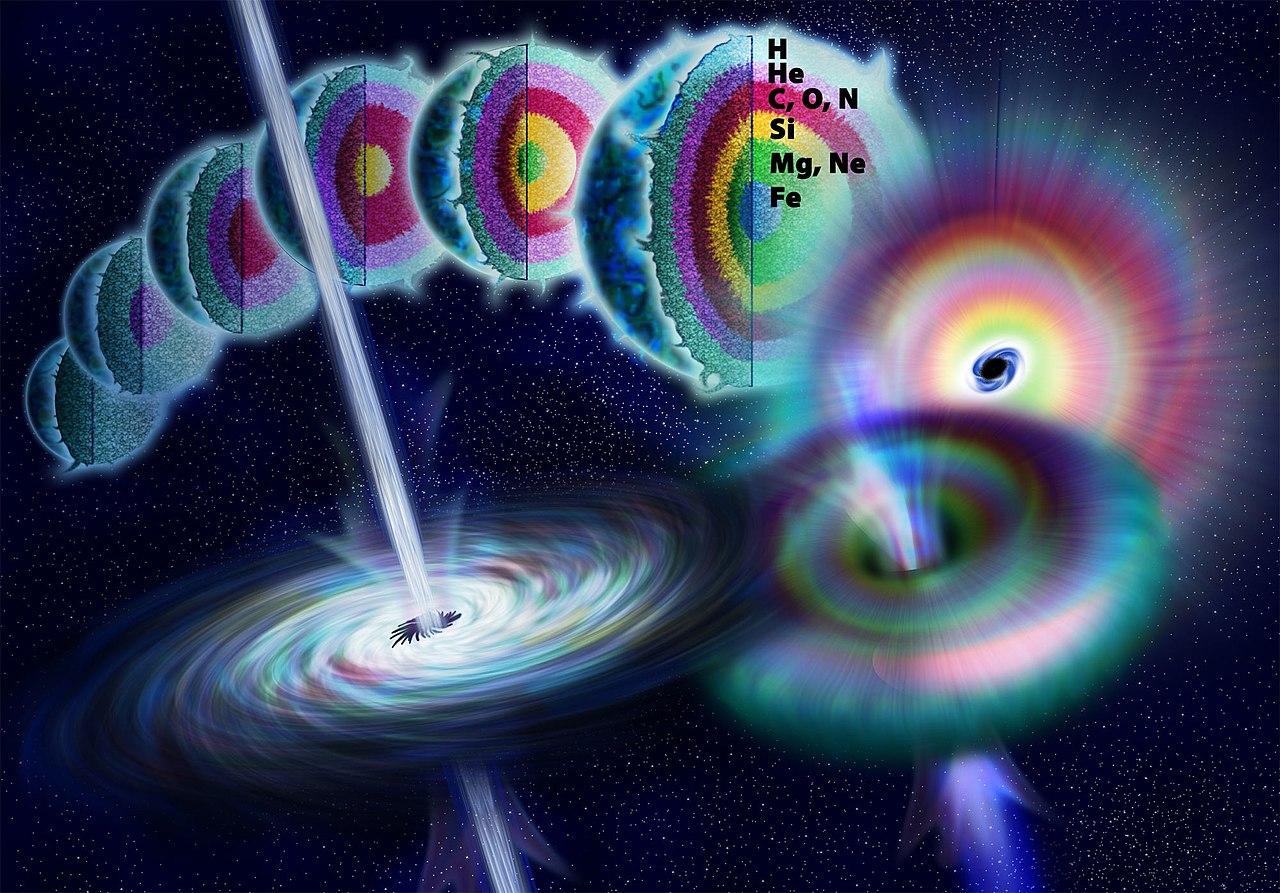
Artist's illustration of a bright gamma-ray burst occurring in a star-forming region. Energy from the explosion is beamed into two narrow, oppositely directed jets.
Artist's illustration of a bright gamma-ray burst occurring in a star-forming region. Energy from the explosion is beamed into two narrow, oppositely directed jets.

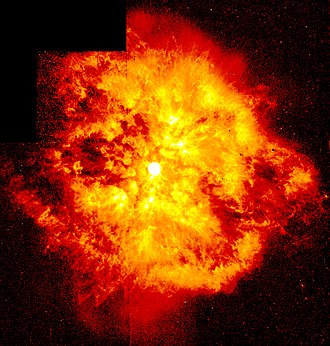
Hubble Space Telescope image of Wolf–Rayet star WR 124 and its surrounding nebula. Wolf–Rayet stars are candidates for being progenitors of long-duration GRBs.

Hubble Space Telescope image of Wolf–Rayet star WR 124 and its surrounding nebula. Wolf–Rayet stars are candidates for being progenitors of long-duration GRBs.

Types Of Gamma-ray Bursts

There are two main types of gamma-ray bursts! The first is called long GRBs, which last more than 2 seconds. 🌟These usually happen when massive stars explode in a supernova. The second type is short GRBs, lasting less than 2 seconds. They happen during events like neutron star collisions. 💥Interestingly, long GRBs happen more frequently, while short GRBs are powerful and intense but less common. Scientists study both types to understand how they form and what they can tell us about the universe!

Future Research Directions

The study of gamma-ray bursts is ongoing, and many exciting adventures lie ahead! 🌌Scientists are building new telescopes and instruments to investigate GRBs further. They want to learn more about the conditions that create these massive explosions. Some researchers are interested in discovering new types of GRBs! 🔍As technology improves, we can gather more information to understand how GRBs affect the universe. Future discoveries could reveal more about the universe's origins and its ultimate fate, sparking even more curiosity about space! 🚀

What Are Gamma-ray Bursts?

Gamma-ray bursts are super-bright flashes of gamma rays, which are high-energy particles. 🤯They occur when massive stars run out of fuel and collapse, or when two stars collide in an extraordinary event called a neutron star merger. 🌠These bursts can outshine entire galaxies for a short time! GRBs are so powerful that if one occurred close to Earth, it could have many effects, like affecting the ozone layer. Luckily, most of them happen very far away—billions of light-years from us! 🌍

Historical Events And Discoveries

The discovery of gamma-ray bursts changed our understanding of the universe! 🌌In the late 1960s, satellites were looking for nuclear test explosions when they detected strange bursts of gamma rays. This was a surprise because scientists didn’t know what they were! 📡Since then, researchers have worked hard to understand these cosmic events. One significant event was GRB 970228, which helped establish GRBs as an important part of the universe study. The incredible energy of these bursts continues to amaze scientists even today! 🚀

The Mechanism Behind Gamma-ray Bursts

Gamma-ray bursts start when a massive star runs out of fuel. 😱When this happens, the star collapses and can explode into a supernova! The core of the star forms a black hole, and in the process, it releases jets of gamma rays. These jets shoot out at nearly the speed of light! 💨The energy releases is tremendous. In the case of neutron star mergers, two dense stars spiral into each other, causing an explosion that produces gamma rays. This mechanism shows us how violent and fascinating the cosmos can be!

Gamma-ray Bursts And The Universe's Fate

Gamma-ray bursts offer clues about the fate of the universe! 🌌Some scientists think these bursts can influence star formation and the structure of galaxies. 🚀When a GRB occurs, it could affect nearby stars and planets. If they happen too close to us, they could even harm Earth's atmosphere! But don’t worry, most GRBs are far away in the cosmos. ⭐Keeping an eye on these events helps scientists predict how our universe could change over time!

The Role Of Gamma-ray Bursts In Cosmology

Gamma-ray bursts play an essential role in cosmology, which is the study of the universe! 🌌By observing these bursts, scientists learn about the universe's expansion and understand more about dark energy. ✨GRBs can also help measure distances in space! Understanding how these powerful explosions relate to the cosmos can unlock answers to big questions like how galaxies form and evolve. The study of GRBs helps build a timeline of the universe and reveals the mysteries of our cosmic home! 🌠

Detection And Observation Of Gamma-ray Bursts

Detecting gamma-ray bursts requires specialized satellites and telescopes! ☄️ NASA uses the Fermi Gamma-ray Space Telescope and the Swift satellite to catch sight of these events. When a burst happens, these tools quickly send alerts to astronomers on Earth! 🔭By studying the bursts' light and energy, scientists can learn what happened and where the burst occurred. For example, the brightest GRB ever recorded was GRB 080916C, detected in 2008! Studies like this help us understand the universe better.

Significance Of Gamma-ray Bursts In Astronomy

Gamma-ray bursts are essential for astronomers because they provide clues about the life cycle of stars! 🌟They also help us understand the formation of black holes and neutron stars. GRBs are so bright they can be seen across vast distances, giving scientists insights into early galaxies and the universe's evolution. 📈Studying these bursts helps scientists learn about the chemical makeup of the universe, including the elements formed in explosions. By understanding GRBs, researchers can unlock the secrets of how galaxies, stars, and planets develop!

Myths And Misconceptions About Gamma-ray Bursts

Many myths and misconceptions surround gamma-ray bursts! 🌌Some people think they could destroy Earth, but most GRBs happen far away! 🌍Others may believe that GRBs are related to UFOs or aliens, but they are purely cosmic events caused by star behavior. ⚡This misunderstanding can lead to fears about space. However, scientists study these powerful bursts to help us learn about the universe while ensuring we know that Earth is safe. By spreading facts, we can celebrate the incredible wonders of space! 🚀

Gamma-ray Burst Quiz

Q1
Question 1 of 10

Learn more about Gamma-ray Burst

Ready to create?

Drop Files here
Make

To create a safe space for kid creators worldwide!

Create

Vibe Coding

Kids GPT

All Tools

Kibu

Resources

Worksheets

SafeTube

Blog

FAQ

Account

Pricing

Log-in

Sign-up

Data Deletion

Company

About

Community Guidelines

Privacy Policy

Terms of Service

2025, URSOR LIMITED. All rights reserved. DIY is in no way affiliated with Minecraft™, Mojang, Microsoft, Roblox™ or YouTube. LEGO® is a trademark of the LEGO® Group which does not sponsor, endorse or authorize this website or event. Made with love in San Francisco.