Fullerene Facts For Kids
A fullerene is an allotrope of carbon whose molecules consist of carbon atoms connected by single and double bonds to form closed shapes with fused rings of five to six atoms.
Select reading age

Fullerene Facts For Kids
Videos & Quizzesincluded
About this topic
Fullerenes are special shapes made of carbon atoms! 🥳They can look like balls, tubes, or even stars! The most famous fullerene is called Buckminsterfullerene, which looks like a soccer ball! ⚽It was discovered in 1985 by scientists Robert Curl, Harold Kroto, and Richard Smalley. Fullerenes are also known as "buckyballs" or "bucky tubes." They are tiny but powerful and can be found in places like outer space and in special materials we make on Earth.
Explore with ChatDinoKey Points
Scientists create fullerenes in a lab!
There are different types of fullerenes!
Fullerenes have exciting uses in medicine!
Fullerenes have amazing properties!
Fullerenes have a unique arrangement!
Scientists are always researching more about fullerenes!
Fullerenes are not just for science; they're also found in art and culture!
Fullerenes have both positive and negative effects on the environment🌎.
In nanotechnology, fullerenes play a big role!
Photos of Fullerene

Ball-and-stick model of the C20 fullerene.

Space-filling model of a carbon nanotube.

C60 fullerite (bulk solid C60).

C60-rods

The icosahedral fullerene C540, another member of the family of fullerenes

C60 with isosurface of ground state electron density as calculated with density functional theory (DFT)

Rotating view of C60, one kind of fullerene

C70 has 10 additional atoms (shown in red) added to C60 and a hemisphere rotated to fit
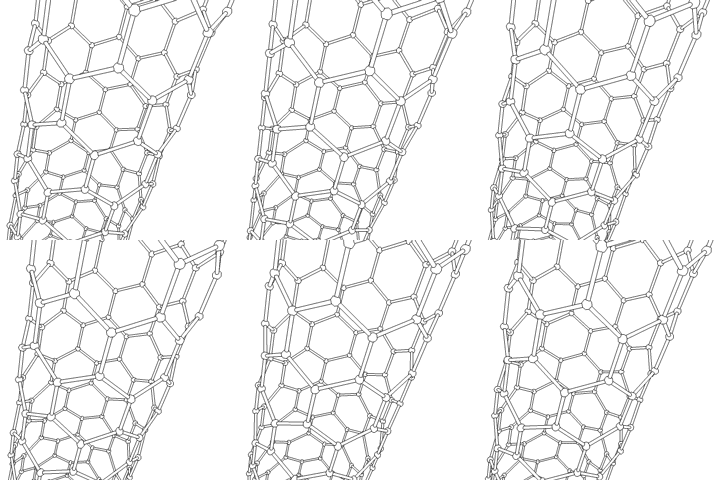
This rotating model of a carbon nanotube shows its 3D structure.
🧪 Synthesis Methods
Scientists create fullerenes in a lab! 🧪One method involves heating carbon in a controlled environment. Researchers can make a spark between two carbon electrodes, which creates tiny fullerene particles! Another way is using lasers to vaporize carbon. ☄️ These methods help produce various fullerenes that can then be studied and used in different fields, like medicine and technology. Making fullerenes is like cooking a delicious recipe, requiring the right ingredients and steps!
Go deeper🤓 Types Of Fullerenes
There are different types of fullerenes! The most popular ones are C60, C70, C76, and C84. 🤓C60 is the famous "buckyball," while C70 looks like an oval. Each type has a different number of carbon atoms! C76 and C84 are less known but have interesting structures too. There are also carbon nanotubes, which are long, thin tubes made of carbon. 🌟Each type of fullerene has different properties and uses, making them very exciting in science!
Go deeper💊 Applications In Medicine
Fullerenes have exciting uses in medicine! 💊They can deliver medicines directly to cells, helping treat diseases like cancer. Fullerenes can also help in imaging, making it easier to see inside our bodies using special machines. 📸They are being researched for their ability to fight viruses and bacteria. Their unique properties allow medical scientists to explore new treatment options for different illnesses. Fullerenes could change the future of healthcare! 🌟
Go deeper💪 Properties Of Fullerenes
Fullerenes have amazing properties! 💪They are super strong, yet lightweight, making them unique in materials science. They can conduct electricity and even act like tiny magnets! Some fullerenes can absorb light, making them useful in devices like solar panels. ☀️ Additionally, they can trap other molecules inside them, which is helpful in medicine and engineering! Their unique structure allows them to behave differently than other forms of carbon, like graphite or diamond.
Go deeper🧊 Structure And Composition
Fullerenes have a unique arrangement! They are made up of carbon atoms, which bond together to form shapes like spheres or cylindrical tubes. 🧊Imagine a beehive or a soccer ball! Each carbon atom connects to three others, creating strong bonds. This pattern makes the fullerene strong and stable. Buckminsterfullerene has 60 carbon atoms arranged in a shape that resembles a globe. 🌍There are also other fullerenes with different numbers of carbon atoms, like C70, which looks like an elongated ball.
Go deeper🔍 Future Research Directions
Scientists are always researching more about fullerenes! 🔍They want to discover new ways to use them in medicine, electronics, and materials. Researchers are also exploring how fullerenes can help with clean energy solutions to protect the environment! 🌱There is excitement about using fullerenes in future technologies like quantum computers. As scientists uncover more possibilities, fullerenes are sure to be a big part of our exciting future. 🛸Who knows what they will invent next?
Go deeper🎨 Fullerenes In Art And Culture
Fullerenes are not just for science; they're also found in art and culture! 🎨Artists use the unique shapes of fullerenes as inspiration for sculptures and designs. Some musicians even use the term "fullerene" in songs to represent new ideas! 🎶Fullerenes can remind us of the beauty of science and how it connects to everything, including our creativity. They have made their way into books, videos, and even toys, showing their influence on the world around us!
Go deeper🌎 Environmental Impact And Challenges
Fullerenes have both positive and negative effects on the environment🌎. They can help clean pollution by breaking down harmful substances. However, releasing too many fullerenes into nature can be harmful to living things. Some studies suggest that fullerenes might interfere with ecosystems. 🌱Scientists are working hard to find safe and eco-friendly ways to use fullerenes while minimizing their impact on the environment. It's important to protect our planet while enjoying these scientific innovations!
Go deeper🤖 Nanotechnology And Materials Science
In nanotechnology, fullerenes play a big role! 🤖They are tiny, making them useful in building super-small machines called nanomachines. Fullerenes can strengthen materials in sports equipment, like tennis rackets and bicycles! 🚴♂️ They are also used in making better batteries and screens for devices. Scientists are experimenting with fullerenes to create new materials that are lighter yet stronger. The potential is huge, and researchers are excited about what they will discover next!
Go deeper