Eurasian Spoonbill Facts For Kids
The Eurasian spoonbill is a striking wading bird known for its distinct spoon-shaped bill, elegant white plumage, and social behavior, thriving in wetlands across Europe, Africa, and Asia.
Select reading age

Eurasian Spoonbill Facts For Kids
Videos & Quizzesincluded
About this topic
The Eurasian Spoonbill 🥄 is a cool wading bird found in Europe, Africa, and Asia! This bird gets its name from its unique spoon-shaped bill, which is perfect for catching food in shallow waters. Spoonbills are usually white with long legs and a graceful neck. You can see them in wetlands, lakes, and mudflats, where they usually hunt for fish, frogs, and crustaceans. These birds are social creatures and often live in groups called colonies! 🌊Their population is stable, making them a happy sight for bird watchers everywhere!
Explore with ChatDinoKey Points
The scientific name of the Eurasian Spoonbill is Platalea leucorodia.
The Eurasian Spoonbill is related to several other spoonbill species worldwide.
Did you know that the Eurasian Spoonbill can live for over 20 years in the wild?
Eurasian Spoonbills are migratory birds!
The Eurasian Spoonbill 🥄 is currently listed as a species of "Least Concern" by the International Union for Conservation of Nature (IUCN).
Eurasian Spoonbills are expert foragers!
During breeding season, Eurasian Spoonbills build their nests in colonies.
In many cultures, the Eurasian Spoonbill is a symbol of grace and beauty.
Eurasian Spoonbills 🦩 love wet places!
Eurasian Spoonbills are easily recognized by their long, flat, and spoon-shaped bills, which can be up to 12 inches long!
Photos of Eurasian Spoonbill

In breeding plumage, Spain

Migrant breeding in Ranganathittu, south India

Museum specimen - île Kiji, Mauritania

Eurasian Spoonbill — photo 4

Eurasian Spoonbill — photo 5
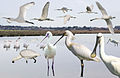
Eurasian Spoonbill — photo 6
🤓 Taxonomy
The scientific name of the Eurasian Spoonbill is Platalea leucorodia. It belongs to the family Threskiornithidae, which includes other fascinating birds like ibises and spoonbills. This bird is part of the order Pelecaniformes, which means "pelican-like" birds! This family has about 10 different species of spoonbills spread across the globe. In total, there are around 20 species in the Threskiornithidae family, making it a diverse group! 🤓Each of these species has its unique features and habitats.
Go deeper🌍 Related Species
The Eurasian Spoonbill is related to several other spoonbill species worldwide. 🌍One notable cousin is the Roseate Spoonbill, which has beautiful pink feathers! Another relative is the African Spoonbill, found in sub-Saharan Africa. Each species has similarities but also distinct differences in appearance and habitat. For example, the Australian Spoonbill has a brownish tinge to its feathers. These related species help make the family Threskiornithidae exciting and diverse! 🦩
Go deeper🥳 Interesting Facts
Did you know that the Eurasian Spoonbill can live for over 20 years in the wild? 🥳They also have a unique courtship dance, where they perform synchronized movements with their partners during breeding season! These birds can be very social, often forming large colonies of hundreds of birds. Eurasian Spoonbills can be seen standing on one leg while they rest, just like flamingos! Lastly, their spoon-shaped bills are specially designed; they can feel vibrations in the water, helping them detect fish even with their eyes closed! 🌊
Go deeper🗺️ Migration Patterns
Eurasian Spoonbills are migratory birds! 🗺️ In the spring, they travel from their winter homes in Africa to their breeding grounds in Europe and Asia. They usually fly in large flocks, which can look very beautiful in the sky! Their migration can be over 2,000 kilometers (about 1,200 miles) in some cases! In the autumn, they return to warmer areas to escape the cold winters. These journeys are important for their survival, as they help find better feeding and nesting locations! 🌍
Go deeper🥄 Conservation Status
The Eurasian Spoonbill 🥄 is currently listed as a species of "Least Concern" by the International Union for Conservation of Nature (IUCN). This means that their population is stable, and they are not in immediate danger. However, habitat loss due to pollution and human activities can affect their numbers. Protecting wetlands is essential for their survival! Organizations around the world work hard to ensure these beautiful birds can thrive and be enjoyed by future generations. 🌿🌼
Go deeper🐟 Behavior And Feeding
Eurasian Spoonbills are expert foragers! They use their unique spoon-shaped bills to sweep through the water, feeling for food like fish, shrimp, and insects. 🐟They often hunt in shallow waters at dawn and dusk. Spoonbills are social animals and can be seen feeding in groups, which helps them catch more food! They also have a special way of communicating; they make soft grunting sounds to talk to each other. When it’s time to eat, they carefully stir up the mud to find tasty treats! 🤤
Go deeper🌿 Breeding And Nesting
During breeding season, Eurasian Spoonbills build their nests in colonies. 🌿The nests are usually made of reeds and twigs and are often found in tall trees or on the ground. Females lay about 2 to 6 eggs that are pale blue in color. Both parents take care of the eggs and help the chicks after they hatch. 🐣The young chicks are covered in soft down feathers and can leave the nest after just a few weeks, although they continue to rely on their parents for food for a while longer.
Go deeper🦢 Cultural Significance
In many cultures, the Eurasian Spoonbill is a symbol of grace and beauty. 🦢They appear in folklore, paintings, and even in mythology. In ancient Egypt, ibises and their relatives were considered sacred birds, representing wisdom and knowledge. Spoonbills are also popular among bird watchers and nature enthusiasts, making them important for eco-tourism! Their striking appearance and interesting behaviors make them a subject of fascination for people of all ages! 🎨
Go deeper🦩 Habitat And Distribution
Eurasian Spoonbills 🦩 love wet places! They can be found in countries like Spain, France, and India. They prefer wetlands and lagoons, which provide lots of food. During the winter months, they move south to warmer areas, where the waters don’t freeze. Some can be seen in Africa's beautiful wetlands! These birds enjoy staying near shallow waters where they can easily find fish and other delicious meals. 📍They are very adaptable and can live in both natural and man-made wetlands!
Go deeper🦵 Physical Characteristics
Eurasian Spoonbills are easily recognized by their long, flat, and spoon-shaped bills, which can be up to 12 inches long! Their bodies are mostly white, with black wing tips and legs. 🦵They also have a long, curvy neck that helps them reach into the water. Adult spoonbills can grow to around 70-80 cm (27-31 inches) in length. Their wingspan is impressive, measuring about 120-150 cm (47-59 inches)! They have beautiful feathers that glisten in the sunlight, making them quite stunning! ☀️
Go deeper