Espanyol Facts For Kids
RCD Espanyol is a professional football club based in Barcelona, Spain, known for its rich history and passionate fanbase.
Select reading age

Espanyol Facts For Kids
Videos & Quizzesincluded
About this topic
Espanyol, officially known as RCD Espanyol de Barcelona, is a famous football club 🥅 from Spain! Founded in 1900, it plays in the city of Barcelona. The team's colors are blue and white, which are seen on their jerseys and flags. Their home ground is the RCDE Stadium, which can hold over 40,000 fans! 🎉This club has a long history and is loved by many people. Espanyol has had great moments in Spanish football, winning the Copa del Rey trophy multiple times. ⚽Espanyol means "Spanish" in English, and it's a team with a strong spirit!
Explore with ChatDinoKey Points
Espanyol (RCD Espanyol de Barcelona) es un equipo de fútbol muy famoso en España.
Spanish culture has influenced the world in many ways!
Here are some common words in Spanish that you can learn!
Spanish grammar is a little different from English!
The Spanish language is one of the most spoken languages in the world!
Spanish has many dialects and variations!
Learning Spanish can be super fun!
Spanish literature is filled with amazing stories!
Spanish has influenced many languages around the world!
Photos of Espanyol

First shield of Club Español de Fútbol
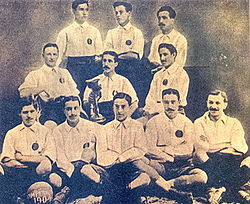
Espanyol — photo 2

Espanyol — photo 3

Ricardo Zamora with Español

Chart of RCD Espanyol league performance 1929–present

Iván Alonso in action during a La Liga fixture in August 2009

Estadi de Sarrià

Espanyol — photo 8

⚽ Español Overview
Espanyol (RCD Espanyol de Barcelona) es un equipo de fútbol muy famoso en España. ⚽Se fundó en el año 1900 y se encuentra en Barcelona, una ciudad conocida por su cultura y arte. Los colores del equipo son azul y blanco. El estadio donde juegan se llama RCDE Stadium, y puede albergar a más de 40,000 aficionados. 🎉A lo largo de la historia, Espanyol ha ganado varios trofeos, incluyendo la Copa del Rey. Es un equipo que representa a muchos seguidores y siempre da lo mejor en el campo. 🥇¡Cada partido es una gran fiesta para los hinchas!
Go deeper🎭 Spanish In Global Culture
Spanish culture has influenced the world in many ways! 🎭Flamenco, a beautiful dance from Spain, is celebrated worldwide. In music, famous artists like Shakira and Juanes sing in Spanish, bringing joy to millions. 🎶In movies, Spanish films like "Pan's Labyrinth" have won awards and praise for their storytelling. The annual Feria de Abril in Seville showcases amazing food and traditional dress. 🍽️ Spanish is also the second most-spoken language in the USA! Learning about Spanish culture helps us understand different perspectives and appreciate diversity in our world. 🌎
Go deeper📝 Common Vocabulary In Español
Here are some common words in Spanish that you can learn! 📝"Hola" means "hello," "gracias" means "thank you," and "adiós" means "goodbye." For colors, "rojo" means "red," "azul" is "blue," and "verde" is "green." 🌈 You can also learn important phrases like "¿Cómo estás?" (How are you?), and "Me gusta" (I like it). These words and phrases are great for starting conversations! Speaking Spanish opens up new friendships and ways to communicate. 🤝Don't be afraid to practice—every time you speak, you get better!
Go deeper🤓 Grammar And Syntax In Spanish
Spanish grammar is a little different from English! 🤓In Spanish, nouns have genders; they can be masculine or feminine. For example, "el libro" (the book) is masculine, while "la mesa" (the table) is feminine. 🇪🇸 Verbs change based on who is doing the action. Regular verbs follow patterns, like "hablar" (to speak) becoming "hablo" (I speak) or "hablas" (you speak). ✏️ Also, adjectives usually come after nouns, like "casa blanca" (white house). Learning Spanish grammar might take time, but it's a fun puzzle to solve!
Go deeper🌍 History Of The Spanish Language
The Spanish language is one of the most spoken languages in the world! 🌍It originated in the Iberian Peninsula and has roots in Latin, just like Italian and French. Spanish is an official language in 20 countries, including Mexico 🇲🇽, Spain 🇪🇸, and Argentina 🇦🇷. It evolved over the centuries, influenced by Arabic, local languages, and even indigenous tongues. The first Spanish dictionary was published in 1780! 📖Many people love to learn Spanish because it is fun and very useful for traveling or communicating with friends from different countries.
Go deeper🎤 Dialects And Variations Of Spanish
Spanish has many dialects and variations! 🎤In Spain, you can find Castilian, Catalan, and Galician. In Latin America, there are unique accents in countries like Argentina, where people say "vos" instead of "tú." 🎉 Each region has special words and phrases, making Spanish colorful! For example, in Mexico, "popote" means "straw," while in Spain, it's called "pajita." 🍹 In total, there are over 500 million Spanish speakers worldwide, each bringing their own style and flair to the language. Learning about these variations is exciting!
Go deeper🎉 Learning Spanish: Tips And Resources
Learning Spanish can be super fun! 🎉Here are some tips: Start with simple phrases and words. Use apps like Duolingo or Memrise to practice every day. You can also watch cartoons or movies in Spanish to hear how it sounds! 📺Reading bilingual books will help you learn vocabulary while enjoying stories. Try speaking with friends or family who know Spanish; practice makes perfect! Don't be afraid to make mistakes—they're part of learning! 🌟Remember, being patient and consistent will help you become a confident Spanish speaker.
Go deeper📚 Spanish Literature And Notable Authors
Spanish literature is filled with amazing stories! 📚One famous author is Miguel de Cervantes, who wrote "Don Quixote," a book about a man on adventures. Another important writer is Gabriel García Márquez, known for his magical realism in books like "One Hundred Years of Solitude." ✨ Both authors have inspired readers around the world. Spanish poetry is beautiful too! Poets like Pablo Neruda created powerful verses. Learning about these authors helps us appreciate art and creativity in the Spanish language. Their works are treasures of literature! 💖
Go deeper🌍 The Influence Of Spanish On Other Languages
Spanish has influenced many languages around the world! 🌍When people moved to the Americas, Spanish mixed with indigenous languages, creating new words in places like Mexico and the Philippines. For example, "coyote" comes from the Nahuatl language, spoken by the Aztecs. 🐾English also borrowed words like "fiesta" (party) and "patio" (backyard) from Spanish! Some languages, like Tagalog in the Philippines, have a lot of Spanish words. It's exciting to explore how languages connect us and how learning one language can help us understand others better! ✨
Go deeper