Edward Burnett Tylor Facts For Kids
Edward Burnett Tylor was an English anthropologist who laid important foundations for understanding human culture and is often referred to as one of the founding fathers of anthropology.
Select reading age
Edward Burnett Tylor Facts For Kids
Videos & Quizzesincluded
About this topic
Edward Burnett Tylor was a famous English anthropologist! 🎩Born on October 2, 1832, in a town called Bedford, he studied how people live and work around the world. Tylor is often called one of the founders of anthropology, a word that means the study of humans! 🌍He loved learning about different cultures and how they developed over time. Tylor passed away on January 2, 1917, but his ideas still help us understand the world today! His work teaches us that every culture is special and important in its own way.
Explore with ChatDinoKey Points
When Tylor wrote "Primitive Culture," he explored what he called "primitive" societies.
Tylor introduced the idea of cultural evolution, which explains how cultures change over time!
Cultural anthropology is the study of how different groups of people live, think, and behave.
Tylor conducted fieldwork, which means he spent time with different cultures to learn directly from them.
Tylor grew up in England, where he loved reading books about world cultures.
Tylor became a professor of anthropology in the 1870s, which means he taught people all about different cultures.
Edward Burnett Tylor left a lasting legacy in anthropology!
Tylor had a big impact on many other anthropologists who came after him!
Tylor believed that culture includes everything people do—how they eat, dress, and even talk!
Photos of Edward Burnett Tylor

queue - people standing in line

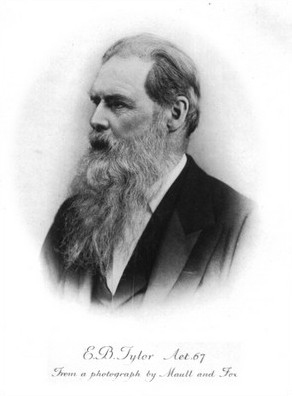
One of the last portraits of the aged Tylor; from Folk-Lore, 1917.

Herbert Spencer
🌳 Primitive Culture
When Tylor wrote "Primitive Culture," he explored what he called "primitive" societies. 🌳He didn’t mean they were less important; instead, he meant that they were early forms of culture. Tylor studied tribes and communities that lived without modern technology. He believed that by studying these cultures, we could learn about how human societies developed. 🌻He also looked at practices like magic and religion, showing that these beliefs have helped shape cultures throughout history. Tylor taught people to respect all cultures, no matter how different they seemed, emphasizing their importance in the human journey.
Go deeper🌱 Evolutionary Theory
Tylor introduced the idea of cultural evolution, which explains how cultures change over time! 🌱He believed societies evolve just like plants grow. He identified three stages of culture: savagery, barbarism, and civilization. Tylor thought that societies start off simple and become more complex as time goes on. 🏛️ Though this idea was popular during his time, it is important to remember that cultures don't follow the same path; they are unique! Tylor’s theories helped others think about culture as something that can develop and grow, inviting more exploration of cultural changes throughout history.
Go deeper👫 Cultural Anthropology
Cultural anthropology is the study of how different groups of people live, think, and behave. 👫Tylor's work focused on this subject and helped create the field! He believed that understanding other cultures can teach us about our own lives. He said that culture is "that complex whole" of knowledge, beliefs, and customs that is learned and shared. Tylor studied ceremonies, languages, and tools from various cultures, leading to a deeper understanding of human behavior. 📖His observations made it easy for everyone to appreciate the different ways people live worldwide.
Go deeper🏕️ Fieldwork And Methods
Tylor conducted fieldwork, which means he spent time with different cultures to learn directly from them. 🏕️ He traveled to places like Mexico and studied the customs and practices of various Indigenous peoples. Tylor believed in using observation and gathering information as methods to understand cultures deeply. 📊He wrote about his experiences, sharing what he learned about languages, tools, and practices. His fieldwork helped demonstrate that experiencing a culture firsthand is essential for truly understanding it. Tylor's love for exploration taught future anthropologists the value of hands-on learning!
Go deeper📚 Early Life And Education
Tylor grew up in England, where he loved reading books about world cultures. 📚He was curious and wanted to know everything about other people’s ways of life. Tylor didn't go to school like most kids; instead, he took interest in self-study. At 18, he traveled to Mexico, where he saw different cultures and people. 🌎This experience made him realize how exciting anthropology could be! He later studied at Oxford University, where he met other thinkers and learned about science and society. Tylor's early adventures showed him that every culture had unique stories and traditions.
Go deeper🎓 Career And Major Contributions
Tylor became a professor of anthropology in the 1870s, which means he taught people all about different cultures. 🎓One of his most important books is called "Primitive Culture," published in 1871. In this book, he explained how cultures change and grow over time! Tylor introduced the idea of "cultural evolution," saying that all societies develop in different ways. He studied things like religion, art, and rituals and discovered that many cultures share similar ideas even if they are far apart. 🌐Tylor's work helped many people understand the unity in our diverse world.
Go deeper🌈 Legacy And Impact On Anthropology
Edward Burnett Tylor left a lasting legacy in anthropology! 🌈His ideas about cultural evolution and understanding cultures have inspired countless researchers and students around the world. He showed that every culture has its own unique story and that these stories matter. 🌎Tylor's work encourages people to be curious and respectful of diverse ways of life. Because of him, many modern anthropologists now study cultures with care, focusing on their beauty and traditions. Tylor's influence can still be seen today, reminding us how rich and colorful humanity's tapestry is!
Go deeper🌟 Influence On Later Anthropologists
Tylor had a big impact on many other anthropologists who came after him! 🌟Some of these scholars expanded on Tylor's ideas. For example, Franz Boas, often called the "Father of American Anthropology," challenged Tylor’s ideas on cultural evolution. Tylor's emphasis on understanding cultures shaped how future anthropologists think about their own studies. 🔍They learned the importance of respecting and valuing different cultures in their work. Today, many anthropologists continue to build on Tylor's lessons, exploring new ways to understand the world and the people in it!
Go deeper🍜 Tylor's Concepts Of Culture And Religion
Tylor believed that culture includes everything people do—how they eat, dress, and even talk! 🍜He studied religion and believed that it was incredibly important to understanding how cultures work. Tylor introduced the idea of animism, which is the belief that everything, even animals and plants, have spirits. 🐻He thought that animism was one of the earliest forms of religion. By learning about these beliefs, we can see how people connect to their world. Tylor's concepts help us understand the role that religion played in forming different cultures throughout history!
Go deeper