All Articles

Cyclotron

Cyclotron Facts For Kids

A cyclotron is a special machine invented by Ernest O. Lawrence that accelerates charged particles to high speeds, used in medical and scientific applications.

🎨 Reading age for 6-8
Background blob
Cyclotron
Cyclotron
Facts for Kids!

Do more with AI

Introduction

A cyclotron is a special machine that helps scientists speed up tiny particles called atoms! 💨It was invented by a smart man named Ernest Lawrence in 1929 at the University of California, Berkeley. The cyclotron lets us study the building blocks of everything—like medicine and elements in space! 🌌Scientists use it to create new materials and even treat illnesses. With a cyclotron, we can launch particles at super-fast speeds, exploring the secrets of the universe! 🌟

Images of Cyclotron

Lawrence's original 4.5-inch (11 cm) cyclotron

Lawrence's original 4.5-inch (11 cm) cyclotron

Lawrence's 60-inch (150 cm) cyclotron at Lawrence Radiation Laboratory, University of California, Berkeley, California, constructed in 1939. The magnet is on the left, with the vacuum chamber between its pole pieces, and the beamline which analyzed the particles is on the right.

Lawrence's 60-inch (150 cm) cyclotron at Lawrence Radiation Laboratory, University of California, Berkeley, California, constructed in 1939. The magnet is on the left, with the vacuum chamber between its pole pieces, and the beamline which analyzed the particles is on the right.

Diagram of a cyclotron. The magnet's pole pieces are shown smaller than in reality; they must actually be at least as wide as the accelerating electrodes ("dees") to create a uniform field.

Diagram of a cyclotron. The magnet's pole pieces are shown smaller than in reality; they must actually be at least as wide as the accelerating electrodes ("dees") to create a uniform field.

Diagram of cyclotron operation from Lawrence's 1934 patent. The hollow, open-faced D-shaped electrodes (left), known as dees, are enclosed in a flat vacuum chamber which is installed in a narrow gap between the two poles of a large magnet (right).

Diagram of cyclotron operation from Lawrence's 1934 patent. The hollow, open-faced D-shaped electrodes (left), known as dees, are enclosed in a flat vacuum chamber which is installed in a narrow gap between the two poles of a large magnet (right).

Vacuum chamber of Lawrence 69 cm (27 in) 1932 cyclotron with cover removed, showing the dees. The 13,000 V RF accelerating potential at about 27 MHz is applied to the dees by the two feedlines visible at top right. The beam emerges from the dees and strikes the target in the chamber at bottom.
Vacuum chamber of Lawrence 69 cm (27 in) 1932 cyclotron with cover removed, showing the dees. The 13,000 V RF accelerating potential at about 27 MHz is applied to the dees by the two feedlines visible at top right. The beam emerges from the dees and strikes the target in the chamber at bottom.

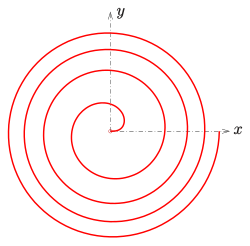
The trajectory followed by a particle in the cyclotron approximated with a Fermat's spiralImage by Ag2gaeh, licensed under Creative Commons Attribution-Share Alike 4.0

The trajectory followed by a particle in the cyclotron approximated with a Fermat's spiral

In isochronous cyclotrons, the magnetic field strength B as a function of the radius r has the same shape as the Lorentz factor γ as a function of the speed v.

In isochronous cyclotrons, the magnetic field strength B as a function of the radius r has the same shape as the Lorentz factor γ as a function of the speed v.

A French cyclotron, produced in Zürich, Switzerland in 1937. The vacuum chamber containing the dees (at left) has been removed from the magnet (red, at right).Image by Edal, licensed under Creative Commons Attribution-Share Alike 3.0

A French cyclotron, produced in Zürich, Switzerland in 1937. The vacuum chamber containing the dees (at left) has been removed from the magnet (red, at right).

A modern cyclotron used for radiation therapy. The magnet yoke is painted yellow.Image by Ikiwaner, licensed under Creative Commons Attribution-Share Alike 3.0

A modern cyclotron used for radiation therapy. The magnet yoke is painted yellow.

Types Of Cyclotrons

There are different kinds of cyclotrons! 🌈The most common ones are called “standard cyclotrons,” which help scientists study particles. Then there's the “sector-focused cyclotron,” which uses magnetic sectors to better control particles’ paths. ⚙️ Superconducting cyclotrons are super cool; they have powerful magnets and can accelerate particles even faster! 🌠Other types include isochronous cyclotrons and microtron cyclotrons. Each type serves unique purposes in research and medicine, helping scientists push the boundaries of what we can discover!

How A Cyclotron Works

Have you ever seen a race car zoom around a track? 🏎️ A cyclotron works a bit like that! Inside the cyclotron, particles move in circular paths due to a magnetic field. It uses electricity to make particles speed up and go faster and faster! ⚡️ The cyclotron has two flat, spiral-shaped metal plates (called dees) that help push the particles along. As they spiral outward, they gain energy and exit the cyclotron to smash into other particles. This helps scientists discover what these particles are made of and find new things in science! ❗️

History Of The Cyclotron

Ernest O. Lawrence and his team built the first cyclotron in 1929. 🏗️ They wanted to learn more about atoms and how they work. The cyclotron was patented in 1932, allowing others to build similar machines. As time passed, cyclotrons became essential tools for scientists! In 1937, Lawrence won the Nobel Prize in Physics for his fantastic invention. 🏆Since then, many new developments have taken place, leading to improvements that help us understand the universe better and advance medicine, making Lawrence a true pioneer!

Components Of A Cyclotron

A cyclotron has several important parts! ⚙️ First, there's the ion source that produces charged particles. Then, the two dees help the particles gain energy and spiral outward! Other components include the magnetic field, which keeps particles in a circular path and a vacuum chamber to keep air away, allowing particles to move freely. 🔄Finally, there’s the detector, which collects data about the particles after they exit the cyclotron. Together, these parts work to create a powerful machine that helps us learn about the universe! 🌌

Applications Of Cyclotrons

Cyclotrons have many exciting uses! 🎉They are mainly used in medical treatments, especially in cancer therapy. Doctors use cyclotrons to create a special kind of radiation called radioisotopes, which help to kill cancer cells! 🔬They are also used to make PET scans, which help doctors see inside our bodies. Moreover, scientists use cyclotrons to study materials for electronics and even explore space! 🌌So, thanks to this amazing machine, we can learn more and help improve the world around us!

Notable Cyclotron Facilities

There are many famous places with cyclotrons! 🌍One of the most notable is the Lawrence Berkeley National Laboratory in California, where Ernest Lawrence invented the first cyclotron! Another important facility is the Oak Ridge National Laboratory in Tennessee, known for advanced research and treatment for diseases. ⚛️ In Switzerland, the CERN facility is famous for studying particles on a large scale using particle accelerators! These facilities allow researchers to make groundbreaking discoveries and improve our understanding of nature! 🌌

Safety Measures In Cyclotron Use

Safety is super important when using a cyclotron! 🚧Scientists wear special protective gear, like lab coats and goggles, to stay safe. They also work behind protective walls while the cyclotron is running to avoid harmful radiation. Proper training is essential for anyone using it, ensuring they understand how it works and the potential dangers. 🚦Regular maintenance and checks are done to make sure the cyclotron operates safely. Following guidelines helps keep everyone safe while contributing to amazing discoveries!

Advantages And Disadvantages Of Cyclotrons

Cyclotrons have great advantages! 🌟They are relatively easy to build, and they provide high-energy particles for research. They help improve medical treatments and discover new elements. However, they have some disadvantages too! ⚖️ Building a cyclotron can be expensive, and it takes a lot of electricity to operate. Plus, the radiation produced can be dangerous if not handled properly. It’s important for scientists to take careful steps to ensure safety while using these powerful machines! 🦺

Comparison With Other Particle Accelerators

Cyclotrons are just one type of particle accelerator! 🤖Others include synchrotrons, which speed up particles in a circular path but use different techniques for energy. Linear accelerators make particles move in a straight line, which is different from the circular path of a cyclotron. 🚩While cyclotrons are great for producing high-energy particles, synchrotrons can create continuous particle beams, often used in advanced research. Each type of accelerator has its strengths and weaknesses, helping scientists choose the right tool for their exciting experiments! 🎉

Future Developments In Cyclotron Technology

The future of cyclotron technology looks bright! 🌞Scientists are working on making cyclotrons even smaller and more efficient, so they can be used in more hospitals for cancer treatment. They're developing new materials to make cyclotrons faster and more powerful! Researchers are also exploring ways to improve our understanding of materials in space. 🚀With these advancements, we could uncover even more secrets of the universe and enhance medical treatments even further! Exciting times are ahead!

Cyclotron Quiz

Q1
Question 1 of 10

Learn more about Cyclotron

Ready to create?

Drop Files here
Make

To create a safe space for kid creators worldwide!

Create

Vibe Coding

Kids GPT

All Tools

Kibu

Resources

Worksheets

SafeTube

Blog

FAQ

Account

Pricing

Log-in

Sign-up

Data Deletion

Company

About

Community Guidelines

Privacy Policy

Terms of Service

2025, URSOR LIMITED. All rights reserved. DIY is in no way affiliated with Minecraft™, Mojang, Microsoft, Roblox™ or YouTube. LEGO® is a trademark of the LEGO® Group which does not sponsor, endorse or authorize this website or event. Made with love in San Francisco.