Common Quail Facts For Kids
The common quail is a small, ground-dwelling bird known for its distinctive calls, migratory behavior, and habitat in grasslands and farmlands.
Select reading age

Common Quail Facts For Kids
Videos & Quizzesincluded
About this topic
The Common Quail, or *Coturnix coturnix*, is a small bird that belongs to the pheasant family. 🐦They are about the size of a baseball, measuring around 6.3 to 7.5 inches long! Quails are known for their unique, plump body shape and short tails. These little birds live in fields and grasslands across Europe, Asia, and North Africa. 🌍Interestingly, quail are famous for their delicious eggs and meat. They often make hiding places in the tall grass to protect themselves from predators. Their sweet, melodic calls can be heard during the day and at night! 🎵
Explore with ChatDinoQuick Facts
Key Points
The Common Quail is not currently endangered, but some populations are facing challenges.
People in many cultures love quails!
Common quails face many threats in the wild!
Common quails are found in various places around the world!
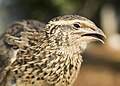
Common quails have a smooth, rounded body covered in beautiful brown and cream feathers.
Common quails are very caring parents!
Quails have simple tastes!
Common quails are famous for their sweet, chirpy calls!
Photos of Common Quail

Common Quail — photo 1

Common Quail — photo 3

Common Quail — photo 4

Common Quail — photo 5

Common Quail — photo 6
🌍 Conservation Status
The Common Quail is not currently endangered, but some populations are facing challenges. 🌍According to the International Union for Conservation of Nature (IUCN), their status is "Least Concern," meaning they are not threatened globally. However, habitat loss due to farming and urbanization is a concern, and conservation efforts are important to keep their numbers stable. 🌿Protecting their habitats can help ensure that these charming little birds continue to chirp in our fields and grasslands! Each small effort counts to keep quails safe! 🕊️
Go deeper🎉 Cultural Significance
People in many cultures love quails! 🎉Quails are mentioned in stories, music, and artwork. In ancient Rome, they were considered a special dish and enjoyed by emperors. 🍽️ In some cultures, quails symbolize happiness and abundance. Their eggs are also a delicacy in many countries, known for their rich flavor. 🥚In Japan, people raise them for their meat and eggs! Quails also appear in various folklore and songs, making them a beloved bird around the world. 🎶
Go deeper🦅 Predators And Threats
Common quails face many threats in the wild! 🦅Their main predators include foxes, hawks, and snakes. These animals love to snack on small birds! Quails use their camouflage to hide from these predators, but they must stay alert. Human activities like farming and urban development can also threaten their habitats by destroying fields and grasslands. 🌾As a result, some quail populations are declining, making it important to protect their homes!
Go deeper🌏 Habitat And Distribution
Common quails are found in various places around the world! 🌏They prefer habitats like open fields, grasslands, and agricultural areas. In Europe, they often stay in the Mediterranean region, while in Africa, they enjoy the grassy savannas. 🏞️ During migration, which happens in spring and autumn, some quails travel long distances between their breeding grounds and winter homes! Depending on the season, you might find them in countries like Italy, France, or even as far east as Mongolia! 📍
Go deeper🟤 Physical Characteristics
Common quails have a smooth, rounded body covered in beautiful brown and cream feathers. 🟤These colors help them blend into their surroundings, making it harder for predators to find them. They have a short, stubby beak, perfect for picking at seeds and insects on the ground. Their legs are strong, allowing them to run quickly when danger approaches! 🏃♂️ The males have a distinctive black "throat patch," while the females are slightly larger with a more speckled appearance. They also have tiny wings that are great for short flights and quick escapes. ✈️
Go deeper🥚 Reproduction And Nesting
Common quails are very caring parents! 🥚They start nesting in late spring, making small hollows in the ground and lining them with grass for comfort. A female can lay between 8 to 15 eggs at a time. These eggs are camouflaged with speckled patterns, which help protect them from enemies. 🦅After about 18 days, the eggs hatch into fluffy, tiny chicks. The parents lead their chicks to food soon after they hatch, teaching them how to find their own meals! 🚼The chicks can walk and feed themselves almost immediately!
Go deeper🌱 Diet And Feeding Behavior
Quails have simple tastes! They primarily eat seeds, grains, and green plants. 🌱They also enjoy small insects and even snails! Quails are ground-feeders, which means they scratch at the dirt with their feet to find food. 🦗Their strong beaks help them crack open hard seeds. During the breeding season, they need extra food to give them energy for raising their chicks! These birds often forage in small groups, which helps them find food more easily and stay safe from predators! 🍽️
Go deeper🎶 Vocalizations And Communication
Common quails are famous for their sweet, chirpy calls! 🎶Males make loud "wet-my-lips" calls during mating season to attract females. They can also make various sounds to communicate with each other. In groups, they might make soft cooing noises to help keep in touch. 🗣️ When a predator approaches, quails produce alarm calls to warn their friends! They communicate by changing the pitch and tone of their calls, showing how smart they really are. 🎤
Go deeper