Clade Facts For Kids
A clade is a group of organisms that includes a common ancestor and all of its descendants, illustrating the evolutionary relationships between them on a phylogenetic tree.
Select reading age

Clade Facts For Kids
Videos & Quizzesincluded
About this topic
Have you ever noticed how different animals and plants can be related? 🌿A clade is a special group of living things that includes a common ancestor and all its descendants! Imagine it like a family tree, where everyone is connected. For example, birds, crocodiles, and dinosaurs share a common ancestor, which makes them part of the same clade. Clades help scientists understand how life on Earth is connected and can help us learn more about nature! 🌎By studying clades, we can explore the marvelous story of evolution through time!
Explore with ChatDinoKey Points
Clades come in different shapes and sizes!
Let’s explore some cool examples of clades!
Phylogenetic trees are like big family trees for living things!
A clade is a group of living organisms that includes a single ancestor and all of its descendants.
The concept of clades was developed by scientists in the 19th century!
Cladistics is a method scientists use to classify living things into clades.
Clades are different from other taxonomic groups like families, orders, or kingdoms!
Understanding clades is super important for evolutionary biology!
Future research on clades is exciting!
Clades play an essential role in conservation biology!
Photos of Clade

Early phylogenetic tree by Haeckel, 1866. Groups once thought to be more advanced, such as birds ("Aves"), are placed at the top.

Gavialidae, Crocodylidae and Alligatoridae are clade names that are here applied to a phylogenetic tree of crocodylians.
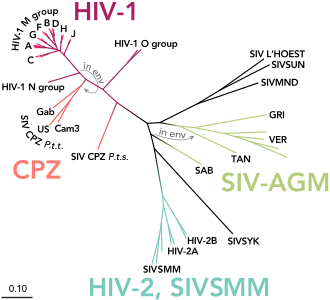
Phylogenetic tree of the SIV and HIV viruses showing clades (subtypes) of the virus.

Cladogram of modern primate groups; all tarsiers are haplorhines, but not all haplorhines are tarsiers; all apes are catarrhines, but not all catarrhines are apes; etc.
🧬 Types Of Clades
Clades come in different shapes and sizes! There are three main types: monophyletic, paraphyletic, and polyphyletic. 🧬Monophyletic clades include an ancestor and all its descendants, like mammals. Paraphyletic clades contain an ancestor and some, but not all, descendants, like reptiles (they leave out birds!). 🦎Lastly, polyphyletic clades are made up of unrelated organisms from different ancestors, like bat and butterfly! 🦇🦋 Learning these types of clades helps scientists understand how different groups are related to one another in the tree of life!
Go deeper🦁 Examples Of Clades
Let’s explore some cool examples of clades! 🦁One famous clade is the "tetrapods," which include all animals with four limbs, like mammals, birds, reptiles, and amphibians. 🦕Another interesting clade is "angiosperms," which are flowering plants! 🌼They evolved around 140 million years ago and include roses and sunflowers! 🌻Cnidarians, like jellyfish and corals, is another fascinating clade! Studying these clades helps scientists learn about the variety of life forms we share our planet with and how they all relate!
Go deeper🌳 Phylogenetic Trees
Phylogenetic trees are like big family trees for living things! 🌳They show how different organisms are related based on their evolutionary history. Each branch represents a clade, connecting species to their common ancestors. 🦖🔗 Starting from the trunk, you see the oldest ancestors, and as you go up, you find younger species! These trees help scientists visualize and understand the complex relationships that make up our biodiversity. By studying these trees, scientists can learn more about evolution, migration, and how different species have developed unique traits over time!
Go deeper🌟 Definition Of Clade
A clade is a group of living organisms that includes a single ancestor and all of its descendants. 🌟Think of a clade as a big family that has the same great-great-grandparent! If we say "mammals," we include all the animals like cats, dogs, and even humans! 🐶🐱 Mammals have a common ancestor that lived millions of years ago. Clades can be identified on a phylogenetic tree, which shows how different living things are related. Clades are essential because they help scientists classify and study different species!
Go deeper📚 Historical Background
The concept of clades was developed by scientists in the 19th century! One important figure was Charles Darwin, who talked about evolution and how species change over time. 📚By the 20th century, a scientist named Willi Hennig created the idea of "cladistics," the method used to classify clades. His work helped scientists understand the relationships between organisms better. Hennig’s ideas shaped how today’s biologists study animals and plants! This new method allowed scientists to see life as a big family tree, leading to exciting discoveries about our planet’s biodiversity! 🌍
Go deeper📊 Cladistics And Classification
Cladistics is a method scientists use to classify living things into clades. 📊It relies on comparing traits and features to figure out relationships. For example, scientists look closely at animals' bones, feathers, or DNA! 🧬By analyzing these characteristics, they create a phylogenetic tree showing how different groups of animals evolved. This scientific classification helps to organize and understand the amazing diversity of life on Earth. Cladistics allows scientists to categorize species more accurately, helping them make informed decisions in conservation and research!
Go deeper🏰 Clade Vs. Other Taxonomic Groups
Clades are different from other taxonomic groups like families, orders, or kingdoms! 🏰For example, the kingdom "Animalia" includes all animals, but the clade "mammals" only includes a specific group. The family "Felidae" includes felines like lions, tigers, and house cats, which are all part of the mammal clade! 🐈Clades focus more on evolutionary relationships, while traditional classifications often group organisms based on similar traits. This clear understanding helps scientists communicate better about organisms and their connections!
Go deeper🌱 Importance In Evolutionary Biology
Understanding clades is super important for evolutionary biology! 🌱It helps scientists explore how different species have developed over time. By studying clades, scientists can identify how adaptations occurred, such as how some animals learned to fly or swim! 🦋🐬 Clades also help scientists figure out the relationships between ancient organisms and their modern relatives, showing how life changes through millions of years. Understanding these connections can lead to discoveries about our planet's ecosystems and how to protect them for future generations!
Go deeper🎇 Future Directions In Clade Research
Future research on clades is exciting! 🎇Scientists are using new technology, like DNA sequencing, to learn more about relationships between organisms. This will help us understand how species adapt to changes in their environments and how they might evolve in the future! 🌌Clades will continue to be key in studying biodiversity, particularly with climate change and habitat loss. By better understanding clades, we can design more effective conservation strategies to protect endangered species. The journey into the fantastic world of clades is just beginning, and every discovery brings us closer to understanding life better! 🌺
Go deeper🌿 Applications In Conservation Biology
Clades play an essential role in conservation biology! 🌿By understanding relationships between species, scientists can prioritize which animals and plants to protect. For instance, if a clade is endangered, like rhinos, it's crucial to conserve its entire habitat, not just one species. 🌏Protecting clades also helps maintain ecosystems, as every organism plays a role in the environment. Conservation efforts that focus on preserving clades lead to healthier ecosystems and biodiversity that benefits everyone! It shows the importance of protecting all kinds of life on Earth! 🌈
Go deeper