Charm Quark Facts For Kids
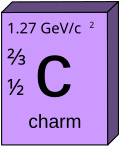
The charm quark, also known as the c quark, is a type of elementary particle that combines with other quarks to form larger particles called hadrons, and it plays a crucial role in particle physics.

Do more with AI
Introduction
Charm quarks are really tiny particles! 🌟They are a special type of particle called "elementary particles," which means they are some of the smallest building blocks of matter. Charm quarks are found in larger particles called hadrons, like the J/psi meson and charmed baryons. These particles are created when scientists smash particles together in huge machines called particle accelerators. The charm quark has a mass that is about 1.27 times heavier than a proton, which is pretty cool! Scientists study charm quarks to understand how the universe works on the tiniest scales. 🌌
Images of Charm Quark

The GIM mechanism explains the rarity of the decay of a K0 into two muons by involving the charm quark (c) in the process.

A supermultiplet of baryons that contain the up, down, strange and charm quarks with half-spin
What Is A Charm Quark?
A charm quark is one of six types of quarks, which are the building blocks of protons and neutrons! 🚀These six types include up, down, charm, strange, top, and bottom quarks. The charm quark is represented by the letter "c." It was discovered in 1974 when scientists found a new particle called the J/psi meson in a laboratory in the United States! 🎉The charm quark is like a little puzzle piece in the big picture of how matter is formed.
Applications In Research
Charm quarks help scientists explore the fundamental laws of nature. 🔭They are used in experiments to understand how matter interacts at a very tiny level. For instance, researchers at labs like Fermilab in the USA and CERN in Europe use charm quarks to study particle decay and uncover the secrets of dark matter. 🌑This research can lead to new technologies and discoveries that might change our understanding of the universe! It's like a treasure hunt for answers in the world of physics!
Production And Detection
To find charm quarks, scientists use particle accelerators, which are gigantic machines that smash particles at high speeds. ⚡One famous particle accelerator is the Large Hadron Collider (LHC) in Switzerland! When particles collide, new particles, including those with charm quarks, are created. Detectors then capture the signals from these collisions. They use cameras and special sensors to see the particles produced and help scientists learn about them! 📸This is how researchers uncover the secrets of the tiny universe!
Role In Particle Physics
Charm quarks play a big role in particle physics, the study of the smallest pieces of our universe! 🔬They help scientists learn how quarks interact with each other and form larger particles. By studying charm quarks, researchers try to find out more about forces like the strong force, which holds quarks together. They are also essential in studying "flavor" changes, where quarks can change types. This helps scientists understand why certain particles decay (break down) more quickly than others. 🧪
Future Research Directions
The study of charm quarks is always evolving! 🔮Future research aims to explore mysterious particles that include charm quarks and understand their role in the universe better. Scientists want to delve deeper into how charm quarks interact with other particles and how they can lead to new discoveries about dark matter, antimatter, and even gravity! 🌌As technology improves, researchers will have new tools to investigate the wonders of charm quarks, making it an exciting field to watch for young scientists! 🌟
Properties Of Charm Quarks
Charm quarks are unique! 🦄They have a positive electric charge of +2/3, which means they have a little extra electricity compared to some other quarks. Their mass is about 1.27 mega-electronvolts (MeV). When charm quarks group together with other quarks, they form different particles. For example, when a charm quark pairs with an up quark and a down quark, they create a particle called a "D meson." Wow! Isn't that neat? ❤️
Comparison With Other Quarks
There are six different kinds of quarks, and they can be grouped by their properties! 😍The charm quark (c) is heavier than the up and down quarks but lighter than the top and bottom quarks. The up quark has a charge of +2/3, like the charm quark, while the down quark has a charge of -1/3. Each quark type has unique characteristics that can affect how they combine to form larger particles. This is what makes studying charm quarks exciting—there's always something new to learn! 🥳
Charm Quarks In The Standard Model
The Standard Model is a scientific theory explaining how the smallest building blocks of the universe behave. 🌈Charm quarks are an important part of this theory, which includes all the quarks, leptons (another type of tiny particle), and forces. In the Standard Model, charm quarks interact with other quarks and particles, revealing more about how the universe is structured. 🎤Understanding charm quarks helps physicists explain mysteries like why certain particles have mass and how they behave in different conditions.
Interesting Facts About Charm Quarks
Did you know the charm quark is named after "charm" because it was a charming surprise to scientists when they discovered it? 😄Also, charm quarks can change into strange quarks through a process known as "flavor change." This remarkable ability helps scientists understand particle interactions better. ✨Lastly, the J/psi meson, which contains charm quarks, had its mass measured so precisely that scientists could use it to calculate the speed of light! Talk about amazing particles! ⚡️
Charm Quark Quiz
Learn more about Charm Quark
