All Articles

Buoyancy

Buoyancy Facts For Kids

Buoyancy, or upthrust, is a net upward force exerted by a fluid that opposes the weight of a partially or fully immersed object.

๐ŸŽจ Reading age for 6-8
Background blob
Buoyancy
Buoyancy
Facts for Kids!
Image by Original: Yupi666 Vector: Pbrks, licensed under Creative Commons Attribution-Share Alike 3.0

Do more with AI

Introduction

Buoyancy is a cool force that makes things float! ๐ŸŒŠWhen an object is placed in water or any fluid, buoyancy comes into play. It pushes upward, against the weight of the object. Did you know that boats and ships float because of buoyancy? ๐Ÿ›ฅ๏ธ Even heavy ships made of steel can float because buoyancy is stronger than their weight! The amount of buoyant force depends on the liquid and the objectโ€™s shape. Anytime you swim or see a rubber ducky, youโ€™re witnessing buoyancy in action! ๐Ÿฆ†Let's dive deeper into the fascinating world of buoyancy!

Images of Buoyancy

A metallic coin (an old British pound coin) floats in mercury due to the buoyancy force upon it and appears to float higher because of the surface tension of the mercury.Image by Alby ( talk ), licensed under Creative Commons Attribution-Share Alike 3.0

A metallic coin (an old British pound coin) floats in mercury due to the buoyancy force upon it and appears to float higher because of the surface tension of the mercury.

A duck has difficulties to get under water due to its buoyancy. When no swimming forces are implied, the natural equilibrium of forces keeps about half of the duck above water.Image by FreCha, licensed under Creative Commons Attribution-Share Alike 4.0

A duck has difficulties to get under water due to its buoyancy. When no swimming forces are implied, the natural equilibrium of forces keeps about half of the duck above water.

Pressure distribution on an immersed cubeImage by Peter Southwood, licensed under Creative Commons Attribution-Share Alike 3.0

Pressure distribution on an immersed cube

Forces on an immersed cubeImage by Peter Southwood, licensed under Creative Commons Attribution-Share Alike 3.0

Forces on an immersed cube

Approximation of an arbitrary volume as a group of cubesImage by Peter Southwood, licensed under Creative Commons Attribution-Share Alike 3.0

Approximation of an arbitrary volume as a group of cubes
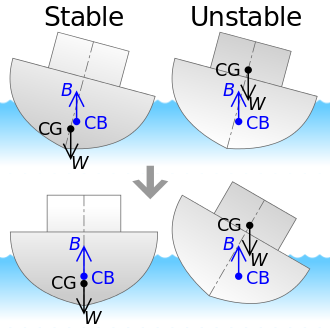
Illustration of the stability of bottom-heavy (left) and top-heavy (right) ships with respect to the positions of their centres of buoyancy (CB) and gravity (CG)Image by Cmglee, licensed under Creative Commons Attribution-Share Alike 3.0

Illustration of the stability of bottom-heavy (left) and top-heavy (right) ships with respect to the positions of their centres of buoyancy (CB) and gravity (CG)

Density column of liquids and solids: baby oil rubbing alcohol (with red food colouring) vegetable oil wax water (with blue food colouring) and aluminium.Image by PRHaney, licensed under Creative Commons Attribution-Share Alike 3.0

Density column of liquids and solids: baby oil rubbing alcohol (with red food colouring) vegetable oil wax water (with blue food colouring) and aluminium.

Buoyancy And Density

Density really matters when it comes to buoyancy! ๐Ÿ”Density is how much stuff is packed into a certain space. For example, a beach ball is less dense than water, which is why it floats! ๐ŸŒŠBut a rock is more dense, making it sink. Weight also plays a role: heavy objects might not float unless they displace enough fluid. โš–๏ธ So remember, if something is heavy but not very dense, it can float! Understanding density helps us predict whether things will sink or swimโ€”how cool is that? ๐ŸŒˆ

Archimedes' Principle

Archimedes was a super-smart Greek scientist who lived around 250 B.C.! โญHe discovered an important rule: when an object is submerged in fluid, it will displace a volume of liquid equal to its own volume. This means if you put a toy boat in water, it pushes away a certain amount of water. ๐Ÿ›ถThe water pushes back up, creating buoyancy! Archimedesโ€™ Principle helps engineers and scientists understand how things will float or sink. Itโ€™s why big ships are designed to stay afloat, making Archimedes a real โ€œfloatโ€ hero! ๐Ÿ’ช

Definition Of Buoyancy

Buoyancy is the upward force that a fluid, like water or air, exerts on an object that is either fully or partially underwater! ๐ŸŒŠImagine you have a beach ball. If you push it underwater, it wants to pop back up ๐Ÿ‘†, and thatโ€™s buoyancy at work! It helps objects like boats stay afloat and lets us enjoy swimming without sinking! When buoyancy is stronger than the weight of an object, it floats. If not, it sinks! So next time you're in a pool, remember: buoyancy helps you stay safe and have fun! ๐ŸŠ

Factors Affecting Buoyancy

Several factors affect buoyancy! ๐ŸŒOne factor is the shape of the object. A wide, flat raft floats better than a tiny rock because it pushes away more water. ๐ŸชจAnother factor is the liquid. For example, youโ€™ll float better in the Dead Sea than in a regular pool because the Dead Sea is much saltier! ๐Ÿง‚The temperature and density of the liquid also play a role. Warmer water is less dense than cold water, which can change how things float. ๐ŸŒŠThese elements make buoyancy an exciting and complex topic!

The Science Behind Buoyancy

Buoyancy happens due to the weight of the fluid around an object. ๐ŸŒˆWhen something is in the water, it pushes down on the liquid, creating an equal force that pushes back. This force comes from the liquidโ€™s molecules bumping into the object and each other! ๐ŸŒŠIf the upward force, or buoyancy, is greater than the downward weight of the object, it will float! If it is less, the object sinks. This is part of physics, the science of how things move and interact! How amazing is that? ๐Ÿค”

Buoyancy In Marine Engineering

Marine engineers use buoyancy to design boats, submarines, and oil rigs! ๐ŸšขThey have to calculate how much weight these structures can hold and how to make them float properly. Submarines can dive or rise based on buoyancy changes by adding or removing water from their tanks! ๐ŸŒŠThis control helps them navigate under the ocean. Safety is crucial; engineers must ensure boats donโ€™t capsize or sink by understanding buoyancy. Marine engineering combines creativity and science to explore the fascinating waters of our world! ๐ŸŒ

Buoyant Force In Different Fluids

Buoyant force can change depending on the fluid! ๐ŸŒŠFor example, you float easier in saltwater than in freshwater. Thatโ€™s because saltwater is denser; it pushes you up more! ๐Ÿง‚Even the air has buoyant forceโ€”helicopters and hot air balloons use this to lift off the ground! ๐ŸŽˆWhile most of our experience is in water, understanding buoyancy in other liquids, like oil or syrup, can be fascinating. Itโ€™s easy to see how different liquids can make floating feel like a fun experiment!

Experiments To Demonstrate Buoyancy

Want to see buoyancy in action? Hereโ€™s a fun experiment! ๐ŸงชFill a large container with water and gather objects like a feather, a coin, and a plastic bottle. Now, drop each object in the water and watch what happens! ๐ŸŒŠThe feather floats, the coin sinks, and the plastic bottle bobs. You can even tweak the experiment by adding salt to the water to increase its density. sprinkle some salt in and see what happens! ๐ŸŽ‰These little experiments reveal how buoyancy works and make learning hands-on!

Historical Perspectives On Buoyancy

Buoyancy has been studied for centuries! ๐ŸŒ…Ancient cultures might not have known the science behind it, but they built amazing boats to travel. In the 3rd century B.C., Archimedes discovered the principle of buoyancy in Greece. ๐Ÿ“œLater, in the Renaissance, scientists like Leonardo da Vinci studied how ships float. Today, we use Archimedes' discoveries to build incredible ships and submarines! ๐ŸšขThe journey of understanding buoyancy shows how curiosity helps us learn about the world and make wonderful things. So next time you see a boat, think of the historical minds that contributed to it! โ›ต

Applications Of Buoyancy In Everyday Life

Buoyancy isn't just for floating things; itโ€™s part of our daily lives! ๐ŸšคBoats use buoyancy to travel on lakes and oceans. We also use hot air balloons! ๐ŸŽˆThey float because hot air is less dense than cold air. Doctors use buoyancy to measure how well our bodies float in water, and engineers rely on it to design submarines! ๐Ÿ‹These everyday wonders show us how important buoyancy is. Whether it's playtime at the beach or traveling across a lake, we frequently encounter this magical force!

Buoyancy Quiz

Q1
Question 1 of 10

Learn more about Buoyancy

Ready to create?

Drop Files here
Make

To create a safe space for kid creators worldwide!

Create

Vibe Coding

ChatDino

All Tools

Kibu

Resources

Worksheets

SafeTube

Blog

FAQ

Account

Pricing

Log-in

Sign-up

Data Deletion

Company

About

Community Guidelines

Privacy Policy

Terms of Service

2025, URSOR LIMITED. All rights reserved. DIY is in no way affiliated with Minecraftโ„ข, Mojang, Microsoft, Robloxโ„ข or YouTube. LEGOยฎ is a trademark of the LEGOยฎ Group which does not sponsor, endorse or authorize this website or event. Made with love in San Francisco.