Brushtail Possum Facts For Kids
The brushtail possum is a nocturnal marsupial native to Australia and New Guinea, known for its bushy tail and adaptability to various environments.
Select reading age

Brushtail Possum Facts For Kids
Videos & Quizzesincluded
About this topic
The brushtail possum is a small marsupial native to Australia and New Zealand. 🦘They are nocturnal, which means they sleep during the day and come out at night to eat and play! Brushtail possums have a thick, bushy tail that helps them balance while climbing trees. They are about the size of a cat, measuring around 30 to 60 cm (12 to 24 inches) in length. Brushtail possums have become a favorite in New Zealand, where they were introduced in the 19th century but have since become a problem for native birds and plants. 🌏
Explore with ChatDinoKey Points
Did you know brushtail possums have opposable thumbs?
Brushtail possums play an important role in their ecosystems!
Overall, brushtail possums are classified as a species of least concern on the conservation scale.
Brushtail possums are herbivores, which means they eat plants!
Brushtail possums prefer living in forests, woodlands, and urban areas.
Brushtail possums have a complex relationship with humans.
Brushtail possums have unique features that help them survive in the wild.
Brushtail possums have a fascinating way of having babies!
Brushtail possums are generally solitary animals, but they sometimes come together in groups.
Photos of Brushtail Possum
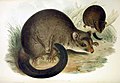
Brushtail Possum — photo 1

Brushtail Possum — photo 2

Brushtail Possum — photo 3
👐 Fun Facts
Did you know brushtail possums have opposable thumbs? This special feature helps them grip branches while climbing! 👐Their bushy tails can also store fat, providing energy when food is scarce. Brushtail possums can leap up to 3 meters (9.8 feet) in a single jump! They are also great at making noise, often making sounds like growls, hisses, and even screeches to communicate. 🎶Have you ever heard a possum at night? Their calls are pretty unique! Isn’t nature fascinating? 🌌
Go deeper🍃 Ecological Role
Brushtail possums play an important role in their ecosystems! 🍃They help plants grow by scattering seeds when they eat fruits and leaves. This helps new plants sprout in the forest. They are also a food source for predators, such as owls and dingoes, making them an important part of the food chain. Additionally, their foraging habit helps keep plant populations healthy. 🌼By browsing on leaves, they encourage new growth and better leaf production in the trees. What amazing little helpers they are! 🌟
Go deeper🌿 Conservation Status
Overall, brushtail possums are classified as a species of least concern on the conservation scale. 🌿However, in some regions, such as New Zealand, they are considered pests because of their negative effect on local wildlife. Since they eat so many native plants, conservationists work to manage their populations. There are some efforts to control brushtail possum numbers in areas where they harm the environment while working to protect native species at the same time. 🌍
Go deeper🌼 Diet And Feeding Habits
Brushtail possums are herbivores, which means they eat plants! 🌼They enjoy munching on leaves, fruits, flowers, and even tree bark. Some of their favorite meals come from eucalyptus trees. 😋Brushtail possums are great at foraging at night, using their strong sense of smell to find tasty treats. They have sharp teeth that help them munch through tough plant material. Sometimes, they even like to nibble on garden plants, which is why people sometimes see them in backyards! 🌿
Go deeper🌳 Habitat And Distribution
Brushtail possums prefer living in forests, woodlands, and urban areas. 🌳These animals are very adaptable! You can find them all over Australia, from tropical rainforests to cooler regions. In New Zealand, they roam throughout the North and South Islands. They enjoy climbing trees to find cozy spots to sleep during the day. 💤Brushtail possums are great at finding food, so they often venture into cities and parks, making them a common sight at night!
Go deeper🌇 Interactions With Humans
Brushtail possums have a complex relationship with humans. 🌇In Australia, they are often seen as cute and friendly creatures, but they can also damage gardens and property by eating plants. Some people enjoy watching them at night while others find them a bit of a nuisance. In New Zealand, however, they are considered pests, leading to control programs to reduce their numbers and protect native wildlife. 💚Many people help by learning how to keep their gardens safe while appreciating the charm of these furry little animals! 🐭
Go deeper🐾 Physical Characteristics
Brushtail possums have unique features that help them survive in the wild. 🐾Their fur is soft and thick, usually grayish-brown, which helps them blend into the trees. They have large, rounded ears and big, shiny eyes that help them see in the dark. Their bushy tail can be as long as their body! It acts like another arm, helping them balance when they climb. Brushtail possums also have a strong sense of smell, which helps them find food in the dark. 👀✨
Go deeper🐾 Reproduction And Development
Brushtail possums have a fascinating way of having babies! 🐾Female brushtail possums usually have one joey (baby) at a time, which is born very tiny—about the size of a jellybean! After birth, the joey climbs into the mother's pouch. 🥰It stays there, drinking milk and growing for about six months. Once it's big enough, the joey starts to explore outside the pouch but will still return frequently for food until it is fully grown. After about a year, the young possum will leave its mother to find its own home! 🌱
Go deeper🐾 Behavior And Social Structure
Brushtail possums are generally solitary animals, but they sometimes come together in groups. 🐾They mark their territory with urine and scent to let others know where they live. They are very playful and like to chase each other in trees, especially young possums! When threatened, they can make loud hissing sounds and can play dead to trick predators. 🌟At night, brushtail possums are very active, climbing trees and exploring their surroundings. They are known for their curious nature, often checking things out with their noses! 👃
Go deeper