Bivalvia Facts For Kids
Bivalvia, or bivalves, are a class of aquatic molluscs characterized by their soft bodies enclosed in two hinged calcium carbonate shells.
About this topic
Key Points
Photos of Bivalvia

Empty shell of the giant clam (Tridacna gigas)
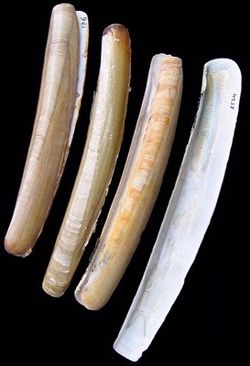
Empty shells of the sword razor (Ensis ensis)
![Drawing of freshwater pearl mussel (Margaritifera margaritifera) anatomy: .mw-parser-output figure[typeof="mw:File/Thumb"] .image-key>ol{margin-left:1.3em;margin-top:0}.mw-parser-output figure[typeof="mw:File/Thumb"] .image-key>ul{margin-top:0}.mw-parser-output figure[typeof="mw:File/Thumb"] .image-key li{page-break-inside:avoid;break-inside:avoid-column}@media(min-width:300px){.mw-parser-output figure[typeof="mw:File/Thumb"] .image-key,.mw-parser-output figure[typeof="mw:File/Thumb"] .image-key-wide{column-count:2}.mw-parser-output figure[typeof="mw:File/Thumb"] .image-key-narrow{column-count:1}}@media(min-width:450px){.mw-parser-output figure[typeof="mw:File/Thumb"] .image-key-wide{column-count:3}}posterior adductoranterior adductorouter left gill demibranchinner left gill demibranchexcurrent siphonincurrent siphonfootteethhingemantleumbo](https://upload.wikimedia.org/wikipedia/commons/thumb/9/9d/Margaritifiera-margaritifiera-Anatomy.png/960px-Margaritifiera-margaritifiera-Anatomy.png)
Drawing of freshwater pearl mussel (Margaritifera margaritifera) anatomy: .mw-parser-output figure[typeof="mw:File/Thumb"] .image-key>ol{margin-left:1.3em;margin-top:0}.mw-parser-output figure[typeof="mw:File/Thumb"] .image-key>ul{margin-top:0}.mw-parser-output figure[typeof="mw:File/Thumb"] .image-key li{page-break-inside:avoid;break-inside:avoid-column}@media(min-width:300px){.mw-parser-output figure[typeof="mw:File/Thumb"] .image-key,.mw-parser-output figure[typeof="mw:File/Thumb"] .image-key-wide{column-count:2}.mw-parser-output figure[typeof="mw:File/Thumb"] .image-key-narrow{column-count:1}}@media(min-width:450px){.mw-parser-output figure[typeof="mw:File/Thumb"] .image-key-wide{column-count:3}}posterior adductoranterior adductorouter left gill demibranchinner left gill demibranchexcurrent siphonincurrent siphonfootteethhingemantleumbo

Interior of the left valve of a venerid

Main parts of a bivalve shell: sagittal planegrowth linesligamentumbo
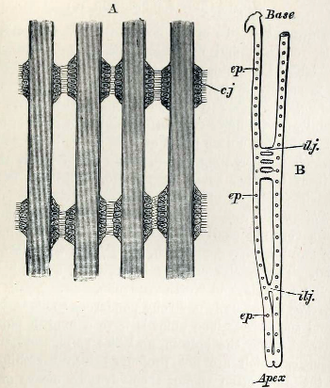
Four filaments of the gills of the blue mussel (Mytilus edulis) a) part of four filaments showing ciliated interfilamentar junctions (cj) b) diagram of a single filament showing the two lamellae connected at intervals by interlamellar junctions (ilj) and the position of the ciliated interfilamentar junctions (cp)

Anadara, a bivalve with taxodont dentition from the Pliocene of Cyprus

A fossil Jurassic brachiopod with the lophophore support intact
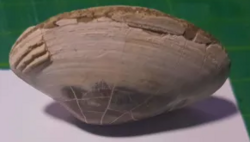
cf. Paratapes textilis from the Pliocene of Java, Indonesia