Bastet Facts For Kids
Bastet is an ancient Egyptian goddess known for her nurturing qualities, connection to cats, and dual identity as both a fierce lioness and a loving domestic cat.
Select reading age

Bastet Facts For Kids
Videos & Quizzesincluded
About this topic
Bastet is a fascinating goddess from ancient Egypt! 🌄She is often shown as a lioness or with a lioness’ head, symbolizing strength and protection. People believed she could keep them safe and bring happiness. Ancient Egyptians worshipped Bastet for many reasons, like defending their homes and families. She was also the goddess of music, dance, and joy. 🎶Bastet's worship began as early as the Second Dynasty (around 3000 BC) in a city called Bubastis, which is located in the Nile Delta. That’s a special place in Egypt where many celebrations took place! 🎉
Explore with ChatDinoKey Points
Bastet's history is quite interesting!
In Egyptian mythology, Bastet is known to be the daughter of the sun god, Ra!
Bastet's festivals were some of the most lively celebrations in ancient Egypt!
Artists in ancient Egypt loved to paint and sculpt pictures of Bastet!
Cats held a special place in society because of Bastet's love for them.
Bastet is most commonly depicted as a woman with a lioness’ head.
Bastet's influence is still felt today!
Bastet played a huge role in the everyday lives of ancient Egyptians.
Bastet is unique compared to other Egyptian deities!
Photos of Bastet

Bastet in her earlier form of a lioness-headed woman depicted the same or very similar to Sekhmet

Wadjet-Bastet, with a lioness head, the solar disk, and the cobra that represents Wadjet

Statue of Bastet holding a sistrum

Bastet, Albert Hall Museum, Jaipur, India
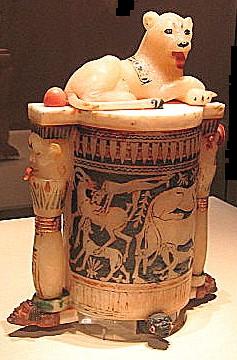
An Eighteenth Dynasty burial artifact from the tomb of Tutankhamun (c. 1323 BC), an alabaster cosmetic jar topped with a lioness representing Bastet — Cairo Museum
🐾 Origins Of Bastet
Bastet's history is quite interesting! 🐾Some believe she originated from Nubia, a region south of Egypt known for its rich culture. Bastet was worshiped as a fierce lioness goddess in her earlier days. 🌍Over time, her image changed to be more gentle and loving, represented as a domestic cat. Domesticated cats became very important in ancient Egyptian homes. It is said that Bastet protects families and children, and worshipping her became a way for people to ask for safety and happiness. Children especially loved her because she symbolized fun and joy! 😊
Go deeper🌞 Bastet In Mythology
In Egyptian mythology, Bastet is known to be the daughter of the sun god, Ra! 🌞Some myths say she fought fierce creatures to protect the sun. Early on, her character was quite wild and brave, representing strength as a lioness. As time passed, she became more nurturing and was loved by families for bringing joy. ⭐Legends also mention that she could help mothers during childbirth. This made her even more special to the people. So, whether she was fierce or gentle, Bastet always held a special place in the hearts of ancient Egyptians! 🥰
Go deeper🌼 Worship And Festivals
Bastet's festivals were some of the most lively celebrations in ancient Egypt! One of the biggest was the "Feast of Bubastis," held every spring in her honor. 🌼Thousands of people traveled to her temple in Bubastis to celebrate with dancing, singing, and delicious food. It was like a gigantic party! 🎈People would bring offerings like fruits and flowers to show their love and respect for Bastet. They even rode boats down the Nile river to attend the festival, singing joyful songs along the way. Isn’t that a fun way to worship a goddess?
Go deeper🎨 Artistic Representations
Artists in ancient Egypt loved to paint and sculpt pictures of Bastet! 🎨They used colorful materials to create lively images of her as a lioness or with kittens. Many paintings showed her celebrating with people at festivals, demonstrating music and joy. 🎶Statues of Bastet were placed in homes and temples to invite her blessings. Some sculptures were made from stone while others were crafted from wood. 🪵Whenever they created art, the Egyptians wanted it to capture her playful spirit and protective nature. Art was a way to honor and remember their beloved goddess!
Go deeper🐾 Bastet And Cats In Society
Cats held a special place in society because of Bastet's love for them. 🐾People believed that if they treated cats well, they would be blessed by Bastet! Cats were often seen as little protectors of homes, chasing away mice and other pests. 🐭Families cared deeply for their furry friends, often feeding them fine food and giving them cozy spaces to sleep. When a cat died, it was a sad event, and families would mourn them like family members! Sometimes, they even buried their pets with small offerings to Bastet, hoping she would welcome their spirits. ❤️
Go deeper🦁 Physical Depiction And Symbols
Bastet is most commonly depicted as a woman with a lioness’ head. 🦁She is often shown holding a musical instrument called a sistrum, which makes joyful sounds! You might also see her with kittens, emphasizing her role as a caring mother. 🐱Symbolically, Egyptians connected her with warm, sunny days. The sun represents brightness and happiness, and this is why her temples often had bright colors and beautiful drawings. 🏺Her main symbol is the cat, which represents protection and love for families. Isn’t it neat how cats were seen as sacred?
Go deeper📅 Bastet's Influence On Modern Culture
Bastet's influence is still felt today! 📅Many people love cats and treat them like family pets, just like the ancient Egyptians. Some hold festivals that celebrate cats, inspired by Bastet’s joyful parties. 🐱You may even find Bastet represented in movies, books, and cartoons where she embodies kindness and protection. 🎥Many artists create cute cat-themed art, showing how beloved these animals are in today’s culture. It’s amazing how an ancient goddess can still inspire joy and love for cats all around the world! 🌏
Go deeper🌾 Cultural Significance In Ancient Egypt
Bastet played a huge role in the everyday lives of ancient Egyptians. 🌾They believed she protected their harvests and gave them happiness. During tough times, they turned to Bastet for comfort. People decorated their homes with cat figures and painted her on walls to invite her blessings. Festivals dedicated to Bastet were lively and colorful, filled with music, dancing, and food. 🎉Families would come together to celebrate and show their love for this special goddess. Cats, being her symbol, were treated very well and even lived in temples! 😸
Go deeper😺 Comparative Analysis With Other Deities
Bastet is unique compared to other Egyptian deities! 😺For example, Sekhmet, another goddess, was depicted as a lioness too, but represented fierce protection and war. While Sekhmet was strong and aggressive, Bastet took on a more gentle role, focusing on family and joy. 🏠Other cultures have goddesses, too! For example, the Greek goddess Artemis is the protector of animals and the wilderness. 🌳Unlike Bastet, Artemis does not focus on home and family but rather on nature. Each goddess has their own special powers and significance, showing how different cultures celebrate various values. 🎉
Go deeper