Ball Lightning Facts For Kids
Ball lightning is a rare and poorly understood electrical phenomenon characterized by glowing, spherical objects that appear during thunderstorms.
Select reading age
Ball Lightning Facts For Kids
Videos & Quizzesincluded
About this topic
Ball lightning is a mysterious little ball of light that sometimes appears during thunderstorms! ⚡️🔦 It can look like glowing orbs, often the size of a soccer ball, floating in the air. People have seen ball lightning inside houses, outside during storms, and even near power lines! Scientists are still trying to figure out exactly what it is and how it forms. Some think it’s made of plasma, a hot, charged gas. But we don’t know for sure yet! Ball lightning can last a few seconds to minutes and has been seen around the world. 🌍
Explore with ChatDinoKey Points
Ball lightning can be dangerous!
Ball lightning is still a mystery, and many scientists are working hard to learn more.
Observing ball lightning can be tricky!
Ball lightning has inspired many stories and legends across cultures!
Ball lightning is closely related to thunderstorms and lightning!
Scientists have many ideas about ball lightning!
Ball lightning has been reported for centuries!
To learn about ball lightning, scientists perform experiments in labs!
Photos of Ball Lightning

Contemporary woodcut of the Widecombe-in-the-Moor storm

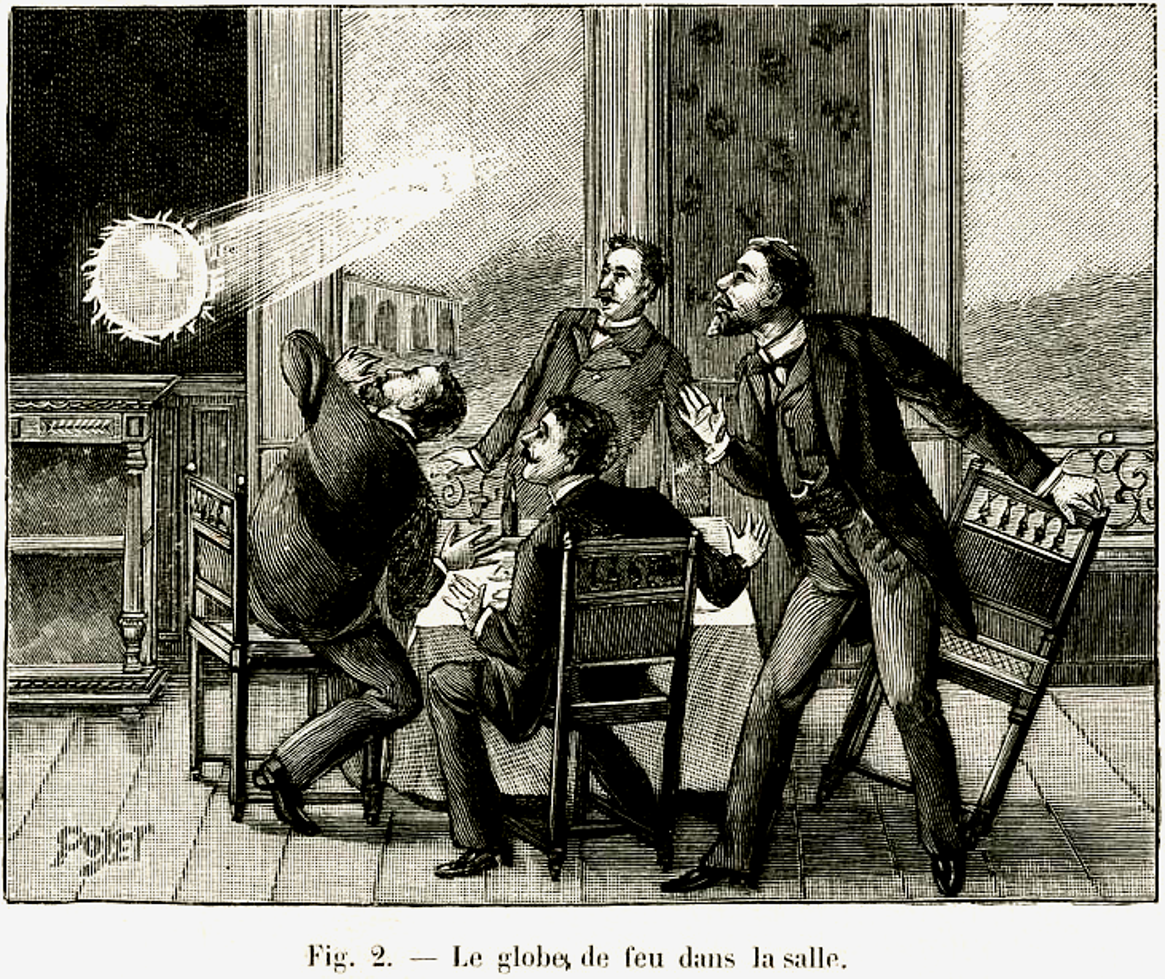
Ball lightning entering via the chimney (1886)

The emission spectrum (intensity vs. wavelength) of a natural ball lightning

A demonstration of the water discharge experiment
⚠️ Safety And Precautions
Ball lightning can be dangerous! ⚠️ If you see it, it’s best to stay calm and move indoors. Never touch it! Some people say that it can explode, which could be harmful. 🏠During storms, always stay away from metal objects and don’t use electrical appliances until the storm passes. You can also stay safe by avoiding tall trees and open fields. 🌳If you're curious about ball lightning, study it safely from a window. Respect the power of nature, and never go outside in a storm! 🏃♂️💨
Go deeper🔬 Future Research Directions
Ball lightning is still a mystery, and many scientists are working hard to learn more. 🔬In the future, they hope to study it in special labs and use high-tech tools, like satellites, to measure lightning from space! 🌌With new technology, researchers might discover more about how ball lightning forms and what it is made of. They are also interested in studying its effects on the environment and other weather phenomena. As curiosity grows, scientists are excited about the possibilities of new findings about this amazing and rare phenomenon! 🌟
Go deeper🔭 Observations And Measurements
Observing ball lightning can be tricky! 🔭Most of the time, it's seen in stormy weather, which makes it hard to study. Researchers use special cameras and sensors to capture these wonders. One famous event was the 1984 “ball lightning storm” in France. Scientists measured the light and recorded videos, showing how quickly ball lightning can move. 📹They also found that ball lightning can sometimes be heard! People say it makes a soft or crackling sound as it moves. By collecting data from these observations, scientists hope to learn more about this rare phenomenon! 📊
Go deeper👻 Cultural References And Folklore
Ball lightning has inspired many stories and legends across cultures! In ancient China, people thought it was the spirits of their ancestors watching over them. 👻In Western folklore, tales describe ball lightning as fairy lights leading travelers astray! Other cultures believe it could be a bad omen or a sign of trouble ahead. 📚Some movies, books, and even video games feature ball lightning as a mysterious or magical element. Its mysterious nature captured imaginations, making it a popular topic for storytellers throughout history! 🎥
Go deeper🌧️ Ball Lightning And Weather Phenomena
Ball lightning is closely related to thunderstorms and lightning! 🌧️ It usually happens during or right after a storm when the air is charged and full of energy. Some people have spotted ball lightning during tornadoes or hurricanes, too! 🌪️ It’s believed that the energy from lightning strikes can create conditions for ball lightning to form. However, not all storms produce ball lightning! Some scientists think that changes in temperature and humidity might play a role. Understanding how ball lightning connects with weather can help us predict when to see it. ☁️
Go deeper☀️ Scientific Theories And Explanations
Scientists have many ideas about ball lightning! One popular theory is that it’s made of plasma, hot gas like that found in stars. ☀️ Other scientists think it could be caused by chemical reactions in the air during thunderstorms! 🌩️ Another theory is that ball lightning forms when lightning hits the ground, creating energy and particles. Researchers around the world, including in countries like the USA and Japan, are conducting experiments to learn more! Every time they find new clues, they get closer to solving the ball lightning mystery! 🔍
Go deeper📜 Historical Accounts Of Ball Lightning
Ball lightning has been reported for centuries! One of the first stories dates back to 1638 in England. 📜A scientist named Thomas Browne described a glowing ball that flew in the sky. In 1838, a famous writer named Michael Faraday studied ball lightning and suggested it might be related to electricity! ⚡Other reports came from ships sailing in storms or people in their homes who saw glowing balls floating around. In fact, some people believe it may have played a part in famous events like the Tunguska explosion in Russia in 1908! 💥
Go deeper🧪 Experimentation And Laboratory Studies
To learn about ball lightning, scientists perform experiments in labs! 🧪They create conditions similar to thunderstorms using high-energy equipment. Some amazing experiments involve powerful lasers and electric fields that mimic lightning strikes! These experiments help researchers see how light and energy behave, just like during a storm. 🔦Some scientists even mix gas and use electrical currents to create ball lightning-like effects. By studying these controlled environments, scientists gather clues about what makes ball lightning and how it might be formed as it appears in nature! 🌌
Go deeper