Atriplex Facts For Kids
Atriplex is a fascinating genus of plants comprising around 250 species, commonly known as saltbush and orache, thriving in dry and salty habitats worldwide.
Select reading age

Atriplex Facts For Kids
Videos & Quizzesincluded
About this topic
Atriplex, commonly known as saltbush or orache, is a group of plants that includes about 250 species! 🌱These fascinating plants mostly grow in salty and dry areas around the world. They are usually green or gray-green and have thick, fleshy leaves. Saltbush is important for wildlife and grows in places like Australia, North America, and Africa. Some species can even survive in deserts! 🌵People love saltbush for its ability to thrive in tough conditions and its role in supporting ecosystems. Can you imagine living where there’s little water? Saltbush can! 💧
Explore with ChatDinoKey Points
Some saltbush plants are believed to have healing properties!
Many species of saltbush are doing well, but some face challenges!
Did you know that some saltbush species are edible?
Saltbush plays a big role in the ecosystems it lives in!
Atriplex species love to grow in salty or sandy soils!
Saltbush belongs to the family Amaranthaceae.
Saltbush plants have some special features that help them survive!
Scientists are interested in saltbush because of its ability to grow in salty soils!
Farmers and gardeners find saltbush really useful!
Photos of Atriplex

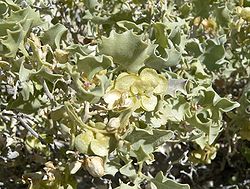


Atriplex — photo 6

Background colour in cladogram represents the region where a species is endemic. .mw-parser-output .legend{page-break-inside:avoid;break-inside:avoid-column}.mw-parser-output .legend-color{display:inline-block;min-width:1.25em;height:1.25em;line-height:1.25;margin:1px 0;text-align:center;border:1px solid black;background-color:transparent;color:black}.mw-parser-output .legend-text{} South America North America Australia Eurasia
![Brignone et al. (2019) hypothesis for the evolution and movement of Atriplex species globally.[18]](https://upload.wikimedia.org/wikipedia/commons/thumb/2/27/Unexpected_insights_hypothesis.svg/960px-Unexpected_insights_hypothesis.svg.png)
Brignone et al. (2019) hypothesis for the evolution and movement of Atriplex species globally.[18]
🌿 Medicinal Uses
Some saltbush plants are believed to have healing properties! 🌿Indigenous people in Australia have used saltbush for many years. Some uses include making herbal remedies for skin irritations. People also use saltbush leaves to make teas that can help with digestion. 🍵However, always check with adults before trying any new plants! Researchers are checking if saltbush can help with other health benefits, such as improving nutrition. This study helps us understand the best ways to use nature to benefit our health and the environment! 🌍
Go deeper🌱 Conservation Status
Many species of saltbush are doing well, but some face challenges! 🌱Habitat loss, climate change, and invasive plant species can affect their growth. Some saltbush species are considered endangered. 🌍That means we need to work together to protect their natural habitats. Local organizations often help to conserve these plants by planting new saltbush and educating communities about their importance. 🌼By learning about saltbush and caring for the environment, we can help ensure that these amazing plants thrive for future generations! 💚
Go deeper🌿 Culinary Applications
Did you know that some saltbush species are edible? 🌿In Australia, people sometimes use the leaves of Atriplex nummularia, called old man saltbush, in salads and wraps! 🥗The leaves have a salty flavor that tastes great in various dishes. It’s like adding a touch of nature's seasoning! Saltbush can also be used in cooking meats, adding a delicious flavor. Chefs are getting creative using saltbush to make unique tastes. 🍳Kids can help in the kitchen and learn about this incredible plant while making yummy food! 🌈
Go deeper🐦 Ecological Importance
Saltbush plays a big role in the ecosystems it lives in! 🐦Many animals love to eat its leaves. Grazing animals like sheep and cattle also enjoy saltbush. 🌲In turn, those animals help spread seeds around! This way, new saltbush plants can grow. Additionally, saltbush provides shelter for small animals and insects. 🌼It helps keep soil healthy by preventing erosion. Saltbush also contributes to the nitrogen cycle, which is crucial for plant health. So, saltbush isn’t just a plant—it’s a vital part of the food chain and the environment! 🍃
Go deeper🌊 Habitat And Distribution
Atriplex species love to grow in salty or sandy soils! 🌊You can find them in places like deserts and along coastlines. Australia is home to many saltbush species, making it a fantastic country for plant lovers! 🌏In the United States, you can find fourwing saltbush in the Southwest, like in Arizona and New Mexico. Saltbush grows in places that other plants find hard to survive. They can grow where the soil is tough! Their ability to grow in these climates makes them important for preserving nature's balance. 🌺
Go deeper🌿 Taxonomy And Classification
Saltbush belongs to the family Amaranthaceae. This group also includes other plants like beets and spinach! 🌿Scientists classify plants by giving them names in Latin. The genus name, Atriplex, helps us understand that these plants are similar. Some common saltbush species include Atriplex canescens (commonly known as fourwing saltbush) and Atriplex patula (spreading orache). Each species has special features! 🌼Just like animals, plants are grouped based on their similarities. Knowing their names helps us learn more about them and where they fit in nature!
Go deeper🌞 Morphological Characteristics
Saltbush plants have some special features that help them survive! 🌞Their leaves are thick and often covered in a white powdery substance. This helps reduce water loss in dry areas. Many saltbush species have small flowers that are green or yellow! 🌼They grow in clusters, and their seeds can spread far with the wind. Some plants even have a bushy appearance, while others can be more spread out. This variety helps them adapt to different environments. 🌾Isn’t it amazing how a plant's design helps it stay alive in challenging places?
Go deeper🌱 Recent Research And Developments
Scientists are interested in saltbush because of its ability to grow in salty soils! 🌱Recent studies look at how saltbush can help improve soil health and fight climate change. Some researchers explore how to breed saltbush for better food production. 🌾Others are examining how its use can grow more sustainable farming practices! Saltbush could also play a role in developing new varieties of plants that thrive in tough climates. Learning from this resilient plant helps us discover ways to protect the earth and grow delicious food! 🌍🌿
Go deeper🌱 Uses In Agriculture And Horticulture
Farmers and gardeners find saltbush really useful! 🌱Because it can grow in salty or dry soils, it’s ideal for areas where other crops might struggle. 🌾Some farmers use saltbush as a natural fence to keep animals in or out of specific areas. It’s also used in land restoration projects to help improve soil quality. 🌿Saltbush can provide nutritious forage for animals, making it valuable in agriculture. Its ability to prevent erosion helps protect the land! It’s a hardworking plant that helps farmers grow healthy crops while using tough land wisely. 🌍
Go deeper