Arquebus Facts For Kids
The arquebus is a long gun from the 15th century that revolutionized warfare in Europe and the Ottoman Empire by enabling soldiers to shoot accurately from a distance.
Select reading age

Arquebus Facts For Kids
Videos & Quizzesincluded
About this topic
The arquebus 🏹 is an early type of gun that was important during the 15th century in Europe and the Ottoman Empire. It looked like a long tube made of metal! This weapon was one of the first guns to be used in battles and influenced how wars were fought. Soldiers called "arquebusiers" used arquebuses to help protect their countries. 📜It made a loud bang when fired and could shoot small metal balls called bullets. The arquebus was not only a tool for fighting but also a symbol of power! As time passed, it inspired many modern guns. 🔫
Explore with ChatDinoKey Points
The arquebus had a big impact on culture!
Arquebuses were mainly used in battles during the 16th and 17th centuries!
There were different types of arquebuses 📚!
The arquebus had a simple yet clever design!
The arquebus was invented in the 1400s, during a time when knights and castles were common.
The legacy of the arquebus lives on!
The arquebus was the starting point for many modern guns!
Artillery and the arquebus worked together in battles!
When comparing the arquebus to other firearms, it's clear they were early and unique!
Many famous battles included soldiers using the arquebus!
Photos of Arquebus

A "double arquebus", 15th century

Depiction of an arquebus fired from a fork rest. Image produced in 1876.

A serpentine matchlock mechanism

Arquebus — photo 4
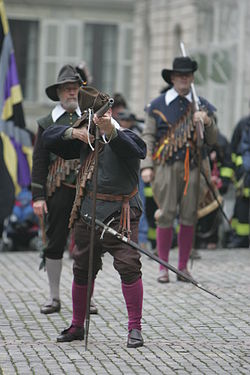
Arquebus — photo 5

Arquebus — photo 6
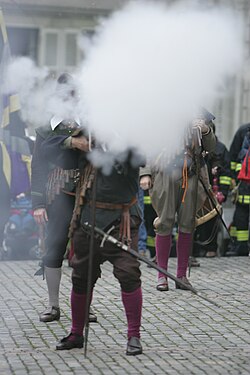
Arquebus — photo 7

Two soldiers on the left using arquebuses, 1470

Early matchlocks as illustrated in the Baburnama (16th century)
🎭 Cultural Impact
The arquebus had a big impact on culture! 🎭It inspired stories, paintings, and movies about battles and adventures. People admired soldiers who used arquebuses, and they were often shown as heroes in tales. ✨One famous painting, "The Battle of San Romano," depicts warriors using arquebuses to fight. It also changed the way countries built armies and trained their soldiers. Countries realized they needed more guns like the arquebus to be strong! 🎨Today, we still see shows and games about this time, reminding us how important the arquebus was in history!
Go deeper⚔️ Usage In Warfare
Arquebuses were mainly used in battles during the 16th and 17th centuries! ⚔️ They helped armies win fights against knights and other warriors. The sound of multiple arquebuses shooting could scare enemies. 🎺Soldiers would often stand in lines, taking turns to fire, and then reload their weapons. This teamwork was essential! They often fought in large battles, like the famous Battle of Pavia in 1525, where the arquebus played a vital role. As armies grew, they used arquebuses in tactics like ambushes and skirmishes, making them a significant part of military strategy! 🛡️
Go deeper📚 Types Of Arquebuses
There were different types of arquebuses 📚! Some had a matchlock, which used a burning match to fire, while others had a wheel lock that used a spinning wheel to create sparks. The caliver was a smaller version that was easier to carry. 🔫Another type was called the "bando" arquebus which was longer and had a better range. Soldiers loved the arquebus because it could shoot at a target from far away, allowing them to stay safe while aiming! As these types developed, they became more accurate and powerful, changing how battles were fought. 🏰
Go deeper🎯 Design And Mechanism
The arquebus had a simple yet clever design! It was made of a barrel 🎯, a stock (the part you hold), and sometimes a trigger. Inside the barrel, gunpowder 🔥 was placed at the back, and a bullet was pushed in. To fire it, soldiers would light a small fuse or use a match to ignite the gunpowder. When it exploded, it shot the bullet out! This made it different from bows and arrows, which require more skill! 🎯Arquebuses were heavy, so they needed a stand, like a tripod, to aim properly. Many soldiers trained hard to use them well!
Go deeper🔩 History Of The Arquebus
The arquebus was invented in the 1400s, during a time when knights and castles were common. It was made with a heavy metal barrel 🔩 that was about three feet long! The first arquebuses appeared in Spain and then spread to other countries like France and Italy. By the 16th century, they became very popular in battles. Famous explorers, like Ferdinand Magellan, used arquebuses on their trips! 🌍In wars, these guns helped soldiers fight better than before. By the 17th century, the arquebus was commonly used in armies all over Europe! ⚔️
Go deeper🕰️ Legacy And Preservation
The legacy of the arquebus lives on! 🕰️ Today, museums around the world display arquebuses to show how weapons evolved. Historical reenactments sometimes feature arquebus firing to teach people about history! 📜They remind us of the important changes in warfare. In some countries, traditional soldiers still use replicas of arquebuses in special events, keeping the memory alive! 🌍As newer gun technologies developed, we still see the influence of the arquebus in modern firearms today. Its story is an exciting part of our past, reminding us of how we learned about defense and change!
Go deeper🔥 Evolution Into Modern Firearms
The arquebus was the starting point for many modern guns! 🔥After the arquebus, new designs like the musket emerged in the 17th century. Muskets were longer and had improvements like rifling, which made bullets fly straighter! 🔫Over time, weapon technology advanced, leading to repeating firearms that could shoot multiple times without reloading. Automatics and pistols came later, changing how people aimed and fired weapons. 🛡️ The arquebus set the foundation for these innovations, helping shape military technology. This evolution still affects guns and hunting tools used today! 🚀
Go deeper💥 Artillery And Arquebus Collaboration
Artillery and the arquebus worked together in battles! 💥Artillery refers to larger guns and cannons used to fire heavy projectiles, while the arquebus was smaller and portable. During wars, armies would use cannons to bomb from afar and arquebuses for close combat. The combination was powerful! 🎯During the Siege of Malta in 1565, both arquebusiers and cannons played important roles. Wizard-like coordination was needed to plan attacks! Together, they changed how battles were fought by allowing for different strategies, defending forts, and attacking opponents, making both artillery and arquebuses essential partners. 🏰
Go deeper🔍 Comparative Analysis With Other Firearms
When comparing the arquebus to other firearms, it's clear they were early and unique! 🔍For example, rifles, which appeared later, had grooved barrels that improved accuracy over long distances. The arquebus had a smooth barrel, which meant it was less accurate. However, arquebuses were easier to load and fire than earlier weapons like crossbows! ⚔️ Unlike pistols, which are designed for quick shooting, the arquebus was slower and required more time to reload. Despite this, it was more powerful than simple hand cannons, making it a favorite for many armies at the time!
Go deeper⚔️ Famous Historical Battles Involving Arquebuses
Many famous battles included soldiers using the arquebus! ⚔️ One of the most notable was the Battle of Pavia in 1525, where the Spanish army used arquebuses to defeat the French. Another was the Battle of Lepanto in 1571, when Christian forces fought against the Ottoman Empire. 🚢In each of these battles, the arquebus played a key role in changing the outcome! Both sides began to realize how important guns were in warfare, changing strategies and leading to advancements in military tactics. These events helped shape European history! 📜
Go deeper