Arnold Sommerfeld Facts For Kids
Arnold Johannes Wilhelm Sommerfeld was a pioneering German theoretical physicist who made significant contributions to atomic and quantum physics and inspired countless students in the field.
Select reading age

Arnold Sommerfeld Facts For Kids
Videos & Quizzesincluded
About this topic
Arnold Sommerfeld was a super-smart physicist from Germany! 🇩🇪 He was born on December 5, 1868, in Königsberg, which is now known as Kaliningrad, Russia. He studied hard and became famous for his work in atomic and quantum physics. This means he studied tiny particles that make up everything around us! 🌟Sommerfeld helped people understand how these particles behave. He is remembered for being a great teacher who inspired many students to explore the wonders of science! 📚🌍
Explore with ChatDinoKey Points
Sommerfeld received many awards for his incredible work in physics!
Sommerfeld grew up in a loving family and loved learning from a young age!
Sommerfeld’s discoveries paved the way for modern physics!
Sommerfeld wrote many books and papers that are still read today!
Sommerfeld worked closely with Albert Einstein, the famous scientist who created the theory of relativity!
Arnold Sommerfeld's passion for teaching is a big part of his legacy!
Did you know that every element has a unique light show?
Arnold Sommerfeld was not just a scientist; he was an amazing teacher!
Arnold Sommerfeld changed the way we think about atoms!
Photos of Arnold Sommerfeld

Sommerfeld in 1897
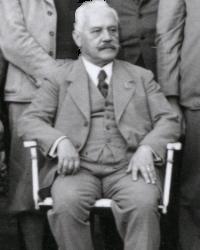
Arnold Sommerfeld, Stuttgart 1935

Sommerfeld's grave at the Munich Nordfriedhof

Title page to Atomic Structure and Spectral Lines (1923), translated by Henry Brose
🏆 Awards And Recognitions
Sommerfeld received many awards for his incredible work in physics! 🏆In 1915, he won the prestigious "Max Planck Medal" for his research and contributions to theoretical physics. 🥇He was also elected to several scientific academies because of his achievements. People admired Sommerfeld not just for his genius but also for his dedication to science and education. His legacy lives on through the respect and admiration he earned throughout his life! 🎉🌈
Go deeper🎓 Biographical Background
Sommerfeld grew up in a loving family and loved learning from a young age! 🎓He went to school in different cities, including Berlin and Göttingen. He became a professor, which means he taught students about physics! Some of his students became famous scientists too. He worked at many universities during his life. Sommerfeld's curiosity and passion for science helped him create amazing theories! He passed away on April 26, 1951, but his ideas live on! 🌈✨
Go deeper🧑🔬 Impact On Modern Physics
Sommerfeld’s discoveries paved the way for modern physics! 🧑🔬 His work on quantum mechanics was crucial for developing new technologies! Many inventions we use today, like computers and smartphones, were made possible by the understanding of atomic behavior he helped create! 📱💻 Scientists today still rely on his theories as they explore new horizons in physics. His contributions show how important it is to keep learning and discovering new things! 🚀🌌
Go deeper📖 Publications And Key Works
Sommerfeld wrote many books and papers that are still read today! 📖One of his most famous books is "Atombau und Spektrallinien," which translates to "Atomic Structure and Spectral Lines." In this book, he explained his ideas about atoms and spectra in detail. Sommerfeld’s research papers laid the foundations for future physics studies! His writings helped many students learn about atomic theory, quantum mechanics, and more. He believed sharing knowledge was important for the scientific community! 🌟📚
Go deeper🥳 Relativity And Atom Theory
Sommerfeld worked closely with Albert Einstein, the famous scientist who created the theory of relativity! 🥳While Einstein studied big things like space and time, Sommerfeld explored small things, like atoms and particles. He combined ideas from relativity with atomic theory to create new theories about how atoms work in high-speed situations. This helped scientists understand particles moving really fast! 😲Their combined efforts pushed the boundaries of science and brought new ideas about the universe! 🌌🌠
Go deeper🎓 Legacy In Physics Education
Arnold Sommerfeld's passion for teaching is a big part of his legacy! 🎓He helped many young scientists start their careers by sharing his knowledge and excitement about physics. Sommerfeld created rich learning environments where curiosity was encouraged! 📚He believed in hands-on learning, which helped students grasp complex subjects. Today, many schools still use techniques inspired by him. His emphasis on mentorship has made lasting impacts on physics education! 🌍✨
Go deeper🌈 Sommerfeld's Theory Of Spectra
Did you know that every element has a unique light show? 🌈Sommerfeld studied the spectra that atoms emit when heated or excited, like fireworks in the sky! 🎆He explained how different colors appear when light passes through a prism. His work on spectra helped scientists identify elements in stars! 🪐This research was very important for astronomy and chemistry. His theory also explained why we see specific lines of light. Sommerfeld made studying light a lot more fun! 🌠
Go deeper📚 Mentorship And Academic Influence
Arnold Sommerfeld was not just a scientist; he was an amazing teacher! 📚He mentored many students who later became brilliant scientists themselves. Some of his students include Wolfgang Pauli and Hans Bethe! 🏅He encouraged them to think creatively and explore new ideas in physics. Sommerfeld’s teaching style was fun and engaging, making complex topics easier to understand. His influence shaped many careers and inspired future generations of physicists! 🌟👩🔬
Go deeper🧪 Contributions To Quantum Mechanics
Arnold Sommerfeld changed the way we think about atoms! 🧪He created a quantum model that showed how electrons move around the nucleus of an atom. An atom is like a tiny solar system! ☀️ This model helped scientists understand why metals conduct electricity and why light behaves differently. Sommerfeld's theories, including the Sommerfeld Model, were super important for future discoveries in quantum physics. He worked hard to simplify difficult ideas so everyone could understand them! 🚀🌌
Go deeper