Amplitude modulation is a method used in electronic communication to encode information onto a radio wave by varying the amplitude, allowing audio signals to be transmitted over long distances.
Set reading age
View for Kids
Easy to read and understand
View for Students
Clear, detailed explanations
View for Scholars
Deep dives and big ideas
Amplitude Modulation, or AM, is a special way of sending messages using radio waves! 📻This technique helps radios play music and news. AM waves change their strength (amplitude) to carry sounds. You can find AM radio stations all over the world, like in the United States 🇺🇸 and Australia 🇦🇺. AM radio works best for talking, while other methods are used for music or high-quality sounds. It's like when you shout to your friends from a distance! 🎤AM makes sure your voice travels far and clear, even over mountains or through buildings. Isn’t that cool?
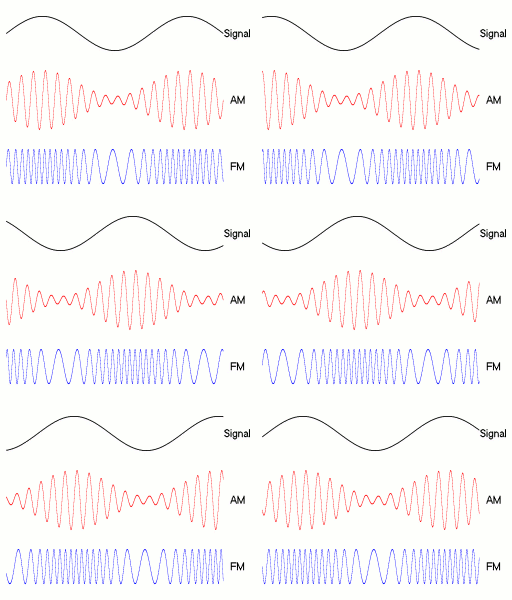
You may have heard of another wave technique called Frequency Modulation, or FM. 🤔While both AM and FM are used for radio, they have differences. AM changes the height (amplitude) of the wave for sending sound, while FM changes the wave's speed or frequency! 🎵FM usually sounds clearer and is better for music, while AM covers more distance and is great for voices and news. For example, the AM station talks about the weather, while FM plays your favorite songs. So, both have their strengths in our daily listening!
Carrier waves play a big role in Amplitude Modulation! 📡Think of a carrier wave as a sturdy boat in water. It keeps everything steady! When you want to send a message, you place it on this boat by changing the wave's amplitude. As the wave travels, it carries the message to radios everywhere! 🌊Carrier waves are super important because they help the signal travel far distances without getting lost. When you listen to the radio, the carrier wave is working hard to ensure you get clear sounds—the strength of your voice, traveling like magic!
Every Amplitude Modulation system has some important parts! 🔧First is the Transmitter, which sends the AM signals. Next is the Carrier Wave, the steady signal that wraps around the message. Then we have the Modulator that mixes your voice or music with the carrier. 📡The Antenna helps send the wave into the air, while the Receiver picks it up so you can listen! Lastly, we have speakers that turn the signal back into sounds you can hear. All these parts work together to make communication possible!
Amplitude Modulation is when the strength of a radio wave changes to send information, like music or voices. Imagine you are talking: sometimes you whisper, and sometimes you shout. 📢Your voice is like the radio wave, and the loudness is the amplitude! Scientists discovered AM in the early 1900s, and it quickly became popular. 🎉You can find AM in radios around the world! When you tune into an AM station, you are listening to sounds that have traveled long distances. It's one way people share messages with each other, using technology!
Amplitude Modulation works through exciting waves! 🌊A radio wave has a steady shape called a carrier wave. When we want to say something, we add (or modulate) our voice to this wave. 🎶The wave's height (amplitude) changes to match our voice. So, when you say "hello," the wave becomes taller and shorter, just like your voice! This new wave carries the information to radios, which then play the sound for you to hear. So each time you adjust the radio dial, you’re tuning into a different message sent via AM!
The history of Amplitude Modulation started in the early 1900s! 🕰️ An inventor named Lee DeForest created the Audion vacuum tube, which helped send AM signals. 📡The first successful AM radio transmission happened in 1906, and soon, people all over had radios in their homes! 🎉AM radio became popular during the 1920s and 1930s. During World War II, they even used AM in messages to soldiers! Over the years, AM radios evolved, but they’ve remained a key way to communicate. Today, AM can be found in many devices, keeping history alive!
Amplitude Modulation has both good and not-so-good parts. 🤩An advantage is its wide coverage area. AM signals can go far and reach people miles away! Also, AM radios are simple and inexpensive to make. 💵However, one disadvantage is that AM can sound fuzzy, especially near big buildings or mountains. This happens because other noises mix in with the waves. 🎶Another downside is that AM isn't as good for music as FM; it may not sound as clear. Still, it remains popular for talking and sharing important messages!
Amplitude Modulation is used for many cool things! 📻Most commonly, it's for AM radio stations, helping share music, news, and sports updates! 🌍You can find these stations even in cars, at home, or on your phone. AM is also used in aviation to help pilots talk with air traffic controllers. 🛩️ Plus, some walkie-talkies and communication devices use AM to ensure clear conversations. It's like a fun secret code that everyone can hear! So next time you listen to the radio, remember how important AM is in our world!
What does the future hold for Amplitude Modulation technology? 🔮Well, AM isn't going anywhere! Even with new methods like FM and digital radio, AM still has a purpose. It might improve with better sound quality and more exciting features! 🎧Scientists are working on making AM systems more efficient and reliable. 🌍You might find these new AM radios in cars, smart devices, or even new gadgets! The legacy of AM continues, promising to connect people and share information in innovative ways. Just like waves, AM will keep rolling on for years to come! 🌊


DIY is a creative community where kids draw, build, explore ideas, and share.
No credit card required