Alphonse Mucha Facts For Kids
Alphonse Mucha was a renowned Czech artist known for his unique style that significantly influenced the Art Nouveau movement, celebrated for his illustrations, posters, and paintings featuring beautiful women and floral motifs.
Select reading age

Alphonse Mucha Facts For Kids
Videos & Quizzesincluded
About this topic
Alphonse Mucha was a famous Czech artist born on July 24, 1860, in Ivančice, Czech Republic 🇨🇿. He became very well-known for his beautiful posters and illustrations that use bright colors and flowing lines. Mucha loved to paint pictures of women, often making them look like goddesses or fairies 🌸. He helped create a special art style called Art Nouveau, which is all about nature and beauty. His work was so popular that it can still be found in galleries and museums around the world today! 🌍✨
Explore with ChatDinoKey Points
Throughout his life, Mucha received many awards and recognitions for his work 🎖️.
Alphonse Mucha did more than just create pretty art; he changed the way people saw art in everyday life!
As a child, Mucha loved drawing and painting 🎨.
Today, Mucha's work is celebrated in many museums and galleries 📅.
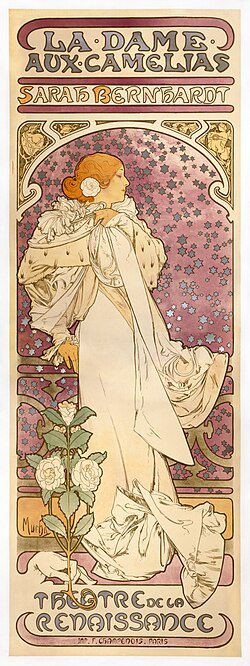
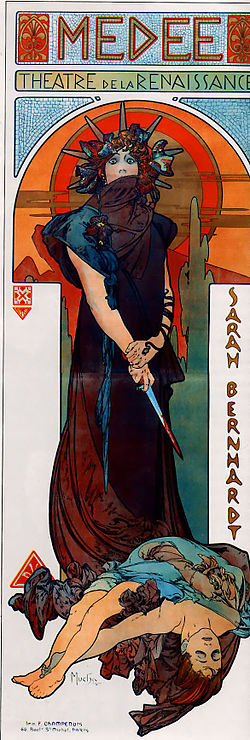
Mucha's art is known for its flowing lines, intricate patterns, and beautiful women, like graceful fairies 🌿.
Some of Mucha's most famous works include the "Gismonda" poster, featuring actress Sarah Bernhardt 🌟, and the "Four Seasons" series!
Mucha's influence can still be seen today in many art forms!
Mucha is often called the "father of Art Nouveau," a style that became popular in the late 1800s and early 1900s ✨.
In the later part of his life, Mucha wanted to focus on history and spirituality, creating large, important works 🌌.
Photos of Alphonse Mucha

Portrait of Saints Cyril and Methodius for the Roman Catholic church in Pisek, North Dakota (1887)

Poster of Sarah Bernhardt as Gismonda (1894)

Alphonse Mucha — photo 3
Alphonse Mucha — photo 4

Alphonse Mucha — photo 5

Alphonse Mucha — photo 6

Alphonse Mucha — photo 7
Alphonse Mucha — photo 8

Alphonse Mucha — photo 9
🎖️ Recognition And Awards
Throughout his life, Mucha received many awards and recognitions for his work 🎖️. He was honored not just in his home country of Czech Republic, but also across Europe and beyond! In 1939, he got the Order of the White Lion, a prestigious award in his land. This recognition showed how much people appreciated his talent and dedication to art. Even today, many art lovers acknowledge Mucha's contributions to the world of art, and he remains a favorite among artists and art enthusiasts! 💖
Go deeper🎨 Mucha's Cultural Impact
Alphonse Mucha did more than just create pretty art; he changed the way people saw art in everyday life! 🎨His works made art feel closer to everyone, moving beyond galleries and into homes, theaters, and shops. Mucha's influence is not limited to just one place; his art can be found around the world! From jewelry designs to wallpaper patterns, his magical style continues to inspire people of all ages! His legacy reminds us that art can be fun and beautiful at the same time! 🌈
Go deeper🎨 Early Life And Education
As a child, Mucha loved drawing and painting 🎨. Even though his family was not rich, they supported his dreams. At just 15 years old, he moved to the city of Brno to study at an art school. Later, he traveled to Paris, France 🇫🇷, to learn more about art at the famous Académie Julian. His time in Paris was important, as he met other artists and became more exposed to different styles of art. He worked hard and never gave up on becoming a great artist! 💪
Go deeper📅 Exhibitions And Collections
Today, Mucha's work is celebrated in many museums and galleries 📅. The Mucha Museum in Prague, Czech Republic 🇨🇿, has many of his original posters and works on display. Major art institutions worldwide, such as the Museum of Modern Art in New York, also showcase his art! Exhibitions featuring Alphonse Mucha often draw large crowds because people love to see his vibrant colors and stunning designs! His artworks help us understand the stories and dreams of the past, making him one of the most beloved artists of all time! 🖌️
Go deeper🌿 Artistic Style And Influences
Mucha's art is known for its flowing lines, intricate patterns, and beautiful women, like graceful fairies 🌿. He was inspired by nature, mythology, and even the culture of his homeland, Czech Republic 🇨🇿. He loved to use pastel colors, which made his paintings feel soft and dreamy. Artists like Henri Toulouse-Lautrec and Gustav Klimt also influenced him. Mucha created posters that made everyday items look magical, turning the ordinary into the extraordinary! ✨
Go deeper🌟 Major Works And Iconic Posters
Some of Mucha's most famous works include the "Gismonda" poster, featuring actress Sarah Bernhardt 🌟, and the "Four Seasons" series! Each season had its own unique design, showing the beauty of nature. He also created a well-known piece called "The Slav Epic," which tells the history of the Slavic people across 20 huge canvases! His posters were not just art; they became part of everyday life, adorning theaters, cafés, and homes, making art accessible to everyone! 🎭
Go deeper🎉 Legacy And Influence On Modern Art
Mucha's influence can still be seen today in many art forms! His unique style inspired graphic designers, illustrators, and even fashion designers! 🎉People still love his work, and you can find it in art galleries and exhibitions all over the world. Every year, many artists look back at Mucha's creations to inspire their own work. His ability to capture beauty and nature helps remind us how art can connect us to our feelings and culture. 🌟
Go deeper✨ Mucha's Role In The Art Nouveau Movement
Mucha is often called the "father of Art Nouveau," a style that became popular in the late 1800s and early 1900s ✨. This movement celebrated nature, elegance, and femininity, aiming to break away from traditional art styles. Mucha's work was featured in many exhibitions, attracting attention and inspiring other artists! He focused on harmony, beauty, and design, helping to create a new and exciting era in art. His style influenced architecture, jewelry, and even graphic design! 🏛️
Go deeper🌌 Later Career And Transition To Historical Painting
In the later part of his life, Mucha wanted to focus on history and spirituality, creating large, important works 🌌. He believed art could tell the stories of people's lives and their cultures! Mucha worked on "The Slav Epic," which celebrates Slavic history and heroes. He felt that it was important for the future generation to remember their roots. His love for history and beautiful storytelling brought new energy to his paintings, and he created big murals and themes that made people think. 🖼️
Go deeper