All Articles

Al-khwarizmi

Al-khwarizmi Facts For Kids

Muhammad ibn Musa al-Khwarizmi was a Persian polymath known for his influential works in mathematics, astronomy, and geography during the Islamic Golden Age.

🎨 Reading age for 6-8
Background blob
Al-khwarizmi
Al-khwarizmi
Facts for Kids!

Do more with AI

Introduction

Al-Khwarizmi was an amazing Persian mathematician who lived a long time ago, around 780-850 AD. 🌟He was born in a city called Khwarezm, located in present-day Uzbekistan. He is often called the "father of algebra." His full name is Muhammad ibn Musa al-Khwarizmi. 📜Al-Khwarizmi wrote many important books that helped people understand math better! He shared his knowledge with others and helped create ideas that we still use today, making him a very special person in history!

Images of Al-khwarizmi

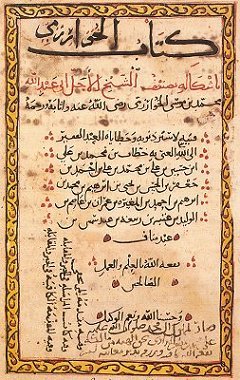
A page from al-Khwārizmī's Algebra

A page from al-Khwārizmī's Algebra

Photos of Al-khwarizmi
Algorists vs. abacists, depicted in an etching from 1503 CE

Algorists vs. abacists, depicted in an etching from 1503 CE

Page from a Latin translation, beginning with "Dixit algorizmi"

Page from a Latin translation, beginning with "Dixit algorizmi"

Page from Corpus Christi College MS 283, a Latin translation of al-Khwārizmī's Zīj

Page from Corpus Christi College MS 283, a Latin translation of al-Khwārizmī's Zīj

Gianluca Gorni's reconstruction of the section of al-Khwārizmī's world map concerning the Indian Ocean. The majority of the placenames used by al-Khwārizmī match those of Ptolemy, Martellus and Behaim. The general shape of the coastline is the same between Taprobane and Cattigara. The Dragon's Tail, or the eastern opening of the Indian Ocean, which does not exist in Ptolemy's description, is traced in very little detail on al-Khwārizmī's map, although is clear and precise on the Martellus map and on the later Behaim version.Image by Gianluca Gorni, licensed under Creative Commons Attribution-Share Alike 4.0

Gianluca Gorni's reconstruction of the section of al-Khwārizmī's world map concerning the Indian Ocean. The majority of the placenames used by al-Khwārizmī match those of Ptolemy, Martellus and Behaim. The general shape of the coastline is the same between Taprobane and Cattigara. The Dragon's Tail, or the eastern opening of the Indian Ocean, which does not exist in Ptolemy's description, is traced in very little detail on al-Khwārizmī's map, although is clear and precise on the Martellus map and on the later Behaim version.

A 15th-century version of Ptolemy's Geography for comparison

A 15th-century version of Ptolemy's Geography for comparison

Earliest extant map of the Nile, in Al-Khwārazmī’s Kitāb ṣūrat al- arḍ.

Earliest extant map of the Nile, in Al-Khwārazmī’s Kitāb ṣūrat al- arḍ.

A page from al-Khwārizmī's Algebra

A page from al-Khwārizmī's Algebra

Photos of Al-khwarizmi
Algorists vs. abacists, depicted in an etching from 1503 CE

Algorists vs. abacists, depicted in an etching from 1503 CE

Page from a Latin translation, beginning with "Dixit algorizmi"

Page from a Latin translation, beginning with "Dixit algorizmi"

Page from Corpus Christi College MS 283, a Latin translation of al-Khwārizmī's Zīj

Page from Corpus Christi College MS 283, a Latin translation of al-Khwārizmī's Zīj

Gianluca Gorni's reconstruction of the section of al-Khwārizmī's world map concerning the Indian Ocean. The majority of the placenames used by al-Khwārizmī match those of Ptolemy, Martellus and Behaim. The general shape of the coastline is the same between Taprobane and Cattigara. The Dragon's Tail, or the eastern opening of the Indian Ocean, which does not exist in Ptolemy's description, is traced in very little detail on al-Khwārizmī's map, although is clear and precise on the Martellus map and on the later Behaim version.Image by Gianluca Gorni, licensed under Creative Commons Attribution-Share Alike 4.0

Gianluca Gorni's reconstruction of the section of al-Khwārizmī's world map concerning the Indian Ocean. The majority of the placenames used by al-Khwārizmī match those of Ptolemy, Martellus and Behaim. The general shape of the coastline is the same between Taprobane and Cattigara. The Dragon's Tail, or the eastern opening of the Indian Ocean, which does not exist in Ptolemy's description, is traced in very little detail on al-Khwārizmī's map, although is clear and precise on the Martellus map and on the later Behaim version.

A 15th-century version of Ptolemy's Geography for comparison

A 15th-century version of Ptolemy's Geography for comparison

Earliest extant map of the Nile, in Al-Khwārazmī’s Kitāb ṣūrat al- arḍ.

Earliest extant map of the Nile, in Al-Khwārazmī’s Kitāb ṣūrat al- arḍ.

Influence On Astronomy

Al-Khwarizmi didn't just love math; he also was fascinated by the stars! 🌌He wrote books about astronomy and helped people improve their understanding of the night sky. He created star charts and helped calculate the lengths of a year. 🌙One of his most famous works is the "Zij al-Sindhind," which studied how to predict the movements of stars and planets. His discoveries helped navigators travel the seas and guided explorers to new lands! 🚢

Works And Publications

Al-Khwarizmi wrote many important books that changed how people learned math and science. 📖His most famous work is "Al-Kitab al-Jabr wal-Muqabala," where he introduced algebra to the world. He also created books on astronomy and geography. 🌍Some titles include "The Great Book of the Description of India," which explained land and people. Al-Khwarizmi's writings were translated into many languages, helping his ideas spread throughout Europe and Asia! 🌐

Early Life And Education

Al-Khwarizmi was born in a city filled with knowledge and culture. 🕌As a young boy, he loved learning and discovering new things. He studied deeply, especially in mathematics and astronomy. ✨He lived during the Islamic Golden Age, a time when many discoveries were made in science and math. People traveled from far away to learn from talented scholars like Al-Khwarizmi. He grew up in Baghdad, the capital of Iraq, where he learned from some of the best teachers of his time.

The Development Of Algebra

Al-Khwarizmi helped change how people thought about numbers. Before him, math was mostly focused on solving everyday problems. He created rules for working with unknown numbers, which we now call variables. 🔢He taught how to solve equations, like balancing things on both sides. 🎭This way of thinking allowed people to solve problems in a structured way. Al-Khwarizmi's work laid the groundwork for modern algebra, and students still learn about his methods in classrooms everywhere! 🎓

Contributions To Mathematics

Al-Khwarizmi made amazing contributions to mathematics! He introduced the concept of "algebra," which comes from his famous book called "Al-Kitab al-Mukhtasar fi Hisab al-Jabr wal-Muqabala." 📚 The word "algebra" itself comes from "al-jabr," one of the techniques he used! He worked on solving equations and made math easier for everyone. 🌈His ideas helped teach people how to solve problems step by step, which is a big part of math today.

Legacy And Impact On Future Scholars

Al-Khwarizmi's work still influences us today! 🌟He is known as the "father of algebra," and many mathematicians and scientists have built further ideas on his foundation. Scholars from different cultures studied his books and learned from his methods. 🚀Even now, students around the world learn algebra in school thanks to what he shared! His dedication to learning and teaching has inspired countless generations to explore math and science.

Cultural Context And Historical Background

Al-Khwarizmi lived during the Islamic Golden Age from the 8th to 13th century. 🕌This was a magical time when scholars made breakthroughs in art, science, and math, especially in cities like Baghdad! 🌏People from different cultures shared their knowledge, and libraries were filled with wise texts. Al-Khwarizmi's work was influenced by older Greek texts, but he added his own ideas and techniques. This blend of cultures helped create a rich learning environment that raised the level of knowledge for everyone!

Comparative Analysis With Other Mathematicians

Al-Khwarizmi is often compared to other great mathematicians like Euclid and Pythagoras. 📐While Euclid focused on geometry and shapes, Al-Khwarizmi created rules for working with numbers and equations. Al-Khwarizmi’s work was unique because he simplified complex problems, making them accessible to anyone! ✨His approach laid the groundwork for future mathematicians like Leonardo Fibonacci. Fibonacci learned from Al-Khwarizmi’s ideas and followed in his footsteps, further improving mathematics in the future. 🔗

Al-khwarizmi's Methods In Everyday Problem Solving

Al-Khwarizmi's methods can help with everyday problems! 🌈For example, if you have 10 apples and want to share them with your 5 friends, his way of thinking can help you find out how many each person gets. 🍏His step-by-step problem-solving techniques are used today in schools to teach kids how to work through math challenges. By learning his methods, you can become a math wizard 🌟 and solve all kinds of problems, big and small!

Al-khwarizmi Quiz

Q1
Question 1 of 10

Learn more about Al-khwarizmi

Ready to create?

Make

To create a safe space for kid creators worldwide!

Create

Vibe Coding

Kids GPT

All Tools

Kibu

Resources

Worksheets

SafeTube

Blog

FAQ

Account

Pricing

Log-in

Sign-up

Data Deletion

Company

About

Community Guidelines

Privacy Policy

Terms of Service

2025, URSOR LIMITED. All rights reserved. DIY is in no way affiliated with Minecraft™, Mojang, Microsoft, Roblox™ or YouTube. LEGO® is a trademark of the LEGO® Group which does not sponsor, endorse or authorize this website or event. Made with love in San Francisco.