Rib Cage Facts For Kids
The rib cage is a bony structure that surrounds and protects the thoracic cavity, housing essential organs such as the heart and lungs.

Do more with AI
Introduction
The rib cage is an important part of our body! 🌟It is a bony structure in our chest that protects vital organs like the heart and lungs. The human rib cage is made up of 12 pairs of ribs, which means we have 24 ribs in total! Each rib connects to the spine at the back and curves around to the front where some connect to the sternum, or breastbone. The rib cage helps keep our bodies strong and protects us from injury. It also plays a role in breathing, making it super important for our daily lives! 😄
Images of Rib Cage

The parts of the rib


A central rib of the left side, viewed from behind.
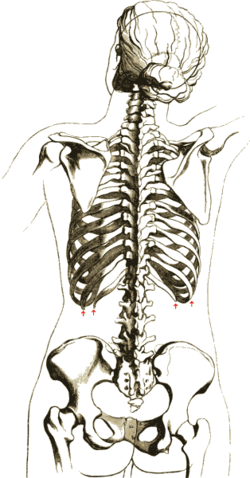
The four floating ribs indicated

Human ribs: trues, false and floating


3D VR of a CT scan: Parallel projection (left) and perspecive projection (right). Generated by Kieran Maher using OsiriX. marz 09:28, 30 October 2006 (UTC)

A C7 rib on the right

The effect of the contraction of the accessory muscles of inhalation, pulling the front of the rib cage upwards, a movement known as the 'pump handle movement'. This increases the antero-posterior diameter of the thorax, contributing to the expansion in the volume of the chest. A similar effect, known as the 'bucket handle movement' causes the transverse diameter of the chest to increase, because not only do the ribs slant downwards from the back to the front, but, in the case of the lower ribs, also from the midline downwards to the sides of the chest.
Anatomy Of The Rib Cage
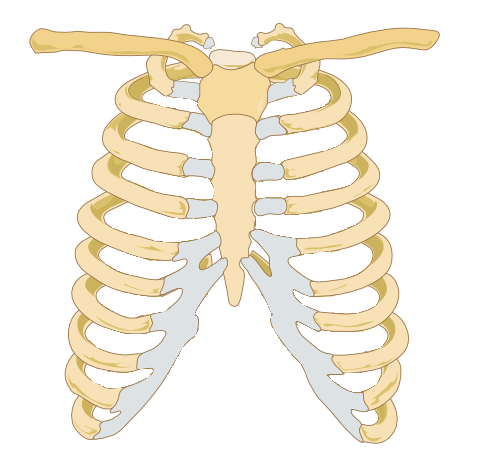
The rib cage has several key components. The 12 pairs of ribs are classified into three types: true ribs, false ribs, and floating ribs. True ribs (1-7) connect directly to the sternum. False ribs (8-10) connect to the sternum through cartilage, while floating ribs (11-12) do not connect at the front! 🦴The ribs attach to the spine at the back, providing a safe space for your lungs and heart. The sternum is shaped like a flat stick and is located right in the center of your chest. All these parts work together!
Functions Of The Rib Cage
The rib cage has several important jobs. First, it protects our heart and lungs from getting hurt! 💔💨 This protection is very important because these organs help us breathe and pump blood throughout our body. Second, the rib cage plays a big role in how we breathe. When we inhale, the ribs move up and out, creating more space for our lungs to fill with air! When we exhale, the ribs move back down. Lastly, the rib cage gives our body shape and helps support our upper body during movement!
Development Of The Rib Cage
The rib cage starts developing when we are babies! 👶During the first few months of life, our rib cage is soft and made of cartilage, which is a flexible material. As we grow, this cartilage slowly turns into bone, just like many other parts of our body. By the time we reach about 18 years old, our rib cage is fully formed and ready to protect our organs! It’s amazing how our bodies grow and change as we learn to walk, run, and play! Remember, taking care of your body helps keep your rib cage strong! 🌱
Rib Cage Disorders And Injuries
Like all parts of our body, the rib cage can experience problems too! Some common injuries include rib fractures from accidents or sports. 🏃♂️⚽ A fractured rib can be very painful and may make it hard to breathe deeply. Disorders of the rib cage can include scoliosis, which causes the spine to curve sideways and can affect the rib cage shape. In rare cases, some people may be born with conditions like Poland syndrome, where certain ribs may be missing. If you ever feel pain in your ribs, it's important to tell an adult!
Comparison With Other Vertebrates
Did you know that many animals have rib cages too? 🐶🐱 Just like us, animals like cats and dogs have ribs that protect their organs. However, the number of ribs varies! For example, cats have 13 pairs of ribs, while elephants have 19. Some animals, like snakes, don't have a rib cage quite like ours. 🐍Instead, they have many tiny rib bones that help them move and protect their organs. The rib cage structure helps most vertebrates keep their important organs safe and support their bodies!
Interesting Facts About The Rib Cage
Here are some fun facts about the rib cage! 🤩Did you know that the rib cage is responsible for about 30% of your breathing? Also, the rib cage provides a strong structure that can withstand a lot of pressure! The smallest bone in our body, the stapes, is found in the ear, but bones in the rib cage are larger and help support our body! Some fish also have rib-like structures to protect their organs! Isn’t it amazing how similar and different rib cages can be across the animal kingdom? 🐟🦒
Cultural Perspectives On The Rib Cage
In various cultures, the rib cage holds different meanings. For some, it represents strength and protection. 🙏In Chinese medicine, health is often thought to relate to the ribs and lungs. The rib cage is also celebrated in art, literature, and music! In ancient Egypt, when people were mummified, the rib cage and heart were carefully preserved, showing its importance in their beliefs about the afterlife. In many cultures, caring for our bodies, including the rib cage, is seen as a way to honor ourselves!
Historical Significance Of The Rib Cage
Throughout history, the rib cage has been important in understanding how the body works. Ancient doctors, like Hippocrates in Greece, looked at rib cages to study breathing and medicine! 📜Rib cages have also been found in old fossils, helping scientists learn how animals evolved over millions of years! Different cultures even used rib bones in art and tools. Today, studying the rib cage helps doctors understand human health and design treatments! The rib cage has been a fascinating topic for many people for centuries!
Rib Cage Quiz
Learn more about Rib Cage
