Tetrahedron Facts For Kids
A tetrahedron is a three-dimensional shape composed of four triangular faces, six edges, and four vertices.
Select reading age

Tetrahedron Facts For Kids
Videos & Quizzesincluded
About this topic
A tetrahedron is a special shape in geometry! 🧊It has four triangular faces, six edges, and four corners (or vertices). You can think of it as a pyramid with a triangular base! Tetrahedra are one of the simplest 3D shapes, which makes them very important in math and science. They can look like dice, pyramids, or even the corner of a tent! 🌄The word "tetrahedron" comes from the Greek word "tetra," meaning four. These fascinating shapes are all around us, and you’ll find them in nature, buildings, and even in games!
Explore with ChatDinoKey Points
There are two main types of tetrahedra: regular and irregular!
Tetrahedra can be found in nature in surprising ways!
Tetrahedra have something called symmetry!
In geometry, tetrahedra help us learn about three-dimensional shapes.
A tetrahedron is defined as a polyhedron with four triangular faces.
Tetrahedra are used in many real-life situations!
Artists and architects love to use tetrahedra in their designs!
To explore tetrahedra in math, we use specific formulas!
Photos of Tetrahedron

A cube dissected into six characteristic orthoschemes.

For Euclidean 3-space, there are 3 simple and related Goursat tetrahedra. They can be seen as points on and within a cube.

Six edge-lengths of Tetrahedron

Illustration of the law of sines for tetrahedra
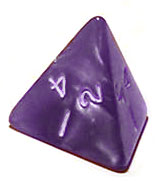
Tetrahedron — photo 5

Tetrahedron — photo 6

Tetrahedron — photo 7

Caltrop from https://www.cia.gov/cia/information/artifacts/caltrop.jpg - w:Caltrop used by the OSS . The hollow spikes puncture self-sealing rubber tires. The hole in the center allows air to escape if the other end of the tube is sealed by soft ground.
🌟 Types Of Tetrahedra
There are two main types of tetrahedra: regular and irregular! 🌟A regular tetrahedron has all four faces the same size and shape (like a perfect pyramid). An irregular tetrahedron has faces that can be different sizes and shapes. There’s also a special kind called a right tetrahedron, where one of the angles is a right angle (90 degrees). 🟠Each type has its own unique properties, making them extremely interesting! Exploring these different shapes helps us understand the world better.
Go deeper🌿 Tetrahedra In Nature
Tetrahedra can be found in nature in surprising ways! 🌿Water molecules have a tetrahedral shape, where one oxygen atom is connected to four hydrogen atoms! This unique shape is essential for life on Earth. Other examples are certain minerals and crystals, like quartz, that have tetrahedral forms. 🌌Also, some viruses use tetrahedral shapes to protect their DNA! Nature loves using tetrahedral shapes to build strong and beautiful things, reminding us how wonderful our world is!
Go deeper🌈 Tetrahedral Symmetry
Tetrahedra have something called symmetry! 🌈Symmetry means something is the same on both sides. A regular tetrahedron has four faces, each the same, so it looks the same from different angles! If you rotate a regular tetrahedron, it still appears unchanged, just like looking in a mirror. 🪞This property helps scientists and mathematicians to study symmetry in nature, from snowflakes to beautiful flowers! It’s an exciting way to explore how things are balanced and pleasing to the eye!
Go deeper📐 Tetrahedra In Geometry
In geometry, tetrahedra help us learn about three-dimensional shapes. 📐They are part of a group called polyhedra, which includes shapes with flat faces. A tetrahedron is the simplest 3-dimensional shape because it has the fewest faces! With geometry, we use tetrahedra in models, designs, and learning about space. 🌌They can also be used to understand how space is divided, like cutting a cake into pieces! Yum! Geometry helps us find the volume 🌊 and surface area ✏️ of a tetrahedron, which are important in math.
Go deeper✨ Definition And Properties
A tetrahedron is defined as a polyhedron with four triangular faces. ✨Each face is a triangle, and these triangles all meet at a point called the vertex. The edges are the lines where two triangles meet. Tetrahedra can be regular (where all faces are the same) or irregular (where faces are different). A regular tetrahedron has all sides of equal length—it's like tossing a fair die! 🎲Did you know? The sum of the angles around each vertex is 360 degrees!
Go deeper🎨 Applications Of Tetrahedra
Tetrahedra are used in many real-life situations! 🎨Engineers often use them in building designs and structures because they provide strength. In computer graphics, tetrahedral shapes help create 3D models for movies and games! 🎮Scientists study them to understand molecules and crystals, as some crystals take on tetrahedral shapes. Even in architecture, resembling tetrahedral forms can help buildings resist strong winds and earthquakes! 🚀So, you'll find these exciting shapes everywhere in our lives!
Go deeper🎨 Tetrahedra In Art And Architecture
Artists and architects love to use tetrahedra in their designs! 🎨Famous buildings often include tetrahedral shapes to create stunning structures. For example, the Eden Project in England has a beautiful geodesic dome that includes tetrahedra! This form helps keep the building sturdy and looks cool too! 🏛️ Artists use tetrahedral structures in sculptures and installations, playing with light and space! Using science and art together, we can create amazing works that inspire and delight us!
Go deeper📏 Mathematical Formulas Related To Tetrahedra
To explore tetrahedra in math, we use specific formulas! 📏The volume (how much space the tetrahedron occupies) is calculated using the formula: V = (1/3) * B * h, where B is the base area and h is the height. This formula helps you find out how much liquid can fit inside! 🔬The surface area formula is more complex: A = √2 * a², where a represents the length of an edge. These mathematical tools help us understand and appreciate the beauty of tetrahedra!
Go deeper