Large Magellanic Cloud Facts For Kids
The Large Magellanic Cloud (LMC) is a dwarf galaxy, orbiting the Milky Way, known for its unique irregular shape and rich star-forming regions.
Select reading age
Large Magellanic Cloud Facts For Kids
Videos & Quizzesincluded
About this topic
The Large Magellanic Cloud (LMC) is a cool dwarf galaxy 🌌 located near our Milky Way galaxy. It's about 163,000 light-years away from Earth, like having a neighbor who takes a long time to visit! The LMC is one of the closest galaxies to us and can be seen from the Southern Hemisphere, especially in places like Australia and South America. Named after explorer Ferdinand Magellan, who sailed around the world, it looks like a small, glowing cloud in the night sky. Just imagine a beautiful, sparkling cloud full of stars! ✨
Explore with ChatDinoKey Points
Galaxies have special structures, and the Large Magellanic Cloud is no different!
Astronomers love studying the Large Magellanic Cloud!
The Large Magellanic Cloud formed over 13 billion years ago!
The Large Magellanic Cloud is home to many fascinating stars and star clusters!
The Large Magellanic Cloud is different from our Milky Way in size and shape.
Did you know that the Large Magellanic Cloud and the Milky Way are best friends?
The Large Magellanic Cloud is not just a scientific wonder; it's also culturally important!
So, what’s next for the Large Magellanic Cloud?
Photos of Large Magellanic Cloud
![Small part of the Large Magellanic Cloud[16]](https://upload.wikimedia.org/wikipedia/commons/thumb/b/bb/Cloaked_in_red.jpg/960px-Cloaked_in_red.jpg)
Small part of the Large Magellanic Cloud[16]

Constellation of Dorado: the LMC is the green circle at the south (bottom) of picture

ESO's VISTA image of the LMC

Location of the Large Magellanic Cloud with respect to the Milky Way and other satellite galaxies
![Two very different glowing gas clouds in the Large Magellanic Cloud, NGC 2014 (red) and NGC 2020 (blue)[39]](https://upload.wikimedia.org/wikipedia/commons/thumb/9/9c/Two_very_different_glowing_gas_clouds_in_the_Large_Magellanic_Cloud.jpg/960px-Two_very_different_glowing_gas_clouds_in_the_Large_Magellanic_Cloud.jpg)
Two very different glowing gas clouds in the Large Magellanic Cloud, NGC 2014 (red) and NGC 2020 (blue)[39]
![NGC 1783 is one of the biggest globular clusters in the Large Magellanic Cloud[44]](https://upload.wikimedia.org/wikipedia/commons/thumb/6/66/A_youthful_cluster.jpg/960px-A_youthful_cluster.jpg)
NGC 1783 is one of the biggest globular clusters in the Large Magellanic Cloud[44]

Small and Large Magellanic Clouds over Paranal Observatory

Large Magellanic Cloud — photo 8
Large Magellanic Cloud — photo 9
📐 Galactic Structure
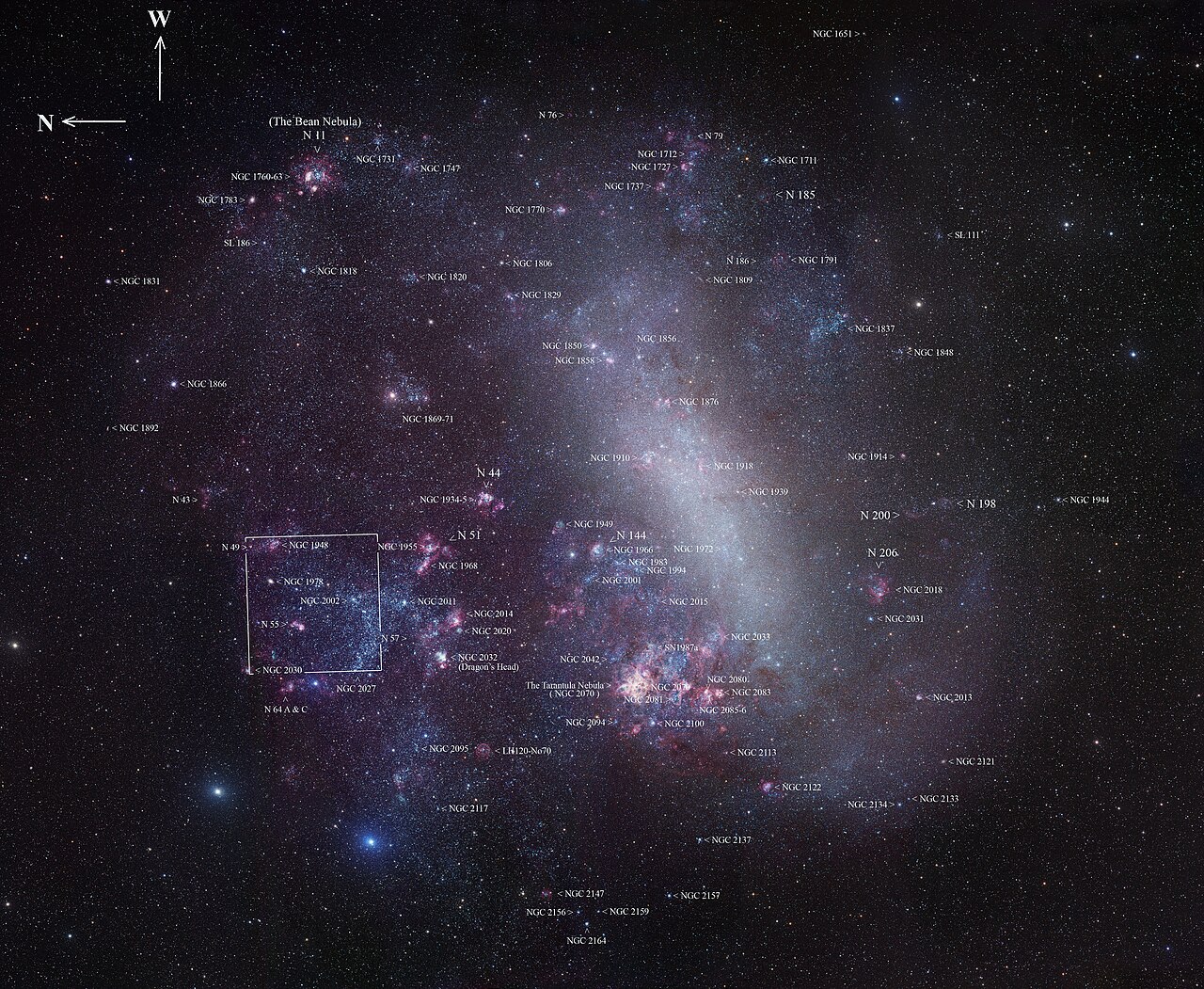
Galaxies have special structures, and the Large Magellanic Cloud is no different! 📐The LMC has a central region where stars are packed closely together. Surrounding this center are different regions filled with gas and newer stars. One interesting thing is that the LMC has a loose, fluffy appearance, unlike the neat spiral of the Milky Way! Did you know that the LMC has also helped scientists learn more about the universe? By studying its structure, they can understand how galaxies work and how they change over time.
Go deeper🔭 Observation And Study
Astronomers love studying the Large Magellanic Cloud! 🔭They use powerful telescopes, like the Hubble Space Telescope, to take amazing pictures and gather data. Because it’s so close, the LMC is perfect for learning about star formation and galactic history. Scientists study its stars, gas, and clusters to understand how galaxies live and thrive. Plus, amateur astronomers can observe the LMC with ordinary telescopes! So, grab your telescope and look at the night sky — you might just spot this fantastic dwarf galaxy! 🌌
Go deeper💫 Formation And Evolution
The Large Magellanic Cloud formed over 13 billion years ago! 💫That's before dinosaurs roamed the Earth! It came together when tiny bits of gas and dust stuck together to create stars and galaxies. Over time, the LMC evolved, gathering stars that formed into clusters and even some fresh stars that continue to shine today. Scientists think that the LMC grew and changed by pulling in material from space and interacting with other galaxies! Isn’t it amazing how galaxies can grow just like how we grow from babies to adults?
Go deeper🌠 Stars And Star Clusters
The Large Magellanic Cloud is home to many fascinating stars and star clusters! 🌠Some famous star clusters include 47 Tucanae and NGC 1978. Many of these stars are much younger than the stars in our Milky Way. In fact, the LMC is a fantastic place for star formation! Scientists have discovered areas called "H II regions," where hot stars create beautiful nebulae. These are colorful clouds where new stars are born! 🌈Isn’t it exciting to think about all the new stars shining bright in this super cool galaxy?
Go deeper🌟 Physical Characteristics
The Large Magellanic Cloud is different from our Milky Way in size and shape. It's about 14,000 light-years wide and contains about 1 billion stars! 🌟That’s a lot of stars! The LMC looks like an irregular shape rather than a perfect spiral like our galaxy. It also has lots of gas and dust, which help create new stars. The LMC is not very bright; it shines faintly compared to other galaxies. But don't worry, you can still find it twinkling in the night sky! 🌙
Go deeper🤝 Interactions With The Milky Way
Did you know that the Large Magellanic Cloud and the Milky Way are best friends? 🤝They interact with each other in special ways! The LMC is a satellite galaxy, which means it orbits around our Milky Way like the Moon orbits Earth. Over millions of years, they’ve pulled on each other’s stars and gas, leading to fascinating cosmic dance moves! This interaction has caused some stars to be ripped from each galaxy and create new star formations. They even exchanged material through gravitational forces, helping both galaxies grow!
Go deeper🎨 Cultural And Historical Significance
The Large Magellanic Cloud is not just a scientific wonder; it's also culturally important! 🎨Through history, people in the Southern Hemisphere have gazed at the LMC, finding inspiration in its beauty. Ancient civilizations used it for navigation, just like stars were guides for explorers! The cloud also got its name from Ferdinand Magellan, who saw it during his journey in the 1500s. Today, artists and storytellers continue to use the LMC in their works, helping us appreciate this cosmic neighbor and its mystical charm! 🎆
Go deeper🤔 Future Of The Large Magellanic Cloud
So, what’s next for the Large Magellanic Cloud? 🤔Scientists think that in about 2 billion years, the LMC will merge with the Milky Way! This could create new stars as they collide and interact. Before that happens, the LMC will continue forming new stars, and its cosmic dance with our galaxy will go on! Understanding the LMC helps us learn more about our own Milky Way and the universe! Who knows what amazing discoveries await? The future of galaxies is full of possibilities that we can't wait to uncover! 🚀
Go deeper