Homeomorphism Facts For Kids
Homeomorphism is a special function in topology that connects two shapes, showing they can be transformed into each other without changing their essential properties.
Select reading age
Homeomorphism Facts For Kids
Videos & Quizzesincluded
About this topic
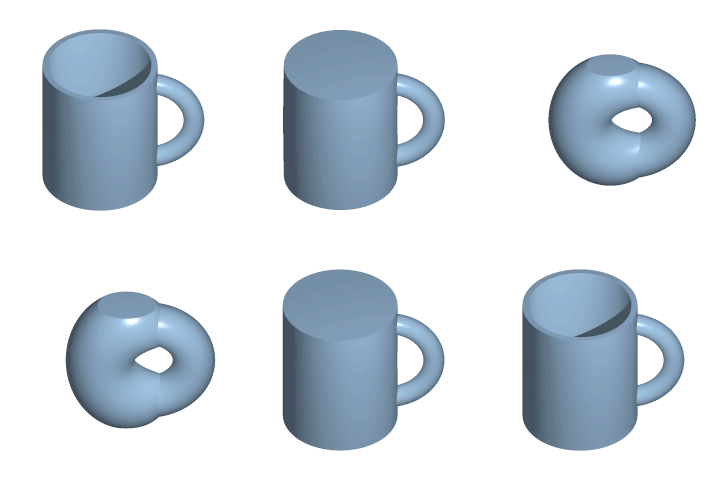
Homeomorphism is a fun idea in math, especially in a branch called topology! 🧩Imagine you have a squishy toy like a doughnut 🍩 and a coffee cup ☕. They might look different, but in topology, they are thought to be the same! This is because you can stretch and squish the doughnut into a coffee cup shape without tearing it. It’s all about how shapes can change while still being the same kind of thing. Homeomorphism is like magical math connecting different shapes! 🎉
Explore with ChatDinoKey Points
A homeomorphism is a special relationship between two shapes or spaces!
Homeomorphisms have some neat properties!
Let’s look at some cool examples!
Continuous functions are super important in understanding homeomorphisms!
Homeomorphisms also play around with various dimensions!
Mathematics has some key theorems related to homeomorphisms!
In topology, homeomorphisms are used like magic keys to unlock how spaces relate!
Think of a graph as a drawing showing how different spaces are connected!
Homeomorphisms connect to many other math ideas!
Although they sound very similar, homeomorphism and homotopy are different!
Photos of Homeomorphism

A thickened trefoil knot is homeomorphic to a solid torus, but not isotopic in R 3 . {\displaystyle \mathbb {R} ^{3}.} Continuous mappings are not always realizable as deformations.
🌌 Definition Of Homeomorphism
A homeomorphism is a special relationship between two shapes or spaces! 🌌For two spaces or shapes to be homeomorphic, they need a few things: they must be matched perfectly (that's called bijective), they must be smooth and without any breaks (that’s continuous), and you should be able to reverse the match without any mess! 😄If you can toy around with one shape and get the other without tearing, you’ve found a homeomorphism!
Go deeper🏰 Properties Of Homeomorphisms
Homeomorphisms have some neat properties! 🏰First, they must be “one-to-one.” This means for every point in one shape, there's a match in the other space! 🌟Second, both the mapping and its reverse must be smooth: no holes, bumps, or jumps! Third, if two shapes are homeomorphic, they share topological properties. For example, they’ll have the same number of holes! 🔍Just like a big castle and a donut have one hole each!
Go deeper🌈 Examples Of Homeomorphic Spaces
Let’s look at some cool examples! 🌈A circle and an ellipse are homeomorphic! You can stretch a circle into an ellipse without breaking it! 🌻A square and a rectangle also share this connection. 🟦➡️🟩 They both have corners, sides, and no holes! Even a ball and a cube are homeomorphic because you can squish and stretch one into the shape of the other! Isn't that fascinating? 🎈
Go deeper🌌 The Role Of Continuous Functions
Continuous functions are super important in understanding homeomorphisms! 🌌A continuous function means no surprises like jumps or breaks! 🎢If you think of walking on a smooth path, that's continuous! (No tripping allowed! 😅) In a homeomorphism, both the function and its reverse need to be continuous to connect spaces perfectly. So, if you can walk smoothly from one shape to the other and back again, you have a homeomorphism!
Go deeper🌐 Homeomorphism In Different Dimensions
Homeomorphisms also play around with various dimensions! 🌐Think of a flat piece of paper as two-dimensional. Now, imagine a ball in three dimensions! 🌍A flat coffee cup and a squishy donut are both in 3D and can be shaped without tears or breaks, showing they are homeomorphic! But a 2D shape like a circle can’t turn into a 3D shape like a sphere without breaking, so they aren’t homeomorphic! 📏
Go deeper📜 Key Theorems Involving Homeomorphisms
Mathematics has some key theorems related to homeomorphisms! 📜One popular one is the Invariance of Domain Theorem. It says that if you homeomorphically map a space into another, the properties of that space stay the same! 🎇This means you can find out all sorts of interesting things about spaces just by looking at their homeomorphic friends! There's also the Urysohn's lemma, which helps in proving two spaces are homeomorphic!
Go deeper🌌 Applications Of Homeomorphism In Topology
In topology, homeomorphisms are used like magic keys to unlock how spaces relate! 🌌They help mathematicians understand complex shapes and patterns. By showing that two shapes are homeomorphic, they can learn things like how to navigate spaces! 🗺️ Also, homeomorphism is useful in areas like physics and computer science, where understanding shapes and spaces is important for everything from designs to simulations! 🎮
Go deeper📊 Visualizing Homeomorphisms Through Graphs
Think of a graph as a drawing showing how different spaces are connected! 📊When learning about homeomorphisms, using graphs can be very helpful! ✏️ You can draw one shape and then draw its homeomorphic partner to see how they relate! Also, drawing transformations step-by-step can really show how these spaces can stretch, twist, or squish into each other smoothly! 💫Using colors and shapes makes it even easier to visualize homeomorphisms! So grab some colored pencils and start exploring Homeomorphism in your drawings! 🎨
Go deeper🌌 Homeomorphism And Other Mathematical Concepts
Homeomorphisms connect to many other math ideas! 🌌For example, topology links with geometry and algebra! In geometry, shapes are studied for their angles and areas, while topology focuses on their connectivity! 📐Homeomorphism helps bridge these concepts by showing how shapes relate despite changes. It helps us visualize different math ideas together! 🧩So, think of homeomorphism as a bridge connecting different parts of the math world!
Go deeper🤔 Differences Between Homeomorphism And Homotopy
Although they sound very similar, homeomorphism and homotopy are different! 🤔Homeomorphism is about stretching and bending shapes without tearing, while homotopy is about changing shapes gradually! 🌅For example, homotopy could transform a circle into an oval, but homeomorphism would keep it a circle the whole time until the very end. So remember, homeomorphism is about being the same shape in a stretchy way, while homotopy is about slowly changing shapes! 🔄
Go deeper