Altair Facts For Kids
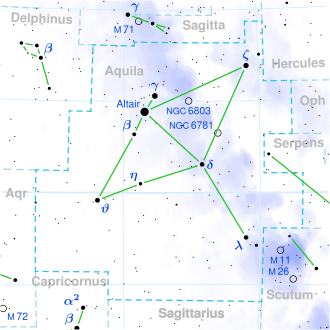
Altair is the brightest star in the constellation Aquila and the twelfth-brightest star in the night sky.
Select reading age
Altair Facts For Kids
Videos & Quizzesincluded
About this topic
Altair is a special star! ✨It is the brightest star in a group of stars called Aquila, which is Latin for "eagle." If you look up at the night sky, you can find Altair shining brightly. It's the 12th brightest star in all the heavens. Located about 16.7 light-years away from Earth, Altair is one of our closest stars! That means light takes about 16.7 years to travel from Altair to our eyes. Isn’t that amazing?🐦🌌 Altair is a hot star, and it's part of a trio of stars known as the Summer Triangle, along with Vega and Deneb!
Explore with ChatDinoKey Points
Every star changes over time, including Altair!
Altair has some cool secrets!
Altair has appeared in many myths and stories!
Altair is a very unique star!
Scientists study Altair to learn more about stars!
Altair has a long history in astronomy.
Altair is not alone!
You can see Altair easily if you look up on a clear night in summer!
Scientists use special tools to learn about Altair!
Photos of Altair

Altair is the brightest star in the constellation Aquila.

Altair in comparison with the Sun
![A light curve for Altair, adapted from Buzasi et al. (2005)[6]](https://upload.wikimedia.org/wikipedia/commons/thumb/9/93/AlphaAqlLightCurve.png/960px-AlphaAqlLightCurve.png)
A light curve for Altair, adapted from Buzasi et al. (2005)[6]

Direct image of Altair, taken with the CHARA array

Altair
🔄 Role In Stellar Evolution
Every star changes over time, including Altair! 🔄Altair is currently in the main sequence stage, which is like its middle-age phase. As time goes by, it will start getting older and change into a red giant. 🌟When it does, it will expand and become much bigger—maybe even swallowing nearby planets! 🌍💥 Eventually, Altair will shed its outer layers and leave behind a core—a special remnant known as a white dwarf. Understanding stars like Altair helps scientists know how all stars, including our Sun, evolve throughout their lives! 🌌
Go deeper🕵️♂️ Interesting Facts About Altair
Altair has some cool secrets! 🕵️♂️ First, it's one of the fastest spinning stars we know of! ❤️ Did you know that Altair is only around 1 billion years old? That's middle-aged for a star! Also, if you could travel to it, you would need to go about 16.7 light-years away, which is REALLY far! 🚀Lastly, Altair is part of a trio known as the Summer Triangle, along with Vega and Deneb. Together, these stars form a bright pattern that delights stargazers. 🌠So next time you look at Altair, remember how special it really is! 🌟
Go deeper🌌 Cultural References And Mythology
Altair has appeared in many myths and stories! In Chinese mythology, Altair is known as the "Cowherd Star," and it is linked to a love story about two star-crossed lovers separated by the Milky Way. 🌌❤️ In Japanese tradition, it is called "Tennin" and is also part of the "Tanabata" festival, where people celebrate love and wishes. 🎋In some Native American stories, Altair represents an eagle that flies through the heavens. These tales show how important Altair has been to different cultures around the world! 📚✨
Go deeper☀️ Physical Characteristics Of Altair
Altair is a very unique star! It is about twice as big as our Sun ☀️ and is also much hotter, with a surface temperature of around 7,500 degrees Fahrenheit (4,200 degrees Celsius). Altair is classified as an A-type star because of its color; it shines a beautiful blue-white hue. 🔵🔆 It's not just big; Altair spins really fast! It rotates about 24 times faster than our Sun, completing a rotation in just 9 hours. 🌪️ This fast rotation gives it a flattened shape, kind of like a pancake! 🥞
Go deeper🔭 Scientific Research And Discoveries
Scientists study Altair to learn more about stars! 🔭Due to its brightness and closeness, it is a fantastic target for research. Astronomers have used telescopes to understand how fast it spins and its age, which is about 1 billion years old! Altair's rotation helps researchers learn about how stars change over time. In 2015, a study found an exoplanet—a planet outside our solar system! 🌍This discovery makes Altair even more special. By looking at stars like Altair, we can understand our universe better and maybe even find life on other planets! 👽
Go deeper🌌 Historical Significance In Astronomy
Altair has a long history in astronomy. 🌌Ancient cultures noticed its brightness. The ancient Egyptians included Altair in their star catalog. It was also recognized by the ancient Greeks, who associated it with the eagle constellation. In the early 19th century, Altair was one of the first stars to have its distance measured by the astronomer Friedrich Bessel. 📏This helped us understand how far stars are from Earth! Also, Altair's position helps navigators guide their ships across oceans, thanks to its brightness and location in the sky! ⛵🌠
Go deeper🌌 Comparison With Other Stars In Aquila
Altair is not alone! It's part of a celestial family. 🌌In the Aquila constellation, Altair is the brightest star, but there are two other notable stars: Tarazed and Alshain. Tarazed is a yellow star, not as bright as Altair but still shines well. 🌟It is located about 460 light-years away! Alshain is even further away, around 45 light-years. Altair stands out because it's closer to us and is hot and fast-spinning. Altair holds a special place among its Aquila companions! 🌟🦅
Go deeper🌙 Position And Visibility In The Night Sky
You can see Altair easily if you look up on a clear night in summer! 🌙It's one of the three stars that form the Summer Triangle, which is high above the horizon. The star is located in the constellation Aquila, which is shaped like an eagle. 🦅Altair is best visible in the northern hemisphere but can also be seen from warmer places in the south. It usually shines bright enough to spot without any tools, just your eyes! So grab a blanket, lie down, and start stargazing!🌠✨
Go deeper🔍 Observational Techniques For Studying Altair
Scientists use special tools to learn about Altair! 🔍Telescopes help them see the star and gather light from it. They also use spectrometers, which can tell what Altair is made of by analyzing its light. Scientists can discover what elements, like hydrogen and helium, are in Altair! 🌌They can even determine the star’s temperature and size using these tools. Sometimes, they use satellites in space for a clearer look! 🚀By studying Altair and other stars, we learn more about how stars like our Sun behave!✨🔭
Go deeper