

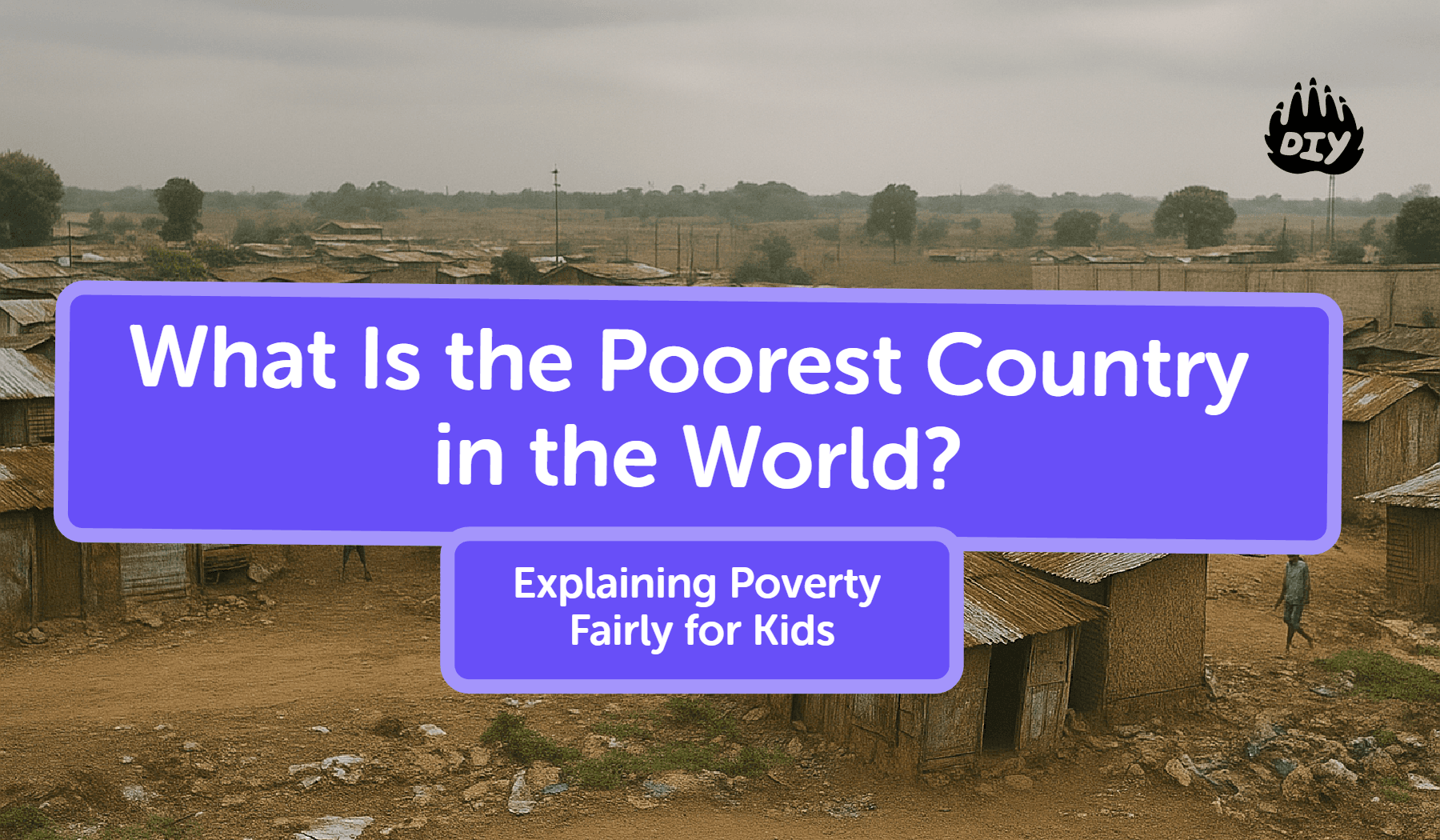
Kids hear about “rich” and “poor” countries all the time. It’s natural for them to ask:
“So… what is the poorest country in the world?”
That’s a big question. It involves real families, real children, and a lot of history. So this guide answers gently what people mean by “poorest country in the world”, how rankings like poorest countries by GDP per capita are made, what actually makes a country poor, and where hope and solutions are showing up.
The goal isn’t to blame any country or group of people. It’s to help kids understand how systems, history, and choices shape poverty and how people are working to change things.
What Do People Mean by “Poorest Country in the World”?
When adults say “poorest country,” they’re usually looking at numbers about money and basic needs, not how kind, creative, or smart the people are.
Money measures: GDP per capita and GNI per capita
Two common ways to rank the poorest countries 2025 list are:
Measure | What It Stands For | Simple Meaning | How People Use It |
GDP per capita | Gross Domestic Product per person | GDP is the total value of all goods and services a country produces in a year. Per capita means per person. So GDP per capita is like “if you shared the whole economy equally, how much would each person get?” It’s an average, not anyone’s real paycheck. | Used to rank things like the poorest countries 2025 list or poorest countries by GDP per capita and compare average economic output per person between countries. |
GNI per capita | Gross National Income per person | GNI counts the income earned by residents of a country, including some money they earn from abroad. | The World Bank uses GNI per capita to sort countries into low-income, lower-middle, upper-middle, and high-income groups. |
These are the numbers behind many headlines about the poorest countries by GDP per capita or low-income countries.
Poverty is more than money
If you ask a child, “What does poverty feel like?” The answer usually sounds like this: not enough food, no safe home, long walks to find clean water, no chance to go to school, nobody to treat you when you are sick.
UNICEF calls this multidimensional poverty, kids missing basic things they need to grow and learn. Nearly 900 million children worldwide experience this kind of poverty, and around 412 million live in households surviving on less than about $3 a day.
So when we talk about the poorest country in the world, we’re really talking about a place where many people don’t have what they need, not a place where people don’t try hard enough.
🧡 Gentle helper for big topics If this feels heavy, kids can open the DIY.org AI Homework Helper and ask things like: “Explain poverty for kids”, “What is GDP per capita?”, or “What does ‘low-income country’ mean?”
It answers in calm, kid-friendly steps so families can read and process together.
Poorest Countries 2025 List (By GDP Per Capita)
Different groups publish slightly different poorest countries 2025 lists, but they tell a similar story.
Recent 2025 data using GDP per capita (often adjusted for purchasing power) usually places South Sudan at the very bottom, with a GDP per person of around $250 a year less than many people spend on groceries in a month.
Other countries that often appear near the bottom include:
Burundi
Central African Republic
Malawi
Madagascar
Sudan
Mozambique
Niger
Somalia
Most of these are low-income countries in Sub-Saharan Africa, where extreme poverty is heavily concentrated. In 2024, this region held about 16% of the world’s population but 67% of people living in extreme poverty.
Why lists don’t always match
You might see one article say South Sudan, another say Burundi. That happens because:
some lists use GDP, others use GNI,
some use current dollars, others use PPP (tries to adjust for local prices),
some are based on slightly different years or forecasts.
The exact order may shift, but the main point stays the same: a group of countries are facing deep, long-lasting obstacles that keep many people poor.
GDP Per Capita and Poverty Explained for Kids
Big numbers can feel abstract. A quick picture helps.
Picture a country as a group project
Imagine a class project where the whole class runs a pretend store.
At the end of the year, the store made $1,000.
There are 100 students.
If you divide the total by the number of students:
$1,000 ÷ 100 = $10 per student. That $10 is like GDP per capita.
If another class makes $500 but only has 10 students:
$500 ÷ 10 = $50 per student.
Even though the second store made less total money, each person’s slice is bigger. That’s why we use GDP per capita when we talk about richest or poorest countries in the world per person.
Why a very low number is a warning sign
A very low GDP per capita often shows that a country: doesn’t have enough good-paying jobs, struggles to fund schools, hospitals, and roads, has difficulty investing in clean water, electricity, and internet for everyone.
But it still doesn’t tell you who is doing okay and who is struggling the most inside that country. It’s a starting clue, not the full story.
📊 Turn numbers into a mini project Have your child pick two countries: one from a poorest countries 2025 list and one middle-income country. Then use the DIY.org AI Homework Helper to: look up or estimate GDP per capita, list three ways daily life might differ (school, health, water), and turn it into a short compare-and-contrast paragraph for class.
What Makes a Country Poor? (Systems, Not Blame)
Saying a country is “poor” can sound like something is wrong with the people who live there. That’s not true.
Most of the time, systems and history explain why poverty sticks around.
History and colonialism
Many developing countries were once ruled by richer countries (colonial powers) that: took valuable resources, drew borders without listening to local communities, left behind weak institutions and unfair systems.
That history still affects how easy or hard it is to build strong economies today.
Conflict and fragile states
In some of the poorest countries in the world, people are living through wars or long-running conflicts. The World Bank notes that in 39 conflict-affected economies, extreme poverty is rising faster than anywhere else, and development goals are moving further out of reach.
Conflict can: destroy schools, hospitals, and roads, scare away investors and tourists, force families to flee their homes, and make it hard for any long-term plan to succeed.
Geography and climate change
Some low-income countries sit in places where: droughts, floods, or storms hit frequently, farming often the main job becomes less reliable, climate change multiplies existing problems.
They may have done very little to cause global warming, but they’re hit hardest by its effects.
Education, health, and basic services
When a country is very poor, it’s harder to fund: schools with trained teachers and safe buildings, clinics with medicine and equipment, clean water systems, electricity, and safe roads.
That means children in low-income countries are more likely to miss school, get sick from preventable diseases, and grow up with fewer opportunities.
Debt and unfair global rules
Some developing countries must spend a big part of their money paying back old debts. That leaves less for kids’ needs, like schools and vaccination programs. Trade rules and global market changes can also make it harder for poor countries to sell what they produce at fair prices.
None of these issues are about people being lazy. They’re about structures that need to change.
What Poverty Feels Like for Kids
It helps to move from numbers to everyday life.
UNICEF describes child poverty as lacking things like safe shelter, education, good nutrition, clean water, or health services. For many children, that can mean:
one meal a day, or sometimes none,
walking a long distance to collect water,
working instead of going to school to help their family survive,
getting sick from water or air pollution, without treatment,
living in crowded or unsafe housing.
At the same time, kids in poorer countries still: laugh and play, invent games with whatever they have, dream about their futures, and show courage adults can learn from.
And there is some good news: over the last few decades, the share of people in extreme income poverty has dropped globally, even though progress has slowed and remains uneven especially in conflict-affected places.
How People Are Fighting Poverty Around the World
Poverty is not a permanent label. It’s a problem people work on every day.
Local heroes and community solutions
In many developing countries, local groups: organize co-ops so farmers or small shop owners can get better prices, build and run community schools or tutoring groups, dig wells or protect springs to improve water access, start women’s or youth groups that support each other.
These efforts may not make headlines, but they change lives.
Global goals and international support
Big organizations like the United Nations, World Bank, and UNICEF set goals to reduce extreme poverty and support low-income countries with:
funding for schools, health programs, and infrastructure,
peacebuilding and conflict resolution,
climate adaptation projects.
Success isn’t instant, but some countries that were once very poor have moved into middle-income status by improving education, health, and governance over time.
What Can Kids Do? Empathy, Learning, and Small Actions
Children don’t need to fix global poverty by themselves. But they can grow up understanding it and caring about fairness.
Learn and listen
Read or watch stories from different countries, not just your own.
When you see a headline about the poorest country in the world, ask:
“What happened in its history?”
“What are people doing to improve things?”
Practice fairness in your own community
Small actions build habits: share toys or books, join or start a local community-service project, speak up kindly when you see unfairness at school.
Support, not “save”
When families donate or volunteer, they can choose groups that: work with local communities, not over them, respect children’s and families’ dignity, focus on long-term solutions like education and healthcare.
🗣️ Turn learning into a voice Kids can open the DIY.org AI Homework Helper and ask it to help them: write a short speech on “what makes a country poor,” draft a letter to a local leader about helping families in need, or outline a poster that focuses on solutions to poverty, not just sad images.
Quick Q&A: Kids’ Biggest Questions About Poor Countries
What is the poorest country in the world in 2025?
Most 2025 rankings using GDP per capita put South Sudan at the bottom, with an extremely low income per person after years of conflict and instability.
Other countries like Burundi, Central African Republic, Malawi, and Madagascar also appear near the bottom of these lists.
Why are so many of the poorest countries in Africa?
Many low-income African countries experienced: harsh colonial histories, long-standing conflicts, heavy climate stress (droughts, floods), and debt or unfair trade relationships.
That mix makes it harder to build strong systems, even though these countries are rich in culture, resources, and human talent.
Can a poor country ever stop being poor?
Yes. Some countries have moved from low-income to middle-income over the last few decades by: keeping peace, investing in schools and healthcare, building better institutions and infrastructure.
Change is possible, it just takes time, wise choices, and support.
Are people in poor countries unhappy all the time?
No. Money shapes safety and opportunities, but people everywhere: love their families, celebrate holidays, share music, games, and stories, feel proud of their cultures.
Poverty makes life harder and less fair. It doesn’t erase joy or dignity.
So How Should We Talk About “Poor Countries”?
When kids ask, “What is the poorest country in the world?”, it’s okay to say:
“Right now, some lists say South Sudan is the poorest by money per person. But those numbers come from a long story of history, conflict, and climate, not from anything wrong with the people who live there.”
Instead of thinking of “poor countries” and “rich countries” as fixed teams, it helps to ask:
What makes a country poor systems, history, or rules?
What’s being done to fix those systems?
How can we treat every country with respect, no matter what the numbers say?
That kind of thinking turns a scary topic into a starting point for fairness, empathy, and action.
