

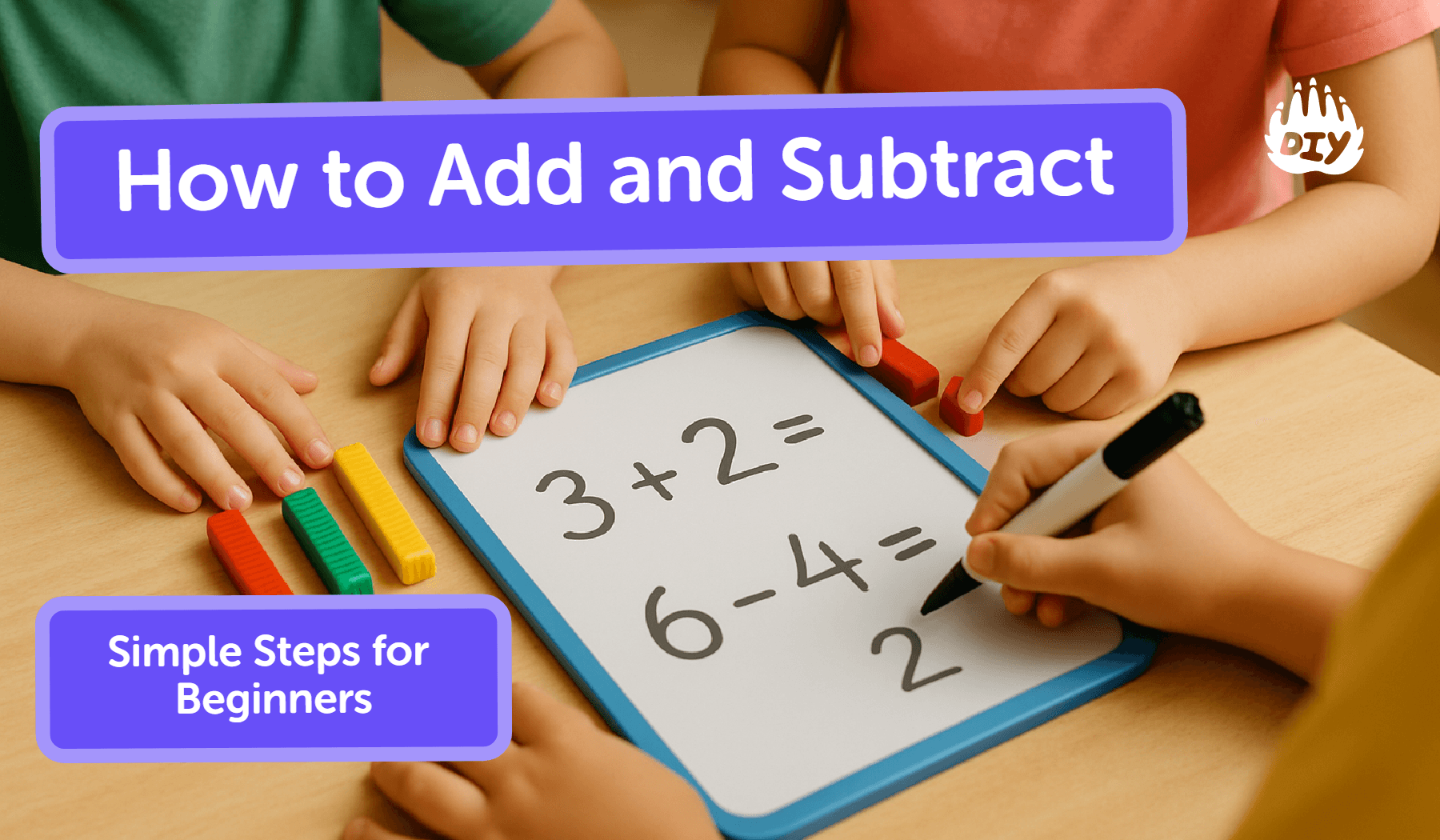
Addition and subtraction are the first big math superpowers kids learn. When they’re taught in small, repeatable steps with pictures, number lines, and quick explain-backs, confidence grows fast. If a step gets sticky, pair practice with the kid-safe AI Homework Helper (an AI math helper that models one similar problem instead of handing over answers).
What Are Addition & Subtraction?
Addition puts groups together to find a total.
Subtraction finds what’s left or how far apart two numbers are.
Kids learn fastest by moving among manipulatives, ten-frames, number lines, and short word problems, then explaining their steps in their own words.
Skill-by-Skill Breakdown (What to Learn First)
1) Count On & Count Back
Goal: Move up/down the number line by 1s, 2s. Try it: Start at 7; count on 3 → ___ (10). Start at 12; count back 4 → ___ (8).
2) Make 10
Goal: Use pairs that make 10 (3+7, 6+4) to simplify sums. Try it: 8 + 5 → (8 + 2) + 3 = 13.
3) Fact Families
Goal: See how + and − are connected. Try it: If 6 + 4 = 10, then 10 − 6 = 4 and 10 − 4 = 6.
4) Number Lines & Bar Models
Goal: Draw jumps for +/−; use bars to show parts–whole. Try it: 14 − 9 = ___ (jump back 9) → 5.
5) Two-Digit Without Regrouping
Goal: Add/subtract tens and ones separately. Try it: 34 + 25 = (30+20) + (4+5) = 59.
6) Gentle Regrouping (Carry/Borrow)
Goal: Trade 10 ones ↔ 1 ten (and back). Try it: 27 + 8 → make 10: (27 + 3) + 5 = 35.
before independent work, let learners request one modeled example for the exact skill they’re practicing via the AI Homework Helper
A One-Week Practice Plan
Meet Eli (Grade 1–2 bridge). He can count to 100 but gets stuck when a problem needs regrouping.
Day | Skill Focus | Practice Set (Examples) | Coaching Notes | Time |
|---|---|---|---|---|
Mon | Count on/back with a number line | Hop +1/−1 and +10/−10; e.g., start at 37 → count on to 45; start at 62 → count back to 55 | Point and say each hop. Ask: “How many hops? What changed?” Use a 0–100 line. | 10 min |
Tue | “Make 10” + fact families | 8–10 items: 7+?=10, 9+?=10; families for 6, 7, 9 (e.g., 7+3=10; 3+7=10; 10−7=3; 10−3=7) | Use ten-frame or fingers to see complements to 10. Say the fact family aloud. | 10–12 min |
Wed | Add/subtract within 20 (mixed) | 8–10 items: 8+6, 12−5, 9+7, 18−9; include 1 explain-back | After each, ask: “How did you know?” Look for make-10 or near-doubles strategies. | 10–12 min |
Thu | Two-digit without regrouping (tens/ones split) | 6–8 items: 34+25, 61−20, 42+17 (no carry/borrow) | Stack neatly. Add/subtract ones, then tens. Use base-ten blocks drawn or physical. | 10–15 min |
Fri | Gentle regrouping (carry/borrow) with manipulatives | 6 items: 27+18, 41−25, 36+17, 52−38 | Trade 10 ones ↔ 1 ten. If he stalls, have him use the AI Homework Helper to model one similar regrouping problem, then finish independently. | 10–15 min |
Weekend (optional) | “Snack Shop” game: tally + totals | Price small snacks (e.g., 7, 13, 18). Keep a tally; add totals. Round to nearest 10 to estimate first. | Let Eli be cashier. Say estimate → compute → compare. Celebrate close estimates. | 15–20 min |
When to Practice What
Daily warm-ups (8–12 min): 6–8 mixed items (count on/back, make-10, one word problem).
Re-teach days: one worked example at the top; fewer, better problems.
Checks for understanding: exit ticket: “Show this two ways (model + numbers).”
Challenge: sums/differences to 100; multi-step mini word problems.
Tips for Parents & Teachers
Model one, then release. Think aloud once; let kids try the rest.
Ask, don’t tell. “What do you know?” “What’s the whole? The parts?”
Use visuals. Ten-frames, counters, number lines > memorizing rules.
Celebrate strategy talk. “I made a 10 first” is a win.
Quick Practice Sets (with mini answer keys)
Set A: Add Within 10
3 + 5 = ___ 2) 6 + 2 = ___ 3) 9 + 1 = ___ Answers: 8, 8, 10
Set B: Subtract Within 10
9 − 4 = ___ 5) 7 − 3 = ___ 6) 10 − 6 = ___ Answers: 5, 4, 4
Set C: Make-10 Helpers
8 + 5 = ___ 8) 7 + 6 = ___ Hints: (8+2)+3; (7+3)+3 → Answers: 13, 13
Set D: Number Line Mix
Start at 12, jump +4 → ___ 10) Start at 18, jump −7 → ___ Answers: 16, 11
Set E: Two-Digit (No Regroup)
34 + 25 = ___ 12) 62 − 30 = ___ Answers: 59, 32
Set F: Gentle Regroup
27 + 8 = ___ 14) 41 − 6 = ___ Answers: 35, 35
FAQs About Adding & Subtracting
What’s the simplest way to teach beginners?
Start with count on/back and make-10, then link to fact families and number lines.
How many problems per day?
8–12 focused items + one quick reflection keeps confidence high.
How do I help without giving the answer?
Ask: “What’s the whole/part?” “Can you show it on a number line?” If needed, let them watch one modeled example and then finish independently.
The Final Word
Fluency comes from tiny wins: visual models → short practice → explain-back. Keep sessions light, celebrate strategies, and grow from there.
Pair these adding and subtracting steps with quick explain-backs and a kid-safe AI study helper that can model a similar example on demand.
