

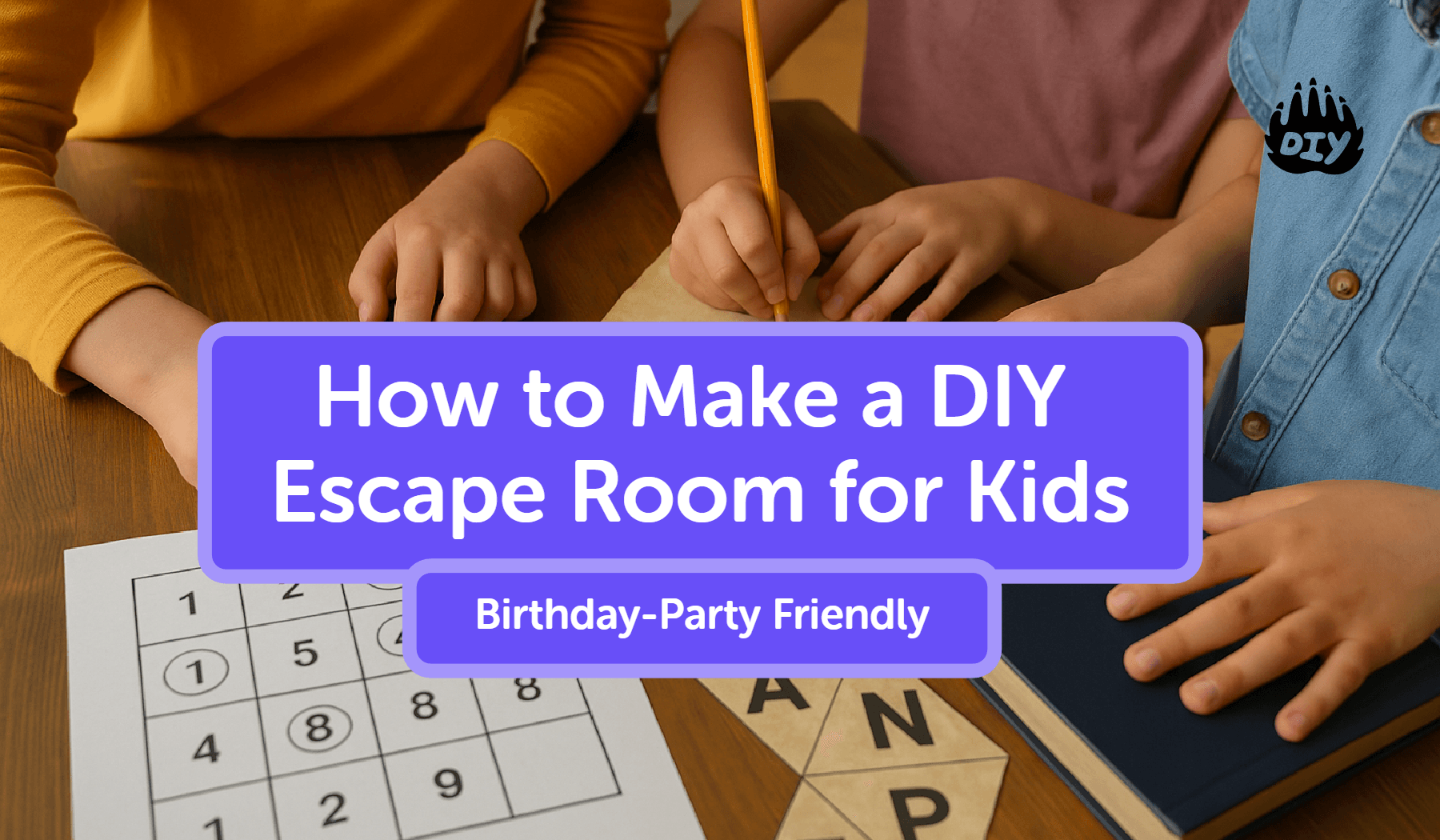
Imagine your living room turned into a spy headquarters. The clock is ticking. Kids are racing around, reading secret messages, piecing together clues, and shouting “We escaped!”
That’s the magic of an escape room for kids and you don’t need a studio or fancy props to pull it off. With a bit of planning, you can build a DIY escape room at home (or in the classroom) using things you already own.
This guide walks you through themes, easy puzzles, and setup tips so you can run your own kid-friendly escape room, whether it’s for a rainy day, a sleepover, or a full birthday party escape room.
Step 1. Pick a Theme and Simple Story
Before you think about locks or clues, choose a theme. The story gives kids a reason to solve every puzzle and keeps the energy high.
Kid-friendly escape room themes
You can keep it light and fun with themes like:
Time-Travel Lab: Get Back to the Right Year
Haunted Library (more silly than scary)
Animal Rescue Mission
Gamer Quest: Escape the Glitched Level
Once you have a theme, plug it into a simple story starter:
“You are [characters] who must [goal] before [what happens if you fail].”
Example: “You are space cadets who must fix the ship’s power core before the oxygen runs out in 30 minutes.”
That’s all you need to make your escape room ideas for kids feel like a real adventure.
Let kids help write the mission
If your child wants to invent their own story, they can describe the theme and ask the DIY.org AI Homework Helper to turn it into a short mission briefing, character names, or a dramatic intro speech you can read out loud.
Step 2. Choose Your Space, Time Limit, and Group Size
You don’t need a huge room. Any contained area works as long as you can hide clues safely.
Section | Details |
Good spots for a DIY escape room | • Living room or playroom • Bedroom (with breakables moved out) • Classroom corners or library area • Backyard or porch for an “escape trail” style game |
Time limit ideas by age | Ages 5–7: 15–20 minutes, very simple path Ages 8–10: 20–30 minutes Ages 10–13: 30–45 minutes with more steps |
Birthday party escape room options | • Run one big game with 4–8 kids at once • Split into teams and give each team the same puzzle path in different corners of the house or classroom |
Step 3. Build Easy Escape Room Puzzles for Kids
Think of your game as a chain: each puzzle unlocks the next clue. You don’t need complicated locks, just clear steps that feel like progress.
Below are puzzle types you can mix and match.
1. Secret Messages and Code Words
Kids love decoding things. Keep it simple and visual. Ideas:
Color code: Write the real message in colored letters. Kids match the colors to a key (red = A, blue = B, etc.).
Picture code: Draw small icons (🌟 = A, 🐱 = B). Give them a key and a message made of pictures.
Hidden message: Write with lemon juice and reveal using a warm light (adult supervised), or write on white paper with white crayon and reveal by coloring over it.
Use these for:
The very first “mission briefing”
A clue that tells them where to search next
The final password phrase they shout to “escape”
2. Hidden Objects and Mini Scavenger Hunts
This is the simplest way to get kids moving.
Hide 3–5 objects around the room: keys, pieces of a map, numbered cards, or shapes.
Each object has part of a clue on it. Once they collect them all, they can read the full message.
You can also hide a code behind a framed picture, under a chair, inside a book, or taped to the underside of a table (nothing sharp or unstable).
Example: Kids must find three “gemstones.” Each gem has a number on the back. Put them in the right order to get a three-digit code that unlocks the final box.
3. Pattern, Sequence, and Logic Puzzles
Great for slightly older kids or classrooms. Ideas:
Puzzle Type | How It Works | Example Use in Escape Room |
Order the pictures | Show four pictures of a story out of order. When kids line them up correctly, the first letters of each picture label spell the next clue. | Pictures of a rocket launch (build, fuel, countdown, blastoff). In the right order, the first letters spell “DOOR,” telling kids where to look next. |
Spot the odd one out | Kids circle the object that doesn’t belong; its position, color, or label points to a code. | Four animal cards: dog, cat, fish, banana. The odd one out (banana) has a number on the back that’s part of a lock code. |
Simple logic puzzle | Give a short clue that narrows down choices so kids must reason it out. | “The treasure isn’t under the blue pillow or the red chair. It’s under something green.” Kids search for green furniture or props. |
Light math / movement add-ons | Use counting or tiny sums as part of the answer; or give a small movement map. | Count objects to get a code (3 stars + 2 moons = 5), or follow a “3 steps left, 2 steps forward” map to reach the next clue. |
You can keep math light: count objects, add two small numbers to get a code, or follow a “3 steps left, 2 steps forward” map.
4. Physical Challenges (Safe and Quick)
A little movement keeps kids engaged.
Stack cups to match a picture. When the stack is correct, you hand over the next clue.
Build a quick bridge from blocks so a toy figure can cross.
Roll a marble through a simple maze made of books or cardboard.
These mini challenges are perfect for kids who love STEM projects and hands-on games.
5. The Final “Unlock the Box” Moment
Even without a lock, you can make the end feel dramatic.
Options:
A decorated shoebox with a number code written on the lid. They can only open it when the digits match the final answer.
A “laser grid” made of yarn that they can only pass once they’ve solved all clues.
A grown-up guarding the exit who only lets them “escape” when they say the correct password.
Inside the box you can put:
Stickers or small toys
Candy or popcorn tickets
Certificates that say “Escape Room Agent”
Step 4. Writing Escape Room Clues Kids Can Actually Use
The trick is to make kids think without totally stumping them.
Keep clues short and visual
Use large fonts, bold key words, and icons.
For early readers, combine words with pictures or color blocks.
For older kids, you can use simple riddles, but still keep them under a few sentences.
Example riddles:
“I’m full of stories, but I’m not a person. Find me on a shelf.” (Books / bookcase)
“I’m cold on the inside, light on the outside. Check where the snacks stay cool.” (Fridge, for home games)
Make your own printable escape room clues
You can:
Write on index cards or cut paper into small “mission files.”
Add a simple symbol on each card (⭐, 🔑, 🕵) so kids can tell which clues belong to which part of the game.
If you have a printer, you can type them in a large font and print them; if not, handwritten is perfectly fine.
Get help writing riddles and hints
Kids who want to write their own clues can draft them, then ask the DIY.org AI Homework Helper to:
Make the wording simpler
Turn a plain clue into a rhyme
Suggest extra hints in case friends get stuck
They’ll still be the designer; the tool just cleans up the language.
Step 5. Set Up and Run Your DIY Escape Room at Home
Before kids enter
Hide every clue and test that each one clearly leads to the next.
Walk the path in order and make sure nothing is impossible to reach or hidden too well.
Add decorations: colored lights, a “Mission Control” sign, background music from a playlist.
Do a quick test run
Have another adult or older sibling try the game:
Start the timer and see how long it actually takes.
Watch for steps that feel confusing or too easy.
Tweak any puzzles that cause total confusion.
Game master tips
Explain the rules clearly at the start: what they can touch, where they shouldn’t go, and how to ask for hints.
Offer hints after a set amount of time (for example, one hint every 3–5 minutes if they’re stuck).
Celebrate all progress, not just the final escape.
Turning It into a Birthday Party Escape Room
For parties, excitement is high and attention is scattered, so a little structure helps.
Managing bigger groups
Split kids into teams of 3–5.
Give each team its own color set of clues so they aren’t all grabbing the same card.
Stagger start times by a few minutes so you can move between teams easily.
Simple party flow
Welcome + mission briefing.
Escape room game (20–30 minutes).
Snack break while you reset or take photos.
Themed craft: spy ID cards, pirate hats, or hero badges.
Cake and “mission complete” ceremony.
No need to rank kids or call out “first place” unless everyone wants that. The focus can be on beating the clock together.
Classroom Version: Escape Rooms as Learning Games
Teachers and homeschool families can wrap curriculum into escape room ideas for kids.
Curriculum themes that fit well
Math: each puzzle solves a multiplication problem or fraction challenge.
Vocabulary and spelling: decode words to unlock the next clue.
Science: match facts to planets, ecosystems, or body systems.
History: each clue reveals a date, place, or historical figure.
Students end up practicing reading, math, and teamwork without feeling like they’re doing a worksheet.
Plan a lesson-based escape room
Teachers and homeschoolers can sketch out their topic and standards, then ask the DIY.org AI Homework Helper to suggest:
Age-appropriate riddles using vocabulary words
Quick math or science puzzles to hide as clues
A short “mission briefing” to hook students at the start
FAQs: Escape Room for Kids Basics
How do you make a simple escape room for kids at home?
Pick a theme, choose 3–6 puzzles, hide clues around one room, and give kids a time limit. Use paper clues, simple codes, and a final “unlock the box” moment.
What age is best for a kids’ escape room?
You can start around ages 5–6 with very simple, visual puzzles and help from adults. Ages 8–12 are the sweet spot for more complex DIY escape rooms.
Do you need locks and fancy props?
No. Number codes, passwords, and hidden objects work just as well. Everyday items books, boxes, pillows, toys make great clue hiding spots.
Can you reuse puzzles?
Yes. You can re-theme the same puzzle path with new art and story (pirates one week, space explorers the next) or swap out a few clues to keep it fresh.
