

Imagine stepping outside and feeling your eyelashes freeze.
Some places on Earth are so cold that winter seems to last most of the year. Kids (and grown-ups) often wonder:
“What is the coldest country in the world?”
The answer depends on how you measure “cold” and whether you’re talking about whole countries, tiny territories, or the most frozen spots where people live. In this guide, you’ll explore:
how scientists build a coldest countries list,
which countries stay chilly almost all year,
what life is like in places close to the Arctic, and
how people (and animals) adapt to extreme cold.
What Does “Coldest Country in the World” Mean?
Before we crown a winner, we need to know what we’re measuring.
Average temperature vs. one super-cold day
Two ideas show up a lot in lists of the coldest countries in the world:
Measure | What It Is | What It Tells You / How It’s Used |
Coldest temperature ever recorded | A single extreme day (for example, a record of −50 °C or lower in a certain town). | Shows how low the thermometer can go, but not what the weather is like most of the time. |
Average yearly temperature | Scientists look at temperatures over a whole year and take an average (add each day’s temperature, then divide by the number of days). | Used when we talk about average temperature by country and to decide the coldest country in the world, because it reflects typical conditions, not one freakishly cold night. |
For deciding the coldest country in the world, average temperature makes more sense than one freakishly cold night.
What about Antarctica and Greenland?
Two very important notes:
Antarctica is the coldest place on Earth, but it isn’t a country. No one is born a citizen of Antarctica; only scientists and support staff live there temporarily at research stations.
Greenland is one of the coldest inhabited places and is often #1 in “coldest places” charts, but it’s an autonomous territory of Denmark, not an independent country.
So in this article, we’ll focus on independent countries for the “coldest country” question, and still talk about Antarctica and Greenland in a special “coldest places on Earth for kids” section.
❄️ Need a kid-sized explanation? If “average temperature” feels confusing, kids can ask the DIY.org AI Homework Helper to walk them through a simple example using their own weekly weather step by step, with numbers they choose.
Coldest Countries in the World (2025)
Different climate datasets and weather services produce slightly different rankings, but they tend to agree on the same “usual suspects.”
When you look at coldest countries in the world 2025 by average yearly temperature, countries that nearly always appear near the top (a.k.a. the bottom of the thermometer) include:
Canada
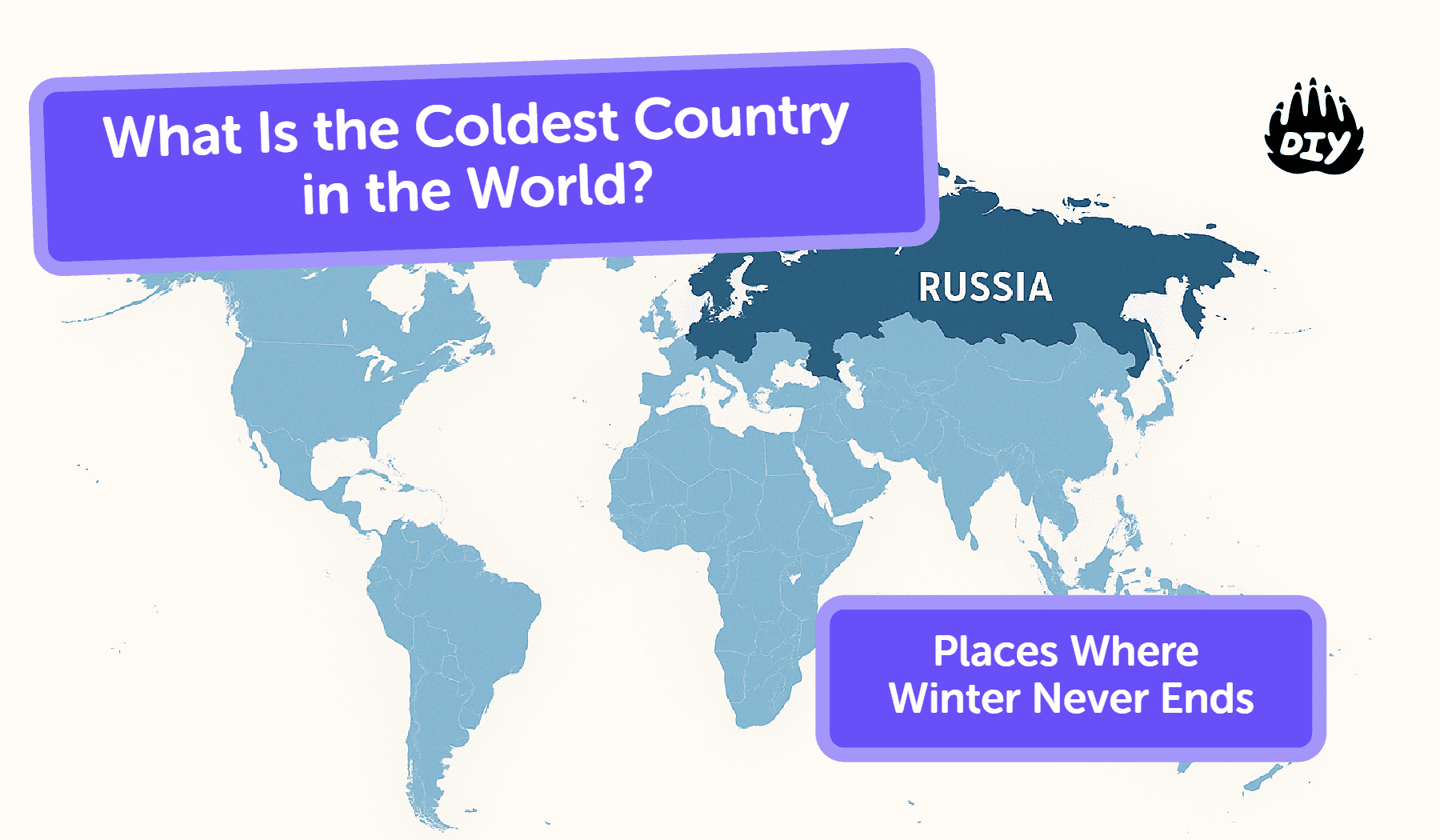
Russia
Iceland
Mongolia
Norway
Finland
Sweden
Kyrgyzstan
Tajikistan
Estonia
Let’s meet some of these icy champs.
Canada
Second-largest country on Earth, stretching far into the Arctic.
Northern regions are tundra treeless, frozen ground where summers are short and cool.
Many communities experience months of snow and deep cold; some areas see winter temperatures below –30 °C.
Russia
Enormous, with a huge region called Siberia known for brutal cold.
Towns like Oymyakon and Yakutsk are among the coldest permanently inhabited places on Earth.
In parts of winter, cars are left running so their engines don’t freeze.
Iceland
An island in the North Atlantic, close to the Arctic Circle.
Despite the name, its climate is a mix of cold and mild, thanks to ocean currents but winters are long and dark.
Glaciers, volcanoes, and hot springs make it a perfect example of “fire and ice.”
Mongolia
A landlocked, high-altitude country in Asia.
The climate swings wildly: very hot summers and extremely cold winters, especially in the north and in the mountains.
Nomadic herders move with their animals across the steppe, dealing with blizzards known as dzud.
Norway, Finland, Sweden (the Nordic trio)
All three sit in northern Europe, with large areas above the Arctic Circle.
They see long winter nights, snow, frozen lakes, and popular winter sports (skiing, skating, ice fishing).
Despite the cold, most people live in well-insulated homes with strong heating systems and cozy traditions.
Kyrgyzstan & Tajikistan
Mountainous countries in Central Asia.
High elevation means thin air and cold temperatures, especially in winter.
Many villages are nestled in valleys surrounded by snowy peaks.
Estonia
A small country in northern Europe near the Baltic Sea.
Winters are cold and often snowy, with short daylight hours; summers are mild and brief.
You can use any of these countries in an “average temperature by country” activity or classroom chart.
Why Are Some Countries So Cold?
Now for the science piece. What makes certain places icy almost all the time?
Latitude: how high on the globe you are
Countries closer to the poles get sunlight at a slant, spreading energy over a larger area and making it weaker. That’s the main reason:
Arctic countries (parts of Canada, Russia, Norway, Finland, Sweden, Iceland) are among the coldest.
Countries near the equator are usually hot, because sunlight hits them more directly.
Land vs. ocean and elevation
A few more ingredients in the “cold recipe”:
Factor | What It Means | Example Countries / Notes |
|---|---|---|
Landlocked & high up | Areas far from the sea and high above sea level heat and cool quickly, so winters can be extremely cold. | Mongolia, Kyrgyzstan, Tajikistan |
Ocean influence | Oceans act like giant heat blankets, helping nearby places stay milder than inland areas at the same latitude. | Iceland, coastal Norway vs. inland Siberian towns |
Mountains | Higher elevation means thinner air, which holds less heat, so temperatures are colder. | Any high mountain region (e.g., Himalayas, Tien Shan, Rockies) |
Snow, ice, and the “albedo effect”
Snow and ice are bright. They reflect sunlight instead of absorbing it. This is called the albedo effect:
More snow and ice → more sunlight bounced back to space → cooler temperatures.
Once ice melts and darker ground or water shows through, more heat is absorbed and things can warm up.
🔍 Turn curiosity into a quick science lesson Kids can ask the DIY.org AI Homework Helper to explain the “albedo effect for kids” or “why the Arctic is so cold,” then use that explanation to label a simple drawing of Earth with the equator and the poles.
Arctic Countries, Polar Night, and Midnight Sun
The Arctic Circle is an invisible ring around the top of the planet. Countries that cross it include:
Canada
Russia
Norway
Sweden
Finland
Iceland (just barely)
plus Greenland (Denmark’s territory)
Life above this line brings two dramatic phenomena kids love hearing about:
Polar night
In winter, the sun may not rise at all for days or even weeks.
People still go to school and work, using streetlights, headlamps, and reflective clothing.
The sky can be dark but sometimes lit by the Northern Lights.
Midnight sun
In summer, the sun can stay up all “night,” circling low in the sky but never fully setting.
Kids in these areas sometimes sleep with blackout curtains to keep their rooms dark.
These are key Arctic countries facts that make them feel like something out of a storybook.
Coldest Places on Earth for Kids to Learn About
Beyond whole countries, a few specific spots are legendary for their chill.
Antarctica
Coldest continent on Earth; interior winter temperatures can drop far below –60 °C.
No permanent residents, only scientists and support staff.
Thick ice sheets hold a huge portion of the world’s freshwater.
Greenland
Covered mostly in ice, with a small population along the coasts.
Often shows up as the #1 coldest place in “average temperature by region” lists.
Home to glaciers, polar bears, and scientists studying climate change.
Oymyakon & Yakutsk (Russia)
Among the coldest towns where people live year-round.
People warm cars in heated garages or leave engines running in winter.
School is only cancelled at astonishingly low temperatures.
How People Adapt to Extreme Cold
It’s not just about surviving, it's about building a life.
Area | Adaptation Type | Details / Examples |
|---|---|---|
Clothing & homes | Layers | Thermal underlayers, thick sweaters, insulated jackets, snow pants. |
Accessories | Hats, scarves, balaclavas, mittens, warm boots. | |
Homes | Strong insulation, double or triple-glazed windows, powerful heating systems. | |
Getting around | Road safety | Winter tires and studded wheels for icy roads; snowplows and sand trucks keep streets open. |
Remote travel | Snowmobiles, dog sleds, skis, and even ice roads in very remote areas. | |
Food & daily routines | Diet | Hearty, energy-dense foods: fish, meat, root vegetables, preserved foods. |
School & daylight | In some communities, kids walk to school in the dark but come home while the sun is still up. | |
Cozy traditions | Many cold-country cultures use cozy rituals (like hygge in Scandinavia) to make long winters feel comforting. |
Climate Change and the Warming Arctic
Here’s a surprising twist: some of the coldest countries in the world are also warming faster than most other places.
As ice and snow melt, darker land and water absorb more sunlight.
This makes the Arctic heat up more quickly, a process called polar amplification.
Sea ice is thinning, glaciers are retreating, and weather patterns are shifting.
For kids, you can frame it like this:
“The freezer of the planet is getting warmer, and that changes the whole kitchen.”
It affects:
Arctic wildlife that depends on sea ice,
Indigenous communities that rely on stable seasons,
and weather around the world, not just in the north.
Kid-Friendly Activities: Explore the World’s Coldest Places
You can turn this topic into geography, science, and art all at once.
1. Make your own “Coldest Countries” world map
Print or draw a world map.
Shade in the coldest countries list (Canada, Russia, Iceland, etc.).
Write their rough winter temperatures next to them and add symbols (snowflakes, polar bears, mountains).
2. Blubber glove / insulation experiment
With a grown-up:
Fill a bowl with ice water.
Have kids dip a bare hand in (briefly!) to feel the cold.
Then put one hand inside a plastic bag surrounded by vegetable shortening or layers of bubble wrap like a “blubber glove” and try again.
They’ll feel how insulation keeps warmth in, just like animal fat or thick coats.
3. Weather diary and comparison
For one month, record your local high and low temperatures.
Choose a city in a cold country (Reykjavik, Yellowknife, Yakutsk).
Look up that city’s temperatures and compare.
📈 Need help turning data into charts? Kids can use the DIY.org AI Homework Helper to turn their weather diary into a bar graph or line chart and to write a short “weather report” comparing where they live to an Arctic town.
Quick Q&A: Kids’ Biggest Questions About Cold Countries
Is there one true “coldest country in the world”?
Not exactly. By average temperature, some lists point to extremely cold regions like Greenland (a territory) first, then countries such as Canada and Russia. Different datasets can shuffle the order slightly.
What is the coldest place on Earth?
Antarctica holds that title especially high inland places where scientists have recorded temperatures far below anything seen in normal towns.
Do people really live in –50 °C?
Yes. In a few Siberian towns, winter temperatures can drop that low. People adapt with special clothing, strong heating, and routines built around the cold.
Can cold countries still have warm summers?
Absolutely. Many “cold countries” have short but surprisingly warm summers. Average temperature includes both the bitter winters and the milder months.
Why the Coldest Countries Matter
Learning about the coldest countries in the world isn’t just about wild weather facts. It helps kids understand:
how sunlight, oceans, and mountains shape climate,
how people and animals adapt to extreme environments,
and why Arctic regions matter for the whole planet’s climate system.
A nice reflection question to end with:
“If you could visit one of the coldest places on Earth, what would you want to see or measure and how would you dress for it?”
