Erythrosuchus Facts For Kids
Erythrosuchus is an early archosaur from the late Permian to early Triassic periods, known for its large size and predatory nature.
Select reading age
Erythrosuchus Facts For Kids
Videos & Quizzesincluded
About this topic
Erythrosuchus (pronounced er-ith-ro-SOO-kus) was a remarkable prehistoric creature that lived about 250 million years ago during the late Permian period! 🌍This fascinating animal is known as a "proto-crocodile" because it's an ancestor of modern crocodiles. Erythrosuchus was a large reptile, growing up to 10 feet long! Its name means “red crocodile” because the first fossils were found in red rock formations in South Africa. Having strong legs and a big head, this creature dominated its environment as one of the top predators of its time! 🐊
Explore with ChatDinoKey Points
Fossils of Erythrosuchus were first discovered in the late 1800s in South Africa, specifically in the Karoo region.
Erythrosuchus lived in areas that are now part of southern Africa, mainly South Africa, close to rivers and lakes.
When compared to modern crocodiles, Erythrosuchus had some interesting differences.
Since Erythrosuchus is an extinct species, there is no conservation status for it—meaning, there are no living members to protect.
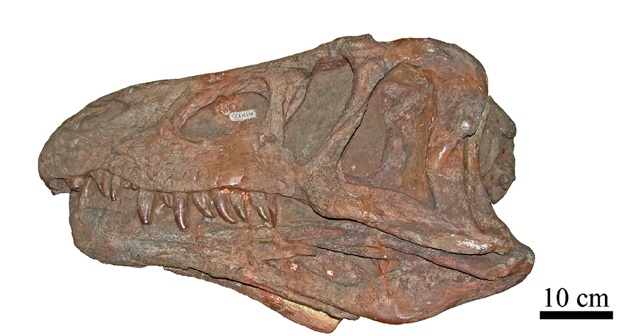
Erythrosuchus was a cool-looking reptile with a long, narrow body and a large head filled with sharp teeth.
Erythrosuchus was an active predator, hunting and swimming in the waters around its habitat.
Erythrosuchus was a carnivore, meaning it mainly ate meat.
Erythrosuchus is significant because it is considered one of the early ancestors of modern crocodiles and birds!
Photos of Erythrosuchus

Digital reconstruction of Erythrosuchus

Fossils, 1 and 3

Parts of vertebrae
🦴 Fossil Record
Fossils of Erythrosuchus were first discovered in the late 1800s in South Africa, specifically in the Karoo region. 🦴The fossils show many details about how this creature looked and lived. Scientists have found not just bones, but also traces of its skin and teeth! These fossils are crucial for understanding how ancient reptiles evolved. Many museums around the world display Erythrosuchus fossils, helping people learn about this fascinating animal from a long time ago!
Go deeper🌊 Habitat And Range
Erythrosuchus lived in areas that are now part of southern Africa, mainly South Africa, close to rivers and lakes. 🌊Researchers have discovered its fossils in places like the Beaufort Group, a sedimentary rock layer that preserves many ancient life forms. Erythrosuchus loved warm and tropical climates, where it could bask in the sun and swim in the waters. During the late Permian, this area was a vast land called Pangaea, the supercontinent that later split into today’s continents! 🌏
Go deeper🏞️ Comparative Anatomy
When compared to modern crocodiles, Erythrosuchus had some interesting differences. While today's crocodiles have short legs and are primarily aquatic, Erythrosuchus had longer legs designed for running on land. 🏞️ Its skull was elongated and different from that of most modern reptiles, which helps scientists understand how features developed over time. The structure of its back and hips shows it was more aligned with early land reptiles. This makes Erythrosuchus a unique species to study in the evolution of reptiles!
Go deeper🦖 Conservation Status
Since Erythrosuchus is an extinct species, there is no conservation status for it—meaning, there are no living members to protect. 🦖However, understanding how Erythrosuchus and other prehistoric animals lived helps scientists learn about biodiversity and extinction events. Today, many modern crocodiles face threats due to habitat loss and pollution. By studying extinct species, scientists stress the importance of preserving our environment to protect the creatures we have today! 🌳
Go deeper🦷 Physical Description
Erythrosuchus was a cool-looking reptile with a long, narrow body and a large head filled with sharp teeth. 🦷Its legs were strong and positioned directly under its body, unlike some lizard-like reptiles. It had a long tail that helped it balance while moving quickly. Interestingly, its skull had a flattened shape, which allowed it to see and grab prey effectively. Scientists believe it looked somewhat like a mix between a crocodile and a dinosaur. Erythrosuchus was covered in scaly skin, which helped protect it from other predators.
Go deeper🌊 Behavior And Activity
Erythrosuchus was an active predator, hunting and swimming in the waters around its habitat. 🌊It likely spent time basking in the sun on the banks of rivers or lakes to stay warm. While we don’t know for sure how it behaved socially, some scientists believe it may have lived alone or in small groups. Erythrosuchus had powerful limbs and could probably run quickly on the land too. This combination of swimming and running made it a versatile creature, able to chase down prey in both water and on land! 🏃♂️
Go deeper🥩 Diet And Feeding Behavior
Erythrosuchus was a carnivore, meaning it mainly ate meat. 🥩Its strong jaws and sharp teeth made it an excellent hunter, perfect for catching fish and small animals. It would probably ambush its prey by hiding in the water and waiting for the right moment to strike! Researchers think it used speed and surprise, like modern crocodiles do, to snatch its meals quickly. Erythrosuchus was also likely to scavenge leftovers from other larger predators if it had the chance!
Go deeper🐦 Evolutionary Significance
Erythrosuchus is significant because it is considered one of the early ancestors of modern crocodiles and birds! 🐦It lived in a time right before the dinosaurs appeared. Studying Erythrosuchus helps scientists understand how reptiles evolved and adapted to different environments. As part of the lineage that would lead to crocodiles, this creature shows how life can change over millions of years. Erythrosuchus also helps us see the connection between ancient reptiles and today's animals. 🌏
Go deeper